データセンターで本当に儲かるのは誰か。原価構造が教えてくれる「隠れた勝者」の地図
Who Really Profits From Japan's Data Center Boom? A Map of the Hidden Winners, Written in the Cost Structure
2024年、日経平均採用225銘柄の株価上昇率1位は、AI企業でも半導体メーカーでもありませんでした。フジクラ。創業139年の電線メーカーです。株価は1年で約6倍。AIデータセンターの内部で、サーバー同士を結ぶ光配線部材の需要が爆発したためでした。
In 2024, the best-performing stock among the 225 names in the Nikkei average was not an AI company or a chipmaker. It was Fujikura, a 139-year-old wire and cable maker. The stock rose roughly sixfold in a single year, driven by exploding demand for the optical wiring that links servers inside AI data centers.
AI人気で光差す139年の老舗電線企業、日本株上昇率1位はフジクラ(Bloomberg)
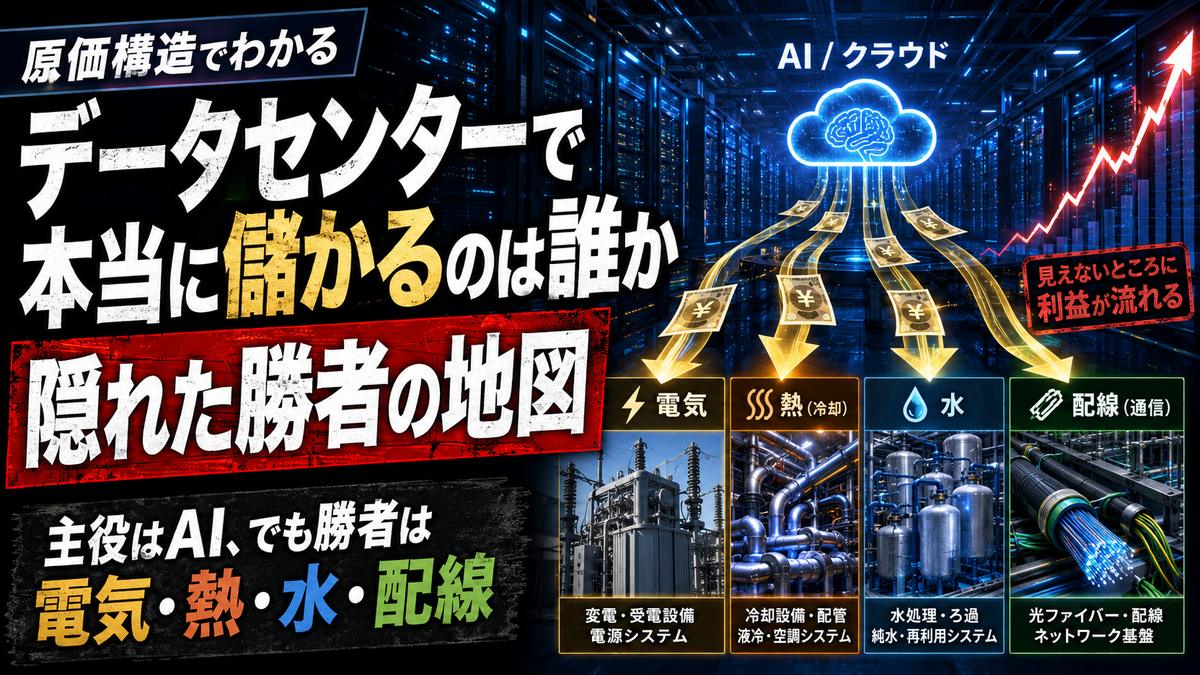
派手な主役はエヌビディアやハイパースケーラーなのに、市場で最も報われたのは「配線屋」だった。この事実は、データセンター投資の本質を教えてくれます。巨大な建設ラッシュで儲かるのは、必ずしも目立つ企業ではない。この記事では、日本のデータセンター建設で「次に静かに儲かるのは誰か」を、建物の原価構造から順にたどります。
The headline stars were NVIDIA and the hyperscalers, yet the market's biggest reward went to a wiring company. That fact captures the essence of data center investing: in a giant construction boom, the money does not necessarily go to the companies in the spotlight. In this article, we trace who quietly profits next from Japan's data center buildout, starting from the cost structure of the building itself.
※ ハイパースケーラーとは、世界規模で超大型のクラウド・データセンターを運営する巨大IT企業のこと。アマゾン(AWS)、マイクロソフト、グーグル、オラクルなどを指す。膨大な計算資源を自前で抱え、AIの学習・運用インフラの中核を担う。
※ A hyperscaler is a giant IT company that operates ultra-large cloud data centers at global scale, such as Amazon (AWS), Microsoft, Google, and Oracle. They own vast computing resources and form the core infrastructure for training and running AI.
まず、お金の入り口。誰もが知っている話
First, Where the Money Enters: The Story Everyone Knows
アマゾン(AWS)は2027年までに日本のクラウド基盤へ2.26兆円を投資中。マイクロソフトは2026年4月、AIデータセンターなどへ4年間で1.6兆円を投じると発表し、同社として過去最大の対日投資になりました。オラクルも今後10年で80億ドル超。海外勢だけで5兆円規模の資金が日本のAI基盤に向かっています。国内でも、ソフトバンクがシャープ堺工場跡で、受電容量150MW超から将来は400MW超への拡張を見込む大規模AIデータセンターを建設中。同じ堺では、KDDIのAIデータセンターが2026年1月22日、エヌビディアの最新GB200システムを積んで稼働を始めました。
Amazon (AWS) is investing 2.26 trillion yen in its Japanese cloud infrastructure through 2027. In April 2026, Microsoft announced 1.6 trillion yen, about $10 billion, over four years for AI data centers and related infrastructure, its largest investment in Japan ever. Oracle has committed more than $8 billion over a decade. Foreign players alone are directing some 5 trillion yen, over $30 billion, at Japan's AI infrastructure. Domestically, SoftBank is building a large AI data center on the former Sharp Sakai plant site, starting above 150MW with expansion beyond 400MW in view, and on the same grounds KDDI's AI data center went live on January 22, 2026, running NVIDIA's latest GB200 systems.
AWS plans to invest 2.26 trillion yen into its Japanese cloud infrastructure by 2027(AWS)
マイクロソフト、日本の AI 主導型成長に 1 兆 6000 億円を投資。AI インフラ、国家安全保障、人材育成を通じたさらなる国力強化を支援(マイクロソフト)
SoftBank Corp. to Construct Large-scale AI Data Center that Utilizes Sharp Sakai Plant(SoftBank)
Osaka Sakai Data Center Commences Operations on January 22(KDDI)
ここまでは新聞の一面の話です。投資家として面白くなるのは、この巨額の資金が「建物のどこに」流れ込むかを見たときです。
So far, this is front-page news. It gets interesting for investors when you look at where inside the building all that money actually goes.
原価構造を見る。ゼネコンは「正解」に見えて浅い
Read the Cost Structure: General Contractors Look Like the Answer, but It Runs Deeper
データセンター関連の国内銘柄と聞いて、多くの人がまず思い浮かべるのはゼネコン(鹿島、大成建設など)でしょう。ですが原価構造を見ると、この直感は半分しか当たっていません。
Ask most people to name a Japanese data center stock and they will start with the general contractors, such as Kajima or Taisei. But look at the cost structure, and that intuition turns out to be only half right.
データセンターの建設費のうち、建物の躯体(シェル)が占めるのは全体の15〜20%にすぎません。残りの約8割は、電気設備(40〜45%)と空調・機械設備(約20%)、そして内装設備です。オフィスビルでは躯体が建設費の半分近くを占めるのと比べると、まったく別の建物だと分かります。つまりデータセンターとは、「建物」の皮をかぶった巨大な電気機械なのです。
Of a data center's construction cost, the building shell accounts for only 15 to 20%. Roughly 80% goes to electrical systems (40 to 45%), mechanical and cooling systems (about 20%), and interior fit-out. In an office building, the shell is closer to half the budget. A data center, in other words, is a giant electrical machine wearing the skin of a building.
How Much Does it Cost to Build a Data Center?(DgtlInfra)
お金の流れはこうなります。発注者(ハイパースケーラーや通信会社)から元請のゼネコンへ。そこから設備工事の専門会社(サブコン)へ。さらに変圧器や空調機、ケーブルといった機器のメーカーへ。建設費の8割が設備なら、利益の本流はゼネコンの下、サブコンと機器メーカーの層を流れます。
The money flows like this: from the client (a hyperscaler or telecom) to the general contractor, from there to the specialist installation firms known as subcontractors, and on to the makers of transformers, cooling units, and cable. If 80% of the build cost is equipment and systems, the main current of profit runs one layer below the general contractor, through the subcontractors and equipment makers.
※ サブコンとは、ゼネコン(元請)の下で電気・空調・衛生などの専門工事を担う設備工事会社のこと。データセンターでは工事費の大半が設備に集中するため、通常のビル以上にサブコンの存在感が大きくなる。
※ A subcontractor (sabukon) is a specialist engineering firm that handles electrical, HVAC, or plumbing work under the general contractor. Because most of a data center's construction cost sits in those systems, subcontractors matter far more here than in ordinary buildings.
建設費の4割強、「電気」の財布
Over 40% of the Budget: The Electrical Wallet
最大の財布は電気設備です。ここには2つの層があります。
The biggest wallet is electrical, and it has two layers.
第一に、電気工事のサブコン。電気設備工事最大手のきんでんは、データセンターと半導体工場の工事需要を取り込んでいます。関電工は2025年4〜12月期の純利益が前年同期比45%増の462億円と、この期間として過去最高を更新し、日本経済新聞はデータセンターの設備投資拡大を追い風のひとつに挙げています。九電工も九州で同様の需要を受けています。
First, the electrical subcontractors. Kinden, Japan's largest electrical engineering firm, is absorbing work from data centers and semiconductor plants. Kandenko's net profit for April to December 2025 rose 45% year on year to 46.2 billion yen, a record for the period, with Nikkei citing expanding data center capex as one of the tailwinds. Kyudenko is riding the same demand in Kyushu.
関電工が上方修正、26年3月期の純利益44%増 配当は30円上積み(日本経済新聞)
第二に、電気を受け止める機器のメーカー。世界的に大型変圧器は品薄で、納期は80〜120週、案件によっては3〜4年先とも言われます。この供給制約は、メーカーにとっては価格決定力を意味します。明電舎は2025年10月、沼津の変圧器工場に160億円を投じ生産能力を約1.5倍にすると発表。ダイヘンも2025年12月、三重に新工場を建てて大型変圧器の生産能力を2029年度までに2倍にすると発表しました。増産投資は、この需要が一過性ではないとメーカー自身が判断した証拠でもあります。
Second, the makers of the equipment that receives all that power. Large transformers are in short supply worldwide, with lead times of 80 to 120 weeks and some orders reportedly stretching three to four years out. For manufacturers, that supply constraint means pricing power. In October 2025, Meidensha announced a 16 billion yen investment in its Numazu transformer plant to lift capacity roughly 1.5 times. In December 2025, Daihen announced a new plant in Mie to double its large-transformer capacity by fiscal 2029. Capacity investment on that scale is the makers' own verdict that this demand is not a passing spike.
沼津事業所 変圧器工場の増産に向けた新建屋の増築 ~160億円の投資により生産能力を約1.5倍に~(明電舎)
ダイヘン、三重県多気町で変圧器の生産能力倍増 データセンター需要で100億円投資(日本経済新聞)
そして冒頭のフジクラ。光配線やケーブルはすでに「発見済み」のテーマで、株価は先に6倍を織り込みました。いま同じ値上がりを期待して飛び乗るのは危険です。ただ、フジクラの軌跡は「この裾野で何が起きるか」を示した先行事例として、他の層を見るときの物差しになります。
And then there is Fujikura, from our opening. Optical wiring and cable are already a discovered theme; the stock priced in its sixfold move ahead of time. Jumping in now expecting the same ride is dangerous. But Fujikura's trajectory serves as a precedent, a yardstick for what can happen across the rest of this supply base.
建設費の2割、「熱」の財布
Another 20% of the Budget: The Heat Wallet
AIサーバーは膨大な熱を出します。データセンターの消費電力の3〜4割は冷却に使われるとされ、ここが第二の財布です。
AI servers throw off enormous heat. Cooling is estimated to consume 30 to 40% of a data center's electricity, and this is the second wallet.
AIデータセンター向け「冷却ソリューション」関連銘柄を紹介!(ダイヤモンド・ザイ)
空調工事のサブコンでは、高砂熱学工業が2026年3月期に売上4,239億円(前期比11%増)、営業利益477億円(同47%増)と過去最高を更新。データセンター向け空調を成長の柱に据えています。ダイダン、三機工業なども同じ需要を受けています。
Among HVAC subcontractors, Takasago Thermal Engineering posted record results for the fiscal year ended March 2026: revenue of 423.9 billion yen, up 11%, and operating profit of 47.7 billion yen, up 47%, with data center cooling as a pillar of growth. Dai-Dan and Sanki Engineering are riding the same demand.
高砂熱の2027年3月期、純利益6.8%増 予想平均上回る(日本経済新聞)
技術の転換点にも注目です。AIサーバーの発熱は空冷の限界を超えつつあり、液体で直接冷やす「液冷」への移行が始まっています。ダイキン工業は2025年11月、AIデータセンター向け液冷技術を持つ米チルダイン社を買収しました。空調の世界王者が液冷に本気で参入した、という合図です。KDDIは液浸冷却でサーバー冷却の電力を94%削減する実証結果を発表しています。
Watch the technology inflection, too. AI server heat is pushing past the limits of air cooling, and a shift to direct liquid cooling has begun. In November 2025, Daikin acquired Chilldyne, a US company specializing in liquid cooling for AI data centers: a signal that the world champion of air conditioning is entering liquid cooling in earnest. KDDI has published trial results cutting server-cooling power by 94% with immersion cooling.
※ 液冷(液体冷却)とは、空気の代わりに液体でサーバーの熱を奪う冷却方式のこと。チップに冷却液を直接届ける方式や、サーバーごと液体に沈める液浸方式がある。AI用サーバーの発熱密度は従来の数倍に達し、空冷では追いつかなくなりつつある。
※ Liquid cooling removes server heat with liquid instead of air, either by piping coolant directly to the chip or by immersing entire servers in fluid. AI servers generate several times the heat density of conventional ones, and air cooling is starting to fall behind.
米チルダイン社の買収によりデータセンター冷却ソリューションを拡充(ダイキン工業)
データセンター内のサーバーを液体冷却、冷却電力の94%減を達成(KDDI)
見落とされがちなのが「水」です。冷却塔や液冷の循環水は、水質を管理しなければ配管の腐食やスケール(水あか)で設備が止まります。栗田工業やオルガノといった水処理企業の薬品・管理サービスは、建設が終わった後も、稼働している限り毎年続く収益です。建設ラッシュの一回きりの売上ではない。カミソリの本体ではなく、替え刃を売る商売に似ています。
The overlooked element is water. Without treatment, the circulating water in cooling towers and liquid-cooling loops corrodes pipes and builds scale until equipment fails. The chemicals and management services of water-treatment firms like Kurita Water Industries and Organo generate revenue every year the facility runs, long after construction ends. It is not one-off boom revenue; it is the razor-blade business, selling the blades rather than the razor.
日本ならではの「増幅装置」
Japan's Own Amplifiers
ここまでの構図は米国でも同じです。ただ日本には、特定の銘柄への追い風を強める固有の制約が3つあります。
Everything so far applies in the United States as well. But Japan has three constraints of its own that amplify the tailwind for specific names.
第一に、電力。東京圏で送電網への接続(系統接続)を待つと5〜10年かかるとされ、米国の1〜3年と対照的です。だからこそ、変圧器や受変電設備、自家発電、蓄電池といった「電力を自前で確保する装置」の価値が上がります。2026年には、電力需要の増加が見込まれる中、東京電力の柏崎刈羽原発6号機が福島の事故以来、同社として初めて再稼働し、4月に営業運転を開始しました。
First, power. Connecting to the grid around Tokyo is said to take 5 to 10 years, versus 1 to 3 in the US. That is precisely why equipment that secures power independently, transformers, substations, on-site generation, batteries, becomes more valuable. In 2026, with power demand set to rise, Unit 6 of TEPCO's Kashiwazaki-Kariwa nuclear plant restarted, the company's first reactor restart since the Fukushima accident, entering commercial operation in April.
※ 系統接続とは、発電設備や大口の需要家を送電網につなぐこと。データセンターは膨大な電力を使うため、この接続の可否と待ち時間が立地を左右する。日本では都心部で接続待ちが長期化しており、地方分散の主因のひとつになっている。
※ Grid connection means linking a power plant or a large power consumer to the transmission network. Because data centers consume enormous power, the availability and wait time of a connection dictates where they can be built. Around Japan's urban cores the queue has stretched to years, a main driver of regional dispersion.
柏崎刈羽原子力発電所6号機が再稼働―運転再開への道のり(前編)(資源エネルギー庁)
第二に、土地。更地が乏しい日本では、シャープ堺工場のような「工場の作り替え」が最短ルートになります。KDDIは旧工場の取得からわずか半年でデータセンターを立ち上げました。遊休工場を持つ企業と、改修工事に強い建設会社には、米国にはない形の需要が生まれます。
Second, land. In a country short on greenfield sites, converting old factories, as at Sharp's Sakai plant, becomes the fastest route. KDDI stood up its data center just six months after acquiring the former plant. Companies holding idle factories, and builders skilled at retrofit work, see a form of demand that does not exist in the US.
第三に、集中と分散。国内容量の約8割は東京(千葉・印西の「回廊」)と大阪に集中していますが、電力制約を受けて北海道・石狩や九州への分散が始まっています。データセンターの地方分散は、地方の電力会社や地場の工事会社にとっての追い風です。
Third, concentration and dispersion. About 80% of domestic capacity sits in Tokyo (the Inzai "corridor" in Chiba) and Osaka, but power constraints are pushing new builds toward Ishikari in Hokkaido and toward Kyushu. That dispersion is a tailwind for regional utilities and local engineering firms.
Japan's data centre market expands beyond Tokyo and Osaka(JLL)
Japan's data centre boom to drive 60% of power demand growth as US$28 billion hyperscaler investment reshapes grid(Wood Mackenzie)
冷静に見るための3つの注意点
Three Cautions Before You Act
この地図を手に売買を始める前に、規模と時間とバリュエーションの話をしておきます。
Before trading on this map, three words of caution: scale, timing, and valuation.
まず規模。日本のデータセンター電力需要は2024年の年19TWhから2034年には57〜66TWhへ約3倍に膨らむ見通しですが、それでも国全体のピーク需要の約4%です。米国の最大15%と比べれば一桁近く小さく、建設の段階も5年ほど遅れています。これは「小さい」とも読めますが、「伸びしろが残っている」とも読めます。
Scale first. Japan's data center power demand is projected to roughly triple from 19TWh in 2024 to 57 to 66TWh by 2034, yet that is still only about 4% of national peak demand, versus estimates of up to 15% in the US. Japan is nearly an order of magnitude smaller and about five years behind in the buildout. You can read that as "small," or you can read it as "runway left."
※ TWh(テラワット時)とは、電力量の単位で、1TWhは10億kWh。データセンターの電力消費規模を示すのに使われる。
※ A TWh (terawatt-hour) is a unit of electrical energy equal to one billion kWh, commonly used to express data center power consumption.
Japan's $26 Billion Data Center Paradox: Record Investment Meets Decade-Long Power Waits(Introl)
次に時間。サブコンや機器メーカーの受注は2026〜2027年に集中するとの見方があり、受注のピークと株価のピークは一致しないのが常です。受注残が売上に変わるまでには数年かかり、その間に市場の関心が先に冷めることもあります。
Timing next. Orders at the subcontractors and equipment makers are widely expected to cluster in 2026 and 2027, and order peaks rarely coincide with share-price peaks. Backlogs take years to convert into revenue, and market attention can cool before they do.
最後にバリュエーション。フジクラの6倍が示す通り、このテーマの一部はすでに広く知られ、株価に織り込まれています。この局面で探すべきは「誰も知らない事実」ではなく、「知られているのに、持続力が過小評価されている事実」です。
Valuation last. As Fujikura's sixfold run shows, parts of this theme are already widely known and priced in. At this stage, the search is not for facts nobody knows, but for facts everyone knows whose durability is underestimated.
儲かる者の地図
The Map of Who Gets Paid
| 層 | 分野 | 主な企業 | 直近の事実 |
|---|---|---|---|
| 表舞台 | クラウド・半導体 | AWS、マイクロソフト、エヌビディア | 海外勢の対日投資は計5兆円規模 |
| 元請 | ゼネコン | 鹿島、大成建設 | 建設費に占める躯体は15〜20% |
| 電気工事 | サブコン | きんでん、関電工、九電工 | 関電工は4〜12月期純利益が過去最高 |
| 電力機器 | 変圧器・受変電 | 明電舎、ダイヘン、富士電機 | 明電舎160億円、ダイヘン100億円の増産投資 |
| 冷却工事 | 空調サブコン | 高砂熱学、ダイダン、三機工業 | 高砂熱学は過去最高益を更新 |
| 冷却機器 | 液冷・空調 | ダイキン工業 | 米液冷企業チルダインを買収 |
| 水 | 水処理 | 栗田工業、オルガノ | 稼働後も続く薬品・管理の継続収益 |
| 配線 | 光ファイバー・電線 | フジクラ、古河電気工業 | フジクラは2024年の日本株上昇率1位 |
| Layer | Segment | Key companies | Recent evidence |
|---|---|---|---|
| Center stage | Cloud and chips | AWS, Microsoft, NVIDIA | Some 5 trillion yen (over $30B) in foreign investment headed for Japan |
| Prime contractor | General contractors | Kajima, Taisei | Building shell is only 15 to 20% of build cost |
| Electrical works | Subcontractors | Kinden, Kandenko, Kyudenko | Kandenko posted a record Apr-Dec net profit |
| Power equipment | Transformers, switchgear | Meidensha, Daihen, Fuji Electric | 16B yen (Meidensha) and 10B yen (Daihen) capacity expansions |
| Cooling works | HVAC subcontractors | Takasago Thermal, Dai-Dan, Sanki | Takasago posted record profits |
| Cooling equipment | Liquid cooling, HVAC | Daikin | Acquired US liquid-cooling firm Chilldyne |
| Water | Water treatment | Kurita, Organo | Recurring chemicals and service revenue after construction |
| Wiring | Optical fiber, cable | Fujikura, Furukawa Electric | Fujikura was Japan's top-performing major stock of 2024 |
この表は投資の推奨ではなく、資金が流れる経路の整理です。個別の投資判断は、必ずご自身の調査と責任で行ってください。
This table is not an investment recommendation; it is a map of where the money flows. Any individual investment decision should rest on your own research and responsibility.
まとめ。熱狂の裏の、地味な本流
The Quiet Main Current Behind the Frenzy
データセンターの建設は、AIの物語であると同時に、電気と熱と水の物語です。建設費の8割は設備に流れ、その先には電線、変圧器、空調、水処理といった、創業100年級の「地味な」日本企業が並んでいます。2024年に市場がフジクラで証明した通り、熱狂の最大の受益者は、しばしば熱狂の外にいます。
Data center construction is an AI story, but it is equally a story of electricity, heat, and water. Eighty percent of the build cost flows into systems, and waiting at the end of that flow are Japan's unglamorous, often century-old companies in cable, transformers, HVAC, and water treatment. As the market proved with Fujikura in 2024, the biggest beneficiaries of a frenzy often stand outside it.
こういう構造の話を同僚と整理する時間ほど、思考が進む時間はありません。その場所探しは、Omochiのアプリにお任せください。
Few things sharpen your thinking like working through a structural story with colleagues over a good meal. Leave finding the right place for that conversation to the Omochi app.