3兆ドルが米株へ流入? 暴騰リスクの可能性について
$3 Trillion About to Hit US Equities? The Mega-IPO Melt-Up Setup
2026年は歴史的なIPO年になりそうです。今年はイーロン・マスクが率いる宇宙事業の異端児SpaceXに加えて、全世界を席巻するAIモデルを引っさげるOpenAI(ChatGPT)とAnthropic(Claude)が上場を控えているからです。
2026 is shaping up to be a historic year for IPOs. Beyond SpaceX — Elon Musk's space-industry maverick — both OpenAI (the company behind ChatGPT) and Anthropic (behind Claude), the AI giants reshaping the global landscape, are headed for the public markets.
※ SpaceXは2026年6月12日Nasdaq上場予定(想定時価総額1.75兆ドル)。OpenAIは5月22日に機密S-1を提出、評価額8,520億ドルから1兆ドル超、Q4上場ウィンドウ。Anthropicは6月1日に機密S-1を提出、評価額9,650億ドル、10月上場ウィンドウ。
※ SpaceX is set to list on the Nasdaq on June 12, 2026, at an expected valuation of $1.75 trillion. OpenAI filed a confidential S-1 on May 22, targeting $852 billion to over $1 trillion with a Q4 listing window. Anthropic filed confidentially on June 1 at $965 billion, targeting an October window.
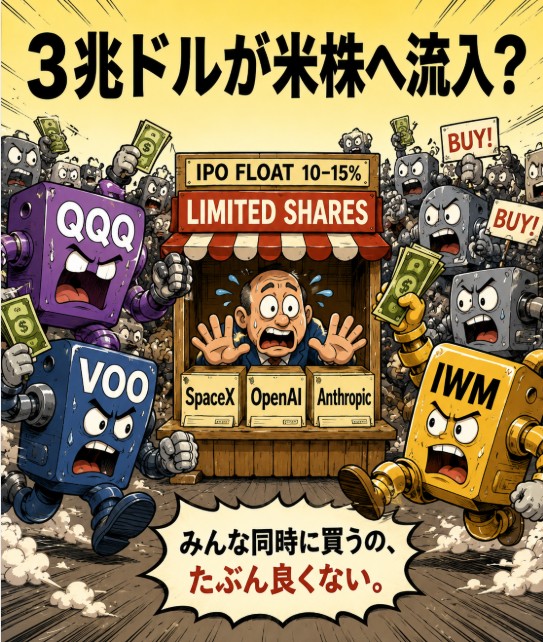
合計で3兆ドルを超えるテック企業群が、ほぼ同時に上場する。歴史的に見ても、こんなことは起きたことがない。
In total, more than $3 trillion of tech companies are about to hit the public market within months of each other. Historically, this has never happened.
問題は、ここから。
The real problem starts here.
ルールが、3つのインデックスで同時に書き換わっている
The Rules Are Being Rewritten Across Three Indices Simultaneously
AIブームだと言われて久しいですが、もう一段このブームの火に油を注ぐ事態が起きるかも知れません。別に公に出ていないマユツバ話ではなく、どちらかというと、人があまり目を通さない取引所サイトのプレスリリースPDFの中に書かれている事が要因です。
The AI boom has been the story for a while now, but there's another layer of fuel about to hit the fire. This isn't some unverified rumor — it's quietly sitting inside press-release PDFs on exchange websites that almost nobody reads.
米国の主要インデックスを提供しているそれぞれが、上場株の指数組み入れまでのシーズニング期間※の短縮を検討している事が発表されています。これは株価にとって少なくとも短期的には大きく影響を伴う変更。具体的には後述しますが、それぞれの指数で何が起きているかを整理すると
Each of the major US index providers has announced that they are reviewing — and shortening — the seasoning period※ a stock must wait before being added to an index. This is a change with significant short-term implications for stock prices. The details follow, but here's a quick map of what's happening at each index:
※ シーズニング期間とは、新規上場した銘柄が主要株価指数に組み入れられるまでに最低限求められる「上場後の経過期間」のこと。十分な取引実績と価格の安定が確認されてから組み入れる、という考え方から設けられている。S&P 500は伝統的に12ヶ月、Nasdaq-100は3ヶ月、Russellは四半期サイクルで運用されてきた。だからこそ今回の一斉短縮が大きな話になっている。
※ A "seasoning period" is the minimum time a newly listed stock must wait after IPO before being eligible for inclusion in a major index. The idea is that enough trading history and price stability needs to be confirmed before the stock joins the index. Traditionally, S&P 500 has required 12 months, Nasdaq-100 three months, and Russell has run on a quarterly cycle. Which is exactly why this simultaneous tightening is such a big deal.
Nasdaq-100は2026年3月30日、「Fast Entry」ルールというものを承認。
On March 30, 2026, Nasdaq-100 approved a so-called "Fast Entry" rule.
時価総額が現構成銘柄の上位40位以内なら、IPOから15営業日で組み入れ可能というもの。通常だとインデックスへの組み入れはシーズニング期間(従来3ヶ月)というものがあって、これが免除される形です。3週間もない。
If a company's market cap ranks within the top 40 of the current index constituents, it can be added just 15 trading days after IPO. Normally, index inclusion requires the seasoning period (previously three months), which under this rule is waived. That's not even three weeks.
S&P 500は2026年4月30日、メガキャップ向けルール変更の市場協議を開始。シーズニング期間を12ヶ月から6ヶ月に短縮。さらに、「4四半期連続GAAP黒字」要件をメガキャップ企業について免除する案を含みます。協議期間は5月28日締切、実施目標は6月8日。要するに、黒字でなくてもS&P 500に入れるようにする、というお話。
On April 30, 2026, S&P 500 opened a market consultation on mega-cap-targeted rule changes. The seasoning period would be cut from 12 months to 6 months. The proposal also includes waiving the "four consecutive quarters of GAAP profit" requirement for mega-cap companies. Consultation closes May 28, with target implementation on June 8. In short: the door is being opened for unprofitable companies to enter the S&P 500.
S&P Global Indices Consultation
Russellは2026年からセミアニュアル(6月・12月)再構成に移行。IPO Fast Entry強化策を導入。Russell Top 500の時価総額閾値を超えるIPOは四半期(3/6/9/12月)組み入れ。
Russell shifted to semi-annual reconstitution (June and December) in 2026, and introduced enhanced IPO Fast Entry rules. IPOs above the Russell Top 500 market-cap threshold now get added quarterly (March, June, September, December).
3つの大きな米国インデックスが、ほぼ同時にIPO対応のルール緩和を進めている。偶然にしてはタイミングが良すぎる?偶然ということにしておきましょう。
The three major US indices are loosening IPO inclusion rules in near-perfect unison. A coincidence? The timing seems a little too clean. Let's call it a coincidence anyway.
構造的な不整合
A Structural Mismatch
投資家がお金を投げるファンドの対象はこのところしばらく、パッシブファンド※が主流なのは周知の事実。特に特定インデックスに連動するパッシブインデックスファンドの規模は、もはや市場構造そのもの。メジャーなファンドであるVanguard VOO単体で約9,950億ドル。米国ETF市場全体で約13兆ドル、グローバルETFの預かり資産は19兆ドルという巨大な規模になっています。
It's been well-known for a while now that passive funds※ have become the dominant destination for investor capital. The scale of index-tracking passive funds in particular has become market structure itself. Vanguard's VOO alone holds about $995 billion. The US ETF market totals around $13 trillion; global ETF AUM stands at a massive $19 trillion.
※ パッシブファンドは、特定の指数(S&P 500やNasdaq-100など)の構成銘柄をそのまま機械的に保有するファンド。運用者の裁量で銘柄を選ぶアクティブファンドと対照的で、指数とほぼ同じリターンを目指す代わりに手数料が安い。指数に銘柄が追加されれば即座に買い、外れれば即座に売る。判断は介在しない、ここが今回の話の核心。
※ Passive funds mechanically hold the constituent stocks of a specific index (such as the S&P 500 or Nasdaq-100). Unlike active funds, where managers exercise discretion, passive funds aim to match the index's return — at a much lower fee. When a stock joins the index, the fund buys instantly; when it's removed, it sells instantly. No judgment is involved. This is the core of today's story.
パッシブファンドの規模感に加えて、その仕組みに暴騰リスクの可能性が潜んでいるといえます。インデックス連動のファンドは文字通り指数に連動するために指数に入っている銘柄と同様の構成に近づける事が必須となります。
On top of the sheer scale, the mechanics themselves carry the seed of a potential melt-up. Index-tracking funds must, by definition, hold the same composition as the index they track.
つまり、仮に新規IPOとなる上記の3銘柄が各指数のどれかに組み入れられるとすると、半ば反射的に買いに行かなければいけません。
Which means: if any of the three IPOs above gets added to one of these indices, every passive fund tracking it has to buy — reflexively.
パッシブファンドのファンドマネージャーに「こんな高値でこの銘柄買うの?」と聞いても答えは返ってこない。インデックスがそう決めたから機械的に買う。理由?"トラッキングエラーがーーー"。要するに、"考えるな感じろ"のようなものだ。
Ask a passive fund manager "Are you really buying this at these prices?" and you won't get an answer. The index decided, so they buy mechanically. The reason? "Tracking error this, tracking error that." In other words: don't think, just feel.
SpaceXの例で具体的に説明してみる。
Let's run through it concretely with SpaceX.
SpaceX上場が想定されているのは6月12日、想定時価総額1.75兆ドル。Nasdaq-100のFast Entryルールにより、上場後15営業日で組み入れ通告が出る可能性があります(可能性が高いと意識されています)。
SpaceX is expected to list on June 12 at a market cap of $1.75 trillion. Under the Nasdaq-100 Fast Entry rule, an inclusion announcement could come within 15 trading days of listing — and is widely expected to.
つまり7月初旬、QQQ※に連動する全パッシブファンドは、上場わずか3週間の銘柄を強制的に買わなければいけない。流動性は薄い。フロート(浮動株※)はロックアップで制限される。インサイダー保有比率※は伝統的IPOより遥かに高いと想定されています。
Which means: by early July, every passive fund tracking QQQ※ will be forced to buy a stock that's been public for barely three weeks. Liquidity is thin. The float (tradable shares※) is constrained by lockups. The insider holding ratio※ is expected to be far higher than for a typical IPO.
つまり、市中に出回る数が構造的に少ないものを大量の人間が買いに行かなければいけなくなる構図の出来上がりです。
In other words: structurally few shares circulating in the market, with a huge number of buyers forced to chase them. The setup is complete.
※ QQQは「Invesco QQQ Trust」、Nasdaq-100指数に連動する世界最大級のETFのひとつ。Apple、Microsoft、NVIDIA、Amazon、Meta、Tesla等のテック大手を中心に構成され、預かり資産は約3,000億ドル規模。Nasdaq-100に新規組み入れが決まると、QQQは即座にその銘柄を買う必要がある。3,000億ドルが一斉に動く、と想像してみてほしい。
※ QQQ is "Invesco QQQ Trust," one of the world's largest ETFs and tracks the Nasdaq-100. It's heavily weighted toward big-tech names like Apple, Microsoft, NVIDIA, Amazon, Meta, and Tesla, with about $300 billion in AUM. When Nasdaq-100 adds a new constituent, QQQ has to buy it immediately. Imagine $300 billion moving at once.
※ フロート(浮動株)とは、市場で実際に売買可能な株式のこと。創業者、経営陣、ロックアップ中の初期投資家が保有する株式を発行済株式総数から除いた残り。フロートが小さい銘柄ほど、需給の偏りで価格が大きく動きやすい。今回のメガIPOの場合、フロートが歴史的に低い水準になる見込み。
※ The "float" refers to the shares actually available to trade in the market — the total shares outstanding minus those held by founders, executives, and early investors under lockup. The smaller the float, the more easily supply-demand imbalances move the price. For these mega-IPOs, the float is expected to be at historically low levels.
※ インサイダー保有比率とは、創業者・経営陣・大株主など内部関係者が保有する株式の比率。これが高いほど、市場で売買できる株が少なくなる。SpaceXの場合、イーロン・マスク本人とSpaceX従業員、初期投資家の保有比率が圧倒的に高く、一般的なIT企業のIPOと比べてフロートが極端に小さくなる見込み。需要対供給のバランスで言うと、供給側が異常に細い。
※ The "insider holding ratio" is the share of stock held by internal parties — founders, executives, large shareholders. The higher the ratio, the fewer shares circulate in the market. In SpaceX's case, Elon Musk himself, SpaceX employees, and early investors hold an overwhelming share, so the float will likely be drastically smaller than a typical tech IPO. On the supply-demand axis, the supply side is unusually thin.
テスラの前例
The Tesla Precedent
これはただの空想ではありません。実は直近で前例があります。覚えている人もいると思います。
This isn't just speculation. There's a recent precedent — many readers will remember it.
2020年12月21日、テスラがS&P 500に組み入れられました。時価総額約6,500億ドル、ウェイト1.69%(当時の組み入れ第5位)。S&P Dow Jonesの推計では、パッシブファンドは約510億ドルの強制買いを実行したとされています。テスラ発行済株式の11.5%、フロートの13%超に相当。
On December 21, 2020, Tesla was added to the S&P 500. Market cap roughly $650 billion, index weight 1.69% (fifth largest at the time). S&P Dow Jones estimated that passive funds executed approximately $51 billion in forced buying — equivalent to 11.5% of Tesla's shares outstanding and over 13% of its float.
組み入れアナウンスから組み入れ日までの約1ヶ月で、テスラ株は+70%上昇しました。同期間の市場リターンの28倍。そして組み入れ翌日から2営業日で-7.86%。短期トレーダーが利確で抜けた。教科書通りの展開です。
Between the inclusion announcement and the inclusion date — about one month — Tesla stock rose +70%. That's 28 times the broader market return over the same period. Then, in the two trading days after inclusion, the stock dropped 7.86%. Short-term traders took profits and exited. Textbook.
これは時価総額6,500億ドルの銘柄が、1年間のシーズニング期間を経て、事前数週間の通告で発生した動きです。
That was a $650 billion stock, with a full year of seasoning, given several weeks of advance notice.
今回の前提はさらに特殊です。時価総額は1.75兆ドル(テスラの約2.7倍)。通告期間はNasdaq-100で15営業日。シーズニングはS&P 500で6ヶ月案、Nasdaq-100では実質ゼロ。構成銘柄はSpaceX、OpenAI、Anthropicが半年以内にほぼ同時上場の可能性があります。
This time, the setup is even more extreme. Market cap: $1.75 trillion (roughly 2.7x Tesla's). Notice period under Nasdaq-100: 15 trading days. Seasoning: 6 months under the S&P 500 proposal; effectively zero under Nasdaq-100. And the lineup — SpaceX, OpenAI, and Anthropic — could potentially all list within the same six-month window.
機械的なメルトアップの規模感は、テスラの倍以上になる蓋然性が高いと予想されます。倍、というのはもはや控えめな表現かもしれません。
The scale of the mechanical melt-up is likely to be more than double Tesla's. "Double" may, frankly, be an understatement.
パッシブファンドが直面する3つの実務的問題
Three Practical Problems Passive Funds Are About to Face
ここからは、実際にインデックスファンドの運用に何が起きるかを書きます。順番に。
From here, let's walk through what's actually about to happen inside index fund operations. In order.
リバランスの強制売り。QQQが新規にSpaceXを1.5%-2.0%ウェイトで組み入れる場合、既存構成銘柄(Apple、Microsoft、NVIDIA、要するにみんなが持ってる銘柄)を等比例で売却して資金を作る必要があります。
Forced rebalancing sells. If QQQ adds SpaceX at a 1.5%–2.0% weight, it has to sell down its existing constituents (Apple, Microsoft, NVIDIA — i.e., what everyone holds) proportionally to fund the purchase.
VOO/QQQ/IWM合計で、推計1,000億ドル超の強制リバランス売りが、上場後15-30営業日内に集中することになります。あなたが今持っている米インデックス連動ファンドも、その「みんな」に入っています。
In total across VOO/QQQ/IWM, an estimated $100+ billion of forced rebalancing sells gets concentrated within 15–30 trading days after listing. The US index funds you currently hold are part of that "everyone."
※ VOOはS&P 500、QQQはNasdaq-100、IWMはRussell 2000にそれぞれ連動するETFで、米国インデックス投資の三大主役。三本合計の預かり資産は約1.5兆ドル規模で、これらが構成銘柄を売買するだけで個別銘柄の価格が動く。日本の個人投資家がつみたてNISAで持っている米国インデックスファンドの多くも、実質的にこの三本のどれかに紐付いている。
※ VOO tracks the S&P 500, QQQ tracks the Nasdaq-100, and IWM tracks the Russell 2000 — the three protagonists of US index investing. Combined AUM is about $1.5 trillion, and individual stock prices move just from these three trading their constituents. Most of the US index funds Japanese retail investors hold in their tsumitate NISA accounts are effectively tied to one of these three.
価格発見の歪み既に株を持っている関係者が株を売却できるまでにはロックアップ期間というものが存在します。そのロックアップ期間の解除前、市場に出回る浮動株は発行済株式の10-15%程度が相場(今回はおそらくこれよりも少ない可能性もある)。パッシブファンドの強制買いが、薄い流動性の中で執行されることになります。価格は本来の適正価格を大きく上方向に(少なくとも一時的には)乖離する可能性が高いです。適正価格がいくらなのか、というのは別の議論として。
Distorted price discovery. Existing shareholders can't sell until the lockup period ends. Before lockup expiry, the typical float circulating in the market is 10–15% of shares outstanding (and this time, it could be even less). The passive funds' forced buying gets executed inside that thin liquidity. Prices are likely to diverge sharply upward from fair value — at least temporarily. What "fair value" actually is is a separate conversation.
利益要件免除の構造リスク。S&P 500の新提案では、メガキャップ企業の4四半期連続GAAP※黒字要件を免除する案が含まれている。OpenAIは2025年通期で131億ドル収益、約220億ドルの赤字。2026年の営業赤字は140億ドル見込み。これが免除規定で組み入れられた場合、S&P 500の「優良大型株インデックス」というブランドそのものの定義が変わります。儲かってなくても入れる優良株インデックス。なるほどですね。。。。
Structural risk from the profitability waiver. The new S&P 500 proposal includes waiving the "four consecutive quarters of GAAP※ profit" requirement for mega-cap companies. OpenAI generated $13.1 billion in revenue in full-year 2025, with a loss of roughly $22 billion. Its 2026 operating loss is projected at $14 billion. If this gets in under the waiver provision, the very definition of "the blue-chip large-cap index" that S&P 500 represents starts to shift. A blue-chip index that lets in companies that don't make money. I see.
※ GAAP(Generally Accepted Accounting Principles)は米国の会計基準。S&P 500の組み入れ要件には「直近4四半期連続でGAAP基準の純利益が黒字」というものがあり、テック企業の赤字成長モデルとは相性が悪い。OpenAIのように営業赤字が膨大な企業は、この要件があるため通常はS&P 500に入れない。だから今回のルール変更が重要になる。
※ GAAP (Generally Accepted Accounting Principles) is the US accounting standard. S&P 500's inclusion criteria require "GAAP-basis net income positive for four consecutive quarters" — which doesn't sit well with the loss-making growth model of tech companies. Companies like OpenAI, with enormous operating losses, would normally never make it into the S&P 500. This is why the current rule change matters.
本当のトレードは、表に出ない
The Real Trades Don't Make the Headlines
ここから先は、機関投資家とプロップトレーダーが既に動き始めている領域。
What follows is the territory where institutional investors and prop traders have already started moving.
シナリオは大きく3つあります。
There are three main scenarios.
1.上場前から組み入れ確実視されている銘柄への先回り買い。
1. Front-running with early buys into stocks where inclusion is already considered a near-certainty.
2.組み入れ直後の機械的な買いの上に乗る短期トレード。
2. Short-term trades that ride the mechanical buying wave immediately after inclusion.
3.組み入れ後30営業日のドリフト(テスラで-7.86%の前例)を狙うショート/プット戦略。
3. Short / put strategies targeting the 30-trading-day drift after inclusion (Tesla's -7.86% as precedent).
具体的なヘッジ手段(VIX、QQQプット、個別IV取引)とポジションサイジングの話、と思ったでしょう。書きません。これ以上は飲食アプリのブログ記事としてはオフテーマ過ぎるので、、、
You were expecting specifics on hedging instruments (VIX, QQQ puts, single-name IV trades) and position sizing? Not happening. This is already pushing it for a restaurant-app blog post...
もし少しでもビジネス記事が面白いと感じてくださったら、是非どこか会食に行く際は僕らのアプリも使ってみてください。幹事になることが多い人やビジネスパーソンであれば間違いなく便利に感じるはずです。
If you found this business piece even a little interesting, give our app a try the next time you're organizing a dinner. If you're the one who ends up booking for the group — or you're a working professional in general — there's a good chance you'll find it genuinely useful.