AIはタダにならなかった。Kimi K3ショックと「オープンモデルの請求書」
AI Didn't Become Free: The Kimi K3 Shock and the Open-Model Invoice
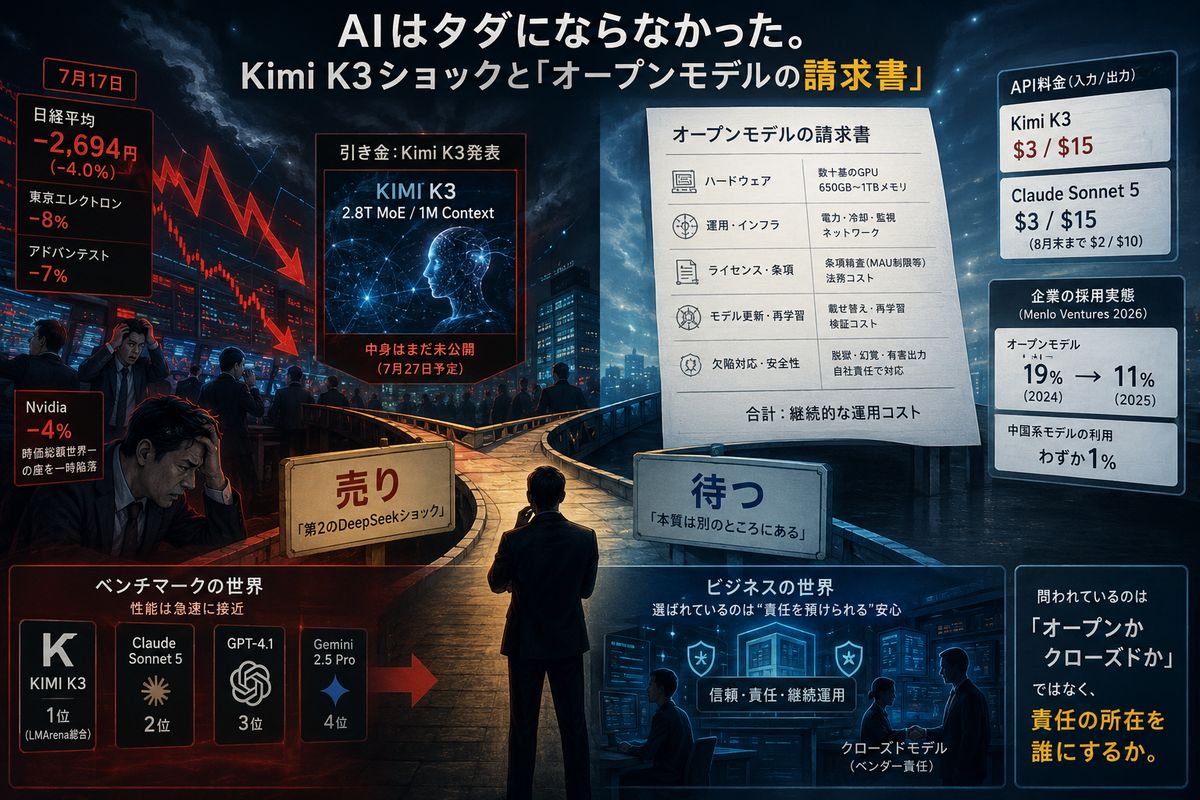
7月17日金曜日、日経平均は2,694円安の64,141円。取引時間中には一時6%を超えて下げる今年最大級の急落で、6月25日の史上最高値から11%超下の「調整局面」に沈みました。東京エレクトロンは約8%安、アドバンテストは約7%安。米国でもNasdaqが1.4%下げ、半導体株指数はベアマーケット入り。NvidiaはAppleに時価総額世界一の座を一時明け渡しました。この世界同時の売りの引き金を引いたのは、決算でも、地政学でも、中央銀行でもありません。前日に中国のスタートアップMoonshot AIが発表した、「Kimi K3」という1本のAIモデルです。
On Friday, July 17, the Nikkei fell 2,694 yen to 64,141, at one point down more than 6% intraday in one of the year's sharpest drops, sinking into correction territory more than 11% below its June 25 record high. Tokyo Electron lost about 8%, Advantest about 7%. In the US, the Nasdaq fell 1.4% and the semiconductor index entered a bear market. Nvidia briefly handed the title of world's most valuable company back to Apple. The trigger for this synchronized global selloff was not an earnings report, not geopolitics, not a central bank. It was a single AI model called Kimi K3, announced the previous day by the Chinese startup Moonshot AI.
Nikkei briefly dives over 4,100 points in afternoon(The Japan Times)
Markets experience new DeepSeek shock after MoonShot AI releases Kimi K3(Fortune)
奇妙なのは、ここからです。世界中の投資家を売りに走らせたこのモデルの中身(weights)は、実はまだ誰も確認できません。公開は7月27日の予定です。つまり市場は、中身を検証すらできない「約束」に対して、これだけの時価総額を動かしたことになります。それでも売りが走ったのは、筋書きが2025年1月と同じだったからです。オープンなAIモデルが米国の最先端に追いつけば、AIはタダ同然になり、高い利用料を取るクローズドAI企業のビジネスは崩れる。メディアはこの日を「第2のDeepSeekショック」と呼びました。
Here is where it gets strange. The weights of the model that sent investors around the world rushing to sell cannot actually be inspected by anyone yet. They are scheduled for release on July 27. In other words, the market moved this much market capitalization on a promise whose contents no one can even verify. The selling ran anyway, because the script was the same as January 2025: if an open AI model catches up to the American frontier, AI becomes essentially free, and the business of closed AI companies charging premium fees collapses. The media named the day the second DeepSeek shock.
しかし同じ日、日本のAIウォッチャーたちのタイムラインで注目を集めていたのは、株価チャートではなく1枚の価格表でした。Kimi K3のAPI料金は、入力100万トークンあたり3ドル、出力15ドル。「締め出される」はずのAnthropicが売るClaude Sonnet 5の定価と、まったくの同額です。タダになるはずのオープンモデルに、フロンティアと同じ値札が付いている。この小さな違和感こそが、7月17日の筋書き全体に入った、最初の綻びです。
But on the same day, what drew attention on the timelines of Japan's AI watchers was not a stock chart. It was a price list. Kimi K3's API costs $3 per million input tokens and $15 per million output tokens, exactly the same as the list price of Claude Sonnet 5, sold by the very Anthropic that is supposedly being priced out. The open model that was supposed to make AI free wears the same price tag as the frontier. That small dissonance is the first crack in the entire July 17 storyline.
※ オープンウェイトとは、モデルの重み(パラメータ)ファイルを誰でもダウンロードできる形で公開する方式のこと。学習データや学習コードまで公開する「オープンソース」とは区別される。
※ Open weights refers to releasing a model's weight (parameter) files for anyone to download. It is distinct from "open source," which also publishes the training data and training code.
3つの命題は、いつの間にか1つに
Three Claims That Quietly Became One
7月17日の売りを分解すると、次の三段論法になります。
Break down the July 17 selloff and you get the following syllogism.
①オープンモデルがベンチマークで追いついた。だから、②AIはタダ同然になる。だから、③有料でAIを売るクローズド企業は負ける。
One: open models have caught up on benchmarks. Therefore, two: AI becomes essentially free. Therefore, three: closed companies that sell AI for money lose.
①は本物です。この記事でも、まずそれを確認します。しかし②と③は、①から自動的には導けない別々の命題です。そして②については、当のKimi K3自身の価格表が反証になっています。この記事では、7月のオープンモデルの波を素直に認めたうえで、②と③がどこで壊れるのかを、実際の運用コストと企業の採用データで確かめていきます。
Claim one is real, and this article will start by confirming it. But claims two and three are separate propositions that do not follow automatically from claim one. And for claim two, the counter-evidence is Kimi K3's own price list. This article gives July's open-model wave its full due, then tests where claims two and three break, using real operating costs and real enterprise adoption data.
波は本物です。7月のオープンウェイト・ウェーブ
The Wave Is Real: July's Open-Weight Surge
まず①の確認から。この1週間で起きたことを並べるだけで、密度が分かります。
First, claim one. Simply listing what happened in a single week conveys the density.
7月15日、元OpenAI CTOのミラ・ムラティ氏が率いるThinking Machines Labが、初の自社モデル「Inkling」を公開しました。総パラメータ9,750億(アクティブ410億)のMoE構成で、テキスト・画像・音声を扱うマルチモーダル。ライセンスは商用利用を無制限に認めるApache 2.0で、weightsは発表と同時にHugging Faceで公開されました。米国勢が久しぶりに投入した本格的なオープンウェイトモデルです。
On July 15, Thinking Machines Lab, led by former OpenAI CTO Mira Murati, released its first in-house model, Inkling: a mixture-of-experts design with 975 billion total parameters (41 billion active), multimodal across text, images, and audio. The license is Apache 2.0, which permits unrestricted commercial use, and the weights went up on Hugging Face the day of the announcement. It is the first serious open-weight model from the US camp in a long while.
Inkling: Our open-weights model(Thinking Machines Lab)
Thinking Machines amps up its bet against one-size-fits-all AI with its first open model, Inkling(TechCrunch)
※ MoE(Mixture of Experts)とは、モデル内部を多数の「専門家」に分割し、入力ごとに一部の専門家だけを動かす設計のこと。総パラメータは巨大でも、1回の応答で使う計算量を抑えられる。
※ MoE (Mixture of Experts) is a design that splits a model into many "experts" and activates only a few of them per input. Total parameters can be enormous while the compute used per response stays contained.
7月16日、Kimi K3。総パラメータ2.8兆は、公開が予定されているオープンウェイトモデルとして史上最大です。896人の専門家のうち16人だけが各トークンで動くMoE構成で、コンテキストは100万トークン。ブラインド評価のLMArenaでは、フロントエンド・コーディング部門で米国の主要モデルを抑えて首位に立ち、総合評価でも米国の最上位モデル群に肩を並べたと報じられています。
On July 16, Kimi K3. Its 2.8 trillion total parameters make it the largest open-weight model ever slated for release. It is an MoE design in which just 16 of 896 experts fire per token, with a 1-million-token context window. In LMArena's blind evaluations, it reportedly took first place in front-end coding ahead of the major US models, and drew level with the top tier of US models in overall rankings.
China's open-weight Kimi model stuns AI world with frontier-level results(Axios)
Moonshot AI Releases Kimi K3: A 2.8 Trillion Parameter Open MoE Model With Kimi Delta Attention and 1M Context(MarkTechPost)
そしてDeepSeek。4月24日にプレビュー公開されたV4は、数学・STEM・コーディングで既存のすべてのオープンモデルを上回り、最上位のクローズドモデルに匹敵する、と自ら謳う性能を掲げています。正式版は7月中旬の公開が予告されています。
And then DeepSeek. V4, released in preview on April 24, carries the company's own claim of beating every existing open model on math, STEM, and coding while rivaling the top closed models. The official release has been announced for mid-July.
DeepSeek V4 Preview Release(DeepSeek API Docs)
| モデル | 公開日 | 規模(総/アクティブ) | ライセンス | weights入手 | API価格(入力/出力) |
|---|---|---|---|---|---|
| Inkling (Thinking Machines) | 7月15日 | 9,750億 / 410億 | Apache 2.0 | 公開済み(即日) | $1.87 / $4.68 |
| Kimi K3 (Moonshot AI) | 7月16日 | 2.8兆 / MoE 16/896 | 未確定(7月27日発表予定) | 7月27日公開予定 | $3 / $15 |
| DeepSeek V4 Pro | 4月24日(プレビュー) | 1.6兆 / 490億 | MIT系(プレビュー版) | 公開済み | $0.435 / $0.87 |
| Model | Release | Size (total/active) | License | Weights | API price (in/out) |
|---|---|---|---|---|---|
| Inkling (Thinking Machines) | Jul 15 | 975B / 41B | Apache 2.0 | Released day one | $1.87 / $4.68 |
| Kimi K3 (Moonshot AI) | Jul 16 | 2.8T / MoE 16 of 896 | TBD (due Jul 27) | Due Jul 27 | $3 / $15 |
| DeepSeek V4 Pro | Apr 24 (preview) | 1.6T / 49B | MIT-style (preview) | Released | $0.435 / $0.87 |
最上位のクローズドモデルとの性能差は、指標によっては数ポイント、世代で言えば「1世代分」まで縮まったと評価されています。数年前の「オープンは2〜3年遅れ」という感覚は、もう通用しません。ここまでは、市場が織り込んだ通りです。
The performance gap to the top closed models has narrowed, by some metrics, to a few points, or in generational terms to about one generation. The old intuition that open models run two to three years behind no longer holds. Up to this point, the market's read was correct.
日本のAI界隈も、この密度をリアルタイムで観測していました。
Japan's AI community was watching this density unfold in real time.
kimi k3すげえな…特定ベンチ上はFable 5上回ってる これAnthropicはFable 5を7/19でサブスク枠から外すのさらにキツくなりそうだなー 中国のモデルは安いけど米フラッグシップモデルの1世代前くらいの性能ってイメージだったけど、K3はかなりAPIコスト高くなってきてるんだね (IN$3/OUT$15)
注目すべきは、このポストの後半です。性能への驚きと同じ行数が、価格への驚きに割かれています。
Note the second half of that post. As many lines are given to surprise at the price as to surprise at the performance.
「無料のweights」の請求書
The Invoice Attached to "Free Weights"
②の検証に入ります。「オープンモデルが追いついた。だからAIはタダ同然になる」。この命題は、今週3つの角度から反証されました。
Now to claim two: "open models caught up, therefore AI becomes essentially free." This week refuted that claim from three angles.
第一に、価格です。Kimi K3のAPI料金、入力3ドル・出力15ドルは、Claude Sonnet 5の定価(入力3ドル・出力15ドル)と同額です。しかもSonnet 5は8月末まで導入価格(入力2ドル・出力10ドル)で提供されているため、いま現在、この中国製オープンモデルはAnthropicの中位モデルより高いことになります。フロンティア級の性能に達した瞬間、オープンモデルはフロンティア価格になりました。「オープンだから安い」のではなく、「1世代前だから安かった」のです。
First, the price. Kimi K3's API rate of $3 in, $15 out is identical to Claude Sonnet 5's list price of $3 in, $15 out. What's more, Sonnet 5 is on introductory pricing of $2 in, $10 out through the end of August, which means that right now, this Chinese open model costs more than Anthropic's mid-tier model. The moment an open model reached frontier-grade performance, it adopted frontier pricing. Open models were never cheap because they were open. They were cheap because they were a generation behind.
Kimi K3 - API Pricing & Benchmarks(OpenRouter)
Introducing Claude Sonnet 5(Anthropic)
あーあ、Kimi-K3の情報が公式から出てこねーから余所からチマチマ小出しに出てきてるよ。Clineが言うにはターミナルベンチでKimi-K3はFable5、Opus4.8超え、GPT-5.6に匹敵。総パラ数は2.8Tでこれまでの1Tに比べて3倍くらいクソデカくなってしまった。API料金は入力3ドル、出力15ドルでSonnet5と同じだ
第二に、自前で動かすコストです。「weightsが無料なら、APIを使わず自社サーバーで動かせばいい」という発想は、2.8兆パラメータの前では成立しません。量子化を施しても必要メモリはおよそ650GBから1TB、フル精度なら約1.7TBに達するとされ、Moonshot自身、本番運用には64基以上のアクセラレータを束ねた構成を推奨していると報じられています。これは中小企業のサーバールームの話ではなく、データセンターの話です。
Second, the cost of running it yourself. The idea that "if the weights are free, skip the API and run it on your own servers" does not survive contact with 2.8 trillion parameters. Even quantized, the memory requirement reportedly runs to roughly 650GB to 1TB, and around 1.7TB at full precision; Moonshot itself is reported to recommend serving the model on clusters of 64 or more accelerators for production use. That is not a small-company server room. That is a data center.
※ 量子化とは、モデルの重みをより少ないビット数で表現してメモリ使用量を減らす圧縮技術のこと。精度と引き換えに、より小さいハードウェアで動かせるようになる。
※ Quantization is a compression technique that represents model weights in fewer bits to reduce memory use. It trades some precision for the ability to run on smaller hardware.
第三に、運用の継続コストです。仮にハードウェアを用意できたとしても、そこからが本番です。
Third, the ongoing cost of operation. Even if you can stand up the hardware, that is where the real work begins.
| 項目 | 自社ホストの場合 | クローズドAPIの場合 |
|---|---|---|
| ハードウェア | 数十基規模のアクセラレータ構成 | 不要(ベンダー負担) |
| メモリ | 量子化でも約650GB〜1TB | 不要 |
| ライセンス管理 | 条項の精査が必要(K2系は大規模商用にMAU条項) | 利用規約の確認のみ |
| モデル更新 | 数ヶ月ごとに新ベースへ載せ替え、追加学習はやり直し | ベンダーが継続更新 |
| 欠陥対応(脱獄・幻覚・安全性) | 自社チームで常時監視・修正 | ベンダーが継続修正 |
| Item | Self-hosted | Closed API |
|---|---|---|
| Hardware | Accelerator clusters at tens-of-units scale | None (vendor's problem) |
| Memory | ~650GB-1TB even quantized | None |
| License management | Clause-by-clause review (K2 line carries an MAU clause for large commercial use) | Read the terms of service |
| Model updates | Migrate to a new base every few months; fine-tuning redone | Vendor updates continuously |
| Flaw handling (jailbreaks, hallucinations, safety) | Your own team, on call | Vendor patches continuously |
このうち「モデル更新」は、今週まさに実物の例が動いています。DeepSeekは旧モデル名(deepseek-chatとdeepseek-reasoner)のAPIを7月24日で完全に打ち切ります。オープンモデルの世界でも、ベースモデルは数ヶ月単位で入れ替わり、その上に築いたファインチューニングや評価基盤は、載せ替えのたびに再構築を迫られるのです。
The "model updates" row has a live example running this very week: DeepSeek is fully retiring its legacy model endpoints (deepseek-chat and deepseek-reasoner) on July 24. Even in the open-model world, base models turn over on a cadence of months, and the fine-tuning and evaluation infrastructure built on top must be rebuilt with every migration.
Change Log(DeepSeek API Docs)
※ ファインチューニングとは、公開済みのモデルに自社データを追加学習させ、特定の業務に合わせて調整すること。ベースのモデルが変わると、多くの場合やり直しになる。
※ Fine-tuning means further training a released model on your own data to adapt it to a specific task. When the base model changes, the work usually has to be redone.
そして欠陥対応。クローズドモデルの欠陥はベンダーの責任であり、修正は利用者が気付かないうちに配信されます。自社ホストしたオープンモデルの欠陥は、脱獄も、幻覚も、有害な出力も、すべて自社の責任です。weightsをダウンロードした瞬間から、あなたの会社がそのモデルの「セキュリティチーム」になります。
And then there is flaw handling. A closed model's flaws are the vendor's responsibility, and fixes ship without users ever noticing. A self-hosted open model's flaws, the jailbreaks, the hallucinations, the harmful outputs, are all yours. From the moment you download the weights, your company becomes that model's security team.
※ ジェイルブレイク(脱獄)とは、AIモデルの安全対策を回避して、本来出力しないはずの内容を引き出す攻撃手法のこと。
※ A jailbreak is an attack technique that circumvents an AI model's safety measures to elicit content it is not supposed to output.
まとめれば、こうなります。オープンモデルのweightsは、拾ってきた犬がタダなのと同じ意味でタダです。連れて帰った日から、餌代と、しつけと、病院代が始まります。
To sum up: open-model weights are free the way a stray dog you take in is free. The food, the training, and the vet bills start the day you bring it home.
採用データが値付けしているのは、能力ではなく「欠陥の所有権」
What Adoption Data Actually Prices: Not Capability, but Ownership of Flaws
最後に③、「クローズド企業は負ける」の検証です。ここには、参照できる実験結果が2つあります。
Finally, claim three: "closed companies lose." Here we have two experiments already on the record.
1つ目は、第1次DeepSeekショックそのものです。2025年1月27日、DeepSeekの低コストモデルの衝撃でNvidia株は17%下落し、1日で5,890億ドルの時価総額が消えました。当時としては米国株式市場史上最大の1日の損失です。ではその後どうなったか。Nvidiaは同年7月に史上初の時価総額4兆ドル企業になり、10月29日には5兆ドルに到達しました。「オープンで安いAIが出たから計算需要は減る」という売りは、9ヶ月で約2兆ドル分、逆方向に間違っていたことになります。オープンモデルもクローズドモデルも、動かすのは同じGPUだからです。
The first is the original DeepSeek shock itself. On January 27, 2025, the shock of DeepSeek's low-cost model knocked Nvidia down 17%, erasing $589 billion of market value in a single day, at the time the largest one-day loss in US stock market history. And then what happened? Nvidia became the first company in history to reach a $4 trillion market cap that July, and hit $5 trillion on October 29. The trade that said "cheap open AI means less compute demand" was wrong by roughly $2 trillion in the opposite direction, in nine months. Open models and closed models run on the same GPUs.
Nvidia stock plummets, loses record $589 billion as DeepSeek prompts questions over AI spending(Yahoo Finance)
Nvidia becomes first company to reach $5 trillion valuation, fueled by AI boom(CNBC)
2つ目は、企業の財布の動きです。ベンチャーキャピタルのMenlo Venturesが米企業のAI意思決定者495人を調査した年次レポートによれば、企業のLLM利用に占めるオープンソースモデルの割合は、この1年で19%から11%へ低下しました。DeepSeekショックで世界が沸いた、まさにその年の数字です。さらに踏み込むと、中国系オープンモデルの割合は、企業のLLM API利用全体のわずか1%。7月17日に世界の株式市場から数兆円規模の時価総額を消し飛ばしたモデル群は、企業の実利用では100分の1の存在なのです。
The second is the movement of enterprise wallets. According to the annual survey by venture firm Menlo Ventures of 495 enterprise AI decision-makers in the US, open-source models' share of enterprise LLM usage fell from 19% to 11% over the past year, the very year the world was buzzing about the DeepSeek shock. Go one level deeper and Chinese open models account for just 1% of total enterprise LLM API usage. The class of models that vaporized trillions of yen in market value on July 17 is a one-in-a-hundred presence in actual enterprise use.
2025: The State of Generative AI in the Enterprise(Menlo Ventures)
ベンチマークがこれだけ接近しているのに、なぜ採用は逆に離れていくのか。同レポートの答えは素っ気ないものです。「性能が意思決定を駆動する。開発者は、安くて速い代替よりフロンティアモデルを一貫して選ぶ」。しかし前段で見たとおり、性能そのものの差は縮まっています。縮まってもなお選ばれない理由を、私たちはこう読みます。企業が値付けしているのは能力ではなく、欠陥の所有権だからです。
If the benchmarks are this close, why is adoption moving the other way? The report's own answer is terse: performance drives decisions, and builders consistently choose frontier models over cheaper, faster alternatives. But as we saw above, the raw performance gap is shrinking. Our read on why open models still are not chosen even as the gap closes: because what enterprises are pricing is not capability. It is ownership of flaws.
ベンチマークは「このモデルに何ができるか」を測ります。企業の調達が値付けするのは「このモデルが失敗したとき、誰が責任を持って直すか」です。AIが実験段階を出て、顧客対応や決済やコード生成の本番系に入った2025年から2026年は、まさにこの責任の重みが一気に増した時期でした。オープンモデルの利用シェアがこの時期に低下したのは、偶然ではないと考えます。
Benchmarks measure what a model can do. Enterprise procurement prices who is responsible for fixing it when it fails. The years 2025 and 2026, when AI left the experimental phase and entered production systems for customer service, payments, and code generation, are exactly when the weight of that responsibility surged. We do not think it is a coincidence that open models' usage share declined over the same period.
では、オープンモデルの波は誰を削るのか。フロンティアの3社ではなく、その下の中間層だと私たちは見ています。フロンティア級の性能を持たないまま、フロンティアに準じた価格を付けてきた二番手のクローズドモデル。そして、オープンモデルが無料で再現できる程度の付加価値しか持たない「薄いラッパー」型のAI製品。K3の価格表が示したのは、オープンの波が「無料」を武器にフロンティアを沈める未来ではなく、性能の裏付けがない価格だけが沈む未来です。
So who does the open-model wave actually cut? Not the three frontier labs, in our view, but the middle layer beneath them: second-tier closed models that have charged near-frontier prices without frontier-grade performance, and "thin wrapper" AI products whose entire added value an open model can replicate for free. What K3's price list points to is not a future where the open wave sinks the frontier with "free" as its weapon. It is a future where only prices unsupported by performance sink.
編集部の見立て。問いは「オープンかクローズドか」ではない
Our Take: The Question Is Not Open vs. Closed
オープンモデルがAIを事実上タダで使えるようにしてくれるから、クローズドモデルを出している企業のビジネスはダメージを受けるというのが市場のショックの背景にありました。しかし、自社管理の大変さを考えれば事実上はコストゼロとは言えず、さらに、APIを使う場合には決して安くはない水準になっている事がわかりました。
Behind the market's shock was the assumption that open models would make AI effectively free to use, damaging the business of companies that sell closed models. But once you account for the burden of managing a model yourself, the cost is nowhere near zero, and as it turns out, using these models through an API is no longer cheap either.
Omochi編集部の見立てはこうです。オープンモデルの本当の市場機能は、クローズド企業を沈めることではなく、クローズド価格に天井を張ることです。1世代前の性能が無料で手に入る世界では、フロンティア企業は「最新の1世代分の差」にしか値付けできません。それは健全な圧力であり、産業の敗北ではありません。
Here is our take. The real market function of open models is not to sink closed companies. It is to put a ceiling on closed pricing. In a world where last generation's performance is free, frontier companies can only charge for the newest generation of difference. That is healthy pressure, not an industry's defeat.
そして企業の側に残る本当の問いは、「オープンかクローズドか」というイデオロギーではなく、もっと実務的なものです。責任の所在を誰にしたいか。
And the real question left for enterprises is not the ideology of open versus closed. It is far more practical: where do you want responsibility to sit?
想像してみてください。あなたが自社のAI導入の決裁者だったとします。机の上に稟議書が2枚あります。1枚は、ベンチマーク1位のオープンモデルを自社インフラで運用する計画。もう1枚は、2位のクローズドモデルをベンダー責任のAPIで使う計画。7月17日の株式市場は、世界中の企業が1枚目に判を押す未来に賭けて売りました。しかしMenloの調査が示すのは、企業の決裁者たちが毎日、2枚目に判を押し続けているという現実です。
Picture it. You are the executive who signs off on your company's AI adoption. Two proposals sit on your desk. One is a plan to run the benchmark-leading open model on your own infrastructure. The other is a plan to use the second-place closed model through a vendor-liability API. On July 17, the stock market sold on a bet that companies worldwide would stamp the first proposal. What Menlo's survey shows is the reality that enterprise decision-makers keep stamping the second one, every single day.
答え合わせの機会は、すぐに来ます。第1弾は7月27日。Kimi K3のweightsとライセンスの実物が公開され、「オープン」の中身が確定します。第2弾は、次回の企業向けLLM調査で、オープンモデルのシェアが11%から反転するかどうか。ベンチマークの点数は一晩で動きますが、採用データは四半期ごとにしか嘘をつけません。私たちはそちらを見ています。
The chances to grade this thesis come quickly. Round one is July 27, when Kimi K3's actual weights and license are published and the substance of "open" is settled. Round two is the next enterprise LLM survey, and whether open models' share reverses from 11%. Benchmark scores can move overnight, but adoption data can only lie once a quarter. That is the number we are watching.
こうしたAIと事業の分かれ目をじっくり語り合う場所探しは、Omochiにお任せください。
When you need the right place to talk through where AI and business diverge, leave finding it to Omochi.