AIに最適なデバイスはどれか。メタの「メガネ」とOpenAIの「画面のないスピーカー」、正反対の賭けを読み解く
What Is the Right Device for AI? Meta's Glasses and OpenAI's Screenless Speaker Are Opposite Bets
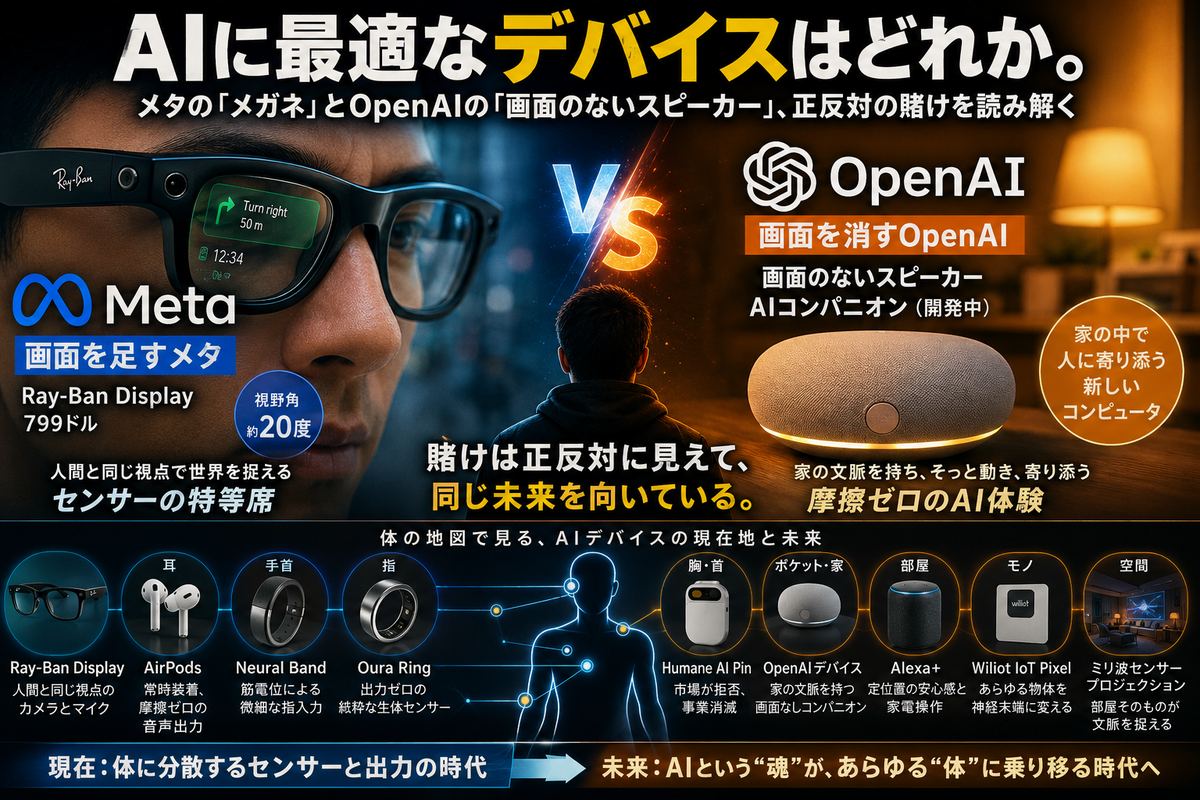
2026年7月14日、Bloombergが報じました。OpenAIが開発中の初のハードウェアは、画面のない、持ち運べるスピーカー。自律的に動く機構を持ち、家の中で人に寄り添うAIコンパニオンだと。その4日前の7月10日、アップルはOpenAIを企業秘密の窃取で提訴しています。標的は、まさにこのデバイス開発でした。一方のメタは2025年9月から、逆に「画面を足した」スマートグラスRay-Ban Displayを799ドルで販売中です。
On July 14, 2026, Bloomberg reported that OpenAI's first hardware product will be a movable, screenless speaker: an AI companion with self-moving mechanical parts that lives alongside you at home. Four days earlier, on July 10, Apple sued OpenAI for trade secret theft, and the target was precisely this device program. Meta, meanwhile, has been betting the other way since September 2025, selling Ray-Ban Display smart glasses that add a screen, for $799.
OpenAI's First Device Will Be Movable, Screenless Speaker Built as AI Companion(Bloomberg)
Apple sues OpenAI alleging trade secret theft, says scheme was 'at every level'(CNBC)
スマートフォンの次に来る「AIの本命デバイス」を巡って、巨人たちは正反対の方向へ賭け始めました。片や画面を足すメタ、片や画面を消すOpenAI。どちらが正しいのでしょうか。この記事では、多くの人が最初に思い浮かべる2つの直感(「メガネは画面が小さすぎる」「映画のホログラムが本命だ」)を順に検証し、体の地図でデバイスの現在地を整理したうえで、最後にOmochi編集部の見立てを述べます。答えは「画面の大きさ」でも「ホログラム」でもありません。
The giants have started placing opposite bets on what succeeds the smartphone as the definitive AI device: Meta is adding a screen, OpenAI is deleting it. Who is right? This article tests the two intuitions most people reach for first ("glasses screens are too small" and "movie-style holograms are the real endgame"), maps where every AI device stands on the human body, and closes with the Omochi editorial team's own thesis. The answer is neither screen size nor holograms.
直感その1。「メガネは画面が小さすぎる」は本当か
Intuition No. 1: "Glasses Screens Are Too Small." Is That True?
本当です。まず事実を見ます。
It is true. Start with the facts.
メタのRay-Ban Displayは、右レンズの右下に600×600ピクセルの映像を映します。視野角は約20度。これは腕を伸ばした先に文庫本をかざした程度の大きさで、視界全体を覆う「AR」ではなく、チラ見するための小窓です。輝度は最大5,000ニトと屋外でも読める水準ですが、映画で見るような「世界に重なる映像」とは別物です。
Meta's Ray-Ban Display projects a 600-by-600-pixel image into the lower right of the right lens. The field of view is roughly 20 degrees, about the size of a paperback held at arm's length. It is not AR that overlays your whole world; it is a small window you glance at. Brightness peaks at 5,000 nits, readable outdoors, but it is nothing like the world-covering imagery of the movies.
※ 視野角(FOV)とは、映像が人間の視界のうちどれだけの範囲を覆うかを示す角度のこと。人間の視野は両眼で約200度あり、Ray-Ban Displayの表示は約20度、つまり視界のごく一部にすぎない。
※ Field of view (FOV) is the angle describing how much of your vision an image covers. Human binocular vision spans roughly 200 degrees; the Ray-Ban Display covers about 20, a small fraction of it.
Meta Ray-Ban Display: Breakthrough AI Glasses Available Now(Meta)

では技術的にもっと広くできないのか。できます。ただし値段が壊れます。メタが2024年に公開した試作機Orionは視野角約70度、重さ98グラムと「普通のメガネ姿のAR」をほぼ実現しましたが、製造原価は1台約1万ドル。原価の大半はレンズに使う炭化ケイ素の導波路で、メタ自身が「製品としては売らない。開発機として使う」と認めています。
Can the view be made wider? Technically, yes, but the price collapses the case. Orion, the prototype Meta unveiled in 2024, achieves roughly a 70-degree field of view at 98 grams, close to "real AR in a normal pair of glasses." It also costs about $10,000 per unit to build, most of it in the silicon carbide waveguide lenses, and Meta itself concedes it will not be sold, serving instead as an internal development kit.
※ 導波路(ウェーブガイド)とは、メガネのフレーム脇から入れた映像の光を、レンズの内部で反射させながら瞳の前まで運ぶ光学部品のこと。透明なレンズのまま映像を重ねられる反面、視野を広げるほど製造が難しく高価になる。
※ A waveguide is the optical component that carries image light injected at the edge of the frame through internal reflections inside the lens to a point in front of the pupil. It keeps the lens transparent while overlaying imagery, but widening the field of view makes it sharply harder and costlier to manufacture.
Meta's 'Orion' Prototype AR Glasses Have 70 Degree FOV And A Wireless Compute Puck(UploadVR)
つまり「メガネの画面はガラスの面積と物理と価格に縛られる」という直感は、2026年時点で正しい。広い視野のARメガネは、まだ物理と経済の壁の向こう側にあります。
So the intuition holds in 2026: a glasses display is bound by glass area, physics, and price. Wide-field AR glasses remain on the far side of a physical and economic wall.
直感その2。「なら映画のホログラムが本命では」も検証する
Intuition No. 2: "Then Movie Holograms Must Be the Endgame"
こちらは、もっと厳しい答えになります。エンジニアリングの問題ではなく、物理の問題だからです。
Here the answer is harsher, because this is not an engineering problem. It is a physics problem.
映像が見えるためには、光が目に届く必要があります。そして光は、何かに当たって散乱しない限り、途中から目に飛び込んでは来ません。空気は光をほぼ散乱しないため、「何もない空中」に映像を描くことは原理的にできないのです。世の中で「ホログラム」と呼ばれているものの正体は、ほぼすべてが別の技術です。2012年のコーチェラ音楽祭に「登場」した故2Pacも、初音ミクのライブも、多くは薄い透明幕や板への投影、いわゆるペッパーズゴーストの応用です。霧をスクリーンにする方式、高速回転するLEDの残像を使う方式、レーザーで空気をプラズマ化して光点を作る研究もありますが、いずれも設備が大掛かりで、家庭のテーブルに置ける製品への道筋は見えていません。
For an image to be seen, light must reach your eyes, and light does not leap into them midair unless it scatters off something. Air barely scatters light, so drawing an image in empty space is impossible in principle. Nearly everything the world calls a "hologram" is another technology in disguise. The late 2Pac who "appeared" at Coachella in 2012, and Hatsune Miku's live concerts, are mostly projections onto thin transparent film or panels, applications of the Pepper's ghost illusion. There are fog screens, spinning-LED persistence displays, and lab research that turns air into plasma dots with lasers, but all require heavy equipment, with no visible path to a product that sits on a household table.
※ ペッパーズゴーストとは、19世紀から舞台で使われる錯視技法のこと。斜めに設置した透明な板や幕に映像を反射させ、あたかも空中に人物が立っているように見せる。現代の「ホログラム風」演出の多くはこの応用である。
※ Pepper's ghost is a stage illusion in use since the 19th century: an image reflected off an angled transparent sheet appears to stand in midair. Most modern "hologram-style" performances are applications of it.

では映画のようなホログラム体験は永遠に来ないのか。来ます。ただし空中ではなく、メガネの中に。ARグラスは目の前のレンズに映像を描くため、装着者にとっては「部屋の中に立体映像が浮かんでいる」ように見えます。物理的には、ホログラムの現実的な実装先はメガネしかない。つまり「ホログラムか、メガネか」という二択は成立せず、ホログラムの未来はメガネの延長線上にあります。皮肉なことに、「メガネは画面が小さいから駄目だ」と考えて期待したその先の未来も、結局はメガネなのです。
Does that mean the movie hologram never arrives? It arrives, just not in midair. It arrives inside the glasses. Because AR glasses draw the image on the lens in front of your eye, the wearer sees three-dimensional imagery floating in the room. Physically, glasses are the only realistic home for the hologram. The choice between "holograms or glasses" is a false one; the hologram future is an extension of the glasses. The irony is that the future people hoped for after dismissing glasses for their small screens turns out to be glasses as well.
ただし、ここで立ち止まるべき点があります。私たちは今、「どうすれば大きな映像を出せるか」を延々と議論してきました。この問い自体が、間違っているとしたらどうでしょう。
But pause here. We have spent this entire discussion asking how to make the image bigger. What if that question itself is wrong?
問いを変える。画面は「GUIの遺産」である
Change the Question: the Screen Is a Legacy of the GUI
コンピュータの歴史は、人間が機械に歩み寄る量を減らしてきた歴史です。パンチカードの時代、人間は機械の言葉を紙に穿孔して渡していました。キーボードとコマンドラインで文字になり、マウスとGUIで「選ぶ」だけになり、スマートフォンのタッチで「触る」だけになった。そして音声AIでは、人間のままの言葉で話すだけになりました。段階が進むたびに、インターフェースは薄く、小さくなっています。
The history of computing is the history of humans meeting machines less than halfway. In the punch-card era, people handed machines their language, hole by hole, on paper. Keyboards and command lines reduced that to typed text; the mouse and the GUI reduced it to choosing; the smartphone reduced it to touching. With voice AI, it is reduced to speaking in your own words. At every step, the interface gets thinner and smaller.
ここで気づきます。画面という装置は、GUIを操作するために必要だったのです。アイコンを見て、メニューを探し、ウィンドウを切り替える。人間が自分の目で「機械の中」をナビゲートするから、大きな表示面が要る。しかしAIが目的を言葉のまま理解して実行するなら、ナビゲートする場所そのものが消えます。AIデバイスに本質的に必要なのは、大きな出力ではなく、次の2つです。
And here is the realization: the screen exists to operate a GUI. You look at icons, hunt through menus, switch between windows. A large display is necessary because a human is navigating the inside of the machine by eye. If an AI understands your goal in plain words and executes it, the place you navigate disappears. What an AI device fundamentally needs is not large output. It needs two things.
- 入力。人間の知覚と同じ位置で世界を捉えるセンサー。あなたが見ているものを見るカメラ、聞いているものを聞くマイク。
- 出力。摩擦のない伝達。耳への音声と、視線を奪わないチラ見の小窓があれば足りる。
- Input: sensors positioned where human perception is. A camera that sees what you see, a microphone that hears what you hear.
- Output: frictionless delivery. Audio to the ear and a glanceable window that does not steal your gaze are enough.
この仮説は、市場がすでに検証しています。画面のないRay-Ban Metaスマートグラスは2025年の1年間で700万本超が売れ、前年の3倍以上に伸びました。製造元のEssilorLuxotticaは2026年末までに年産1,000万本体制を目指しています。一方、画面もカメラも持ちながら死んでいった機器の墓場もあります。胸に付けるAIピンHumaneは累計2.3億ドル超を調達しながら、2025年2月に資産をわずか1.16億ドルでHPに売却し、出荷済みの端末は文鎮化しました。手のひらサイズのRabbit R1は発売直後に10万台を売ったものの、利用者の定着に苦しんだと報じられています。
The market has already tested this hypothesis. Screenless Ray-Ban Meta smart glasses sold more than 7 million units in 2025, more than tripling year over year, and manufacturer EssilorLuxottica is targeting annual capacity of 10 million by the end of 2026. There is also a graveyard of devices that had screens and cameras and died anyway. Humane, maker of the chest-worn AI Pin, raised over $230 million and sold its assets to HP for just $116 million in February 2025, bricking the units it had shipped. The palm-sized Rabbit R1 sold 100,000 units at launch, then reportedly struggled to keep its users.
Ray-Ban maker EssilorLuxottica says it more than tripled Meta AI glasses sales in 2025(CNBC)
Humane's AI Pin is dead, as HP buys startup's assets for $116M(TechCrunch)
With the Humane AI Pin now dead, what does the Rabbit R1 need to do to survive?(TechRadar)
生き残った機器と死んだ機器を分けたのは、画面の有無でも、AIの賢さでもありません。センサーの位置と、摩擦の量です。メガネは人間の目と耳と同じ場所にセンサーを置き、しかも「メガネをかける」という既存の習慣に乗るため、新しい摩擦がほぼゼロでした。ピンは胸元から世界を斜めに見上げ、使うたびに手をかざす摩擦を要求し、しかもスマホでできること以上のことができなかった。デバイスの勝敗は、装着する体の位置でほぼ決まっていたのです。
What separated the survivors from the dead was neither the presence of a screen nor the intelligence of the AI. It was sensor position and friction. Glasses put sensors exactly where human eyes and ears are, and they ride an existing habit, wearing glasses, so they add almost zero new friction. The pin peered up at the world diagonally from a chest, demanded a raised hand for every interaction, and could do nothing a smartphone could not. Victory and defeat were largely decided by where on the body the device sat.
体の地図で見る、AIデバイスの現在地
A Body Map of Where AI Devices Stand
そう考えると、「AIに最適なデバイスはどれか」という問いは、「体のどこにセンサーと出力を置くか」という問いに置き換わります。2026年時点の勢力図を、体の上から順に見ていきます。
Seen this way, "which device is right for AI" becomes "where on the body do the sensors and outputs go." Here is the map as of 2026, from the top of the body down.
顔。センサーの特等席です。目と耳と口と同じ高さで世界を捉えられる唯一の位置で、Ray-Banの成功はこの立地の勝利でした。画面はおまけです。実際、700万本の大半は画面のないモデルでした。
The face: the best seat in the house for sensors. It is the only position that captures the world at the same height as your eyes, ears, and mouth, and Ray-Ban's success was a victory of this location. The screen is a bonus. Most of those 7 million units had no display at all.
耳。隠れた現職王者です。イヤホンは何億人もがすでに常時装着しており、社会的な違和感もゼロ。アップルはAirPodsにLive Translation(リアルタイム通訳)を載せ、耳を静かにAIの出力端末に変えつつあります。弱点はカメラがないこと、つまり「あなたが見ているもの」を知らないことです。
The ear: the hidden incumbent champion. Hundreds of millions of people already wear earbuds constantly, with zero social awkwardness. Apple has put Live Translation on AirPods, quietly turning the ear into an AI output terminal. The weakness is the missing camera: the ear does not know what you are looking at.
New Apple Intelligence features are available today(Apple)
手首。出力ではなく、入力の器官です。Ray-Ban Displayに同梱されるNeural Bandは、手首の筋電位を読み取り、膝の上に置いた手の指のわずかな動きをカーソルやクリックに変えます。スマートウォッチも含め、手首は単体で完結するAIデバイスというより、体のネットワークの入力装置になっていくでしょう。
The wrist: an organ of input, not output. The Neural Band bundled with Ray-Ban Display reads electrical signals at the wrist and turns the slightest finger movements of a hand resting on your lap into cursor moves and clicks. Smartwatches included, the wrist is becoming the input device of the body network rather than a self-contained AI device.
※ 筋電位(EMG)とは、筋肉を動かそうとするときに皮膚の表面へ漏れ出る微弱な電気信号のこと。Neural Bandはこれを手首で検出し、指を大きく動かさなくても入力として認識できる。
※ Electromyography (EMG) refers to the faint electrical signals that leak to the skin's surface when you intend to move a muscle. The Neural Band detects them at the wrist, registering input without large finger movements.
指。画面を完全に捨てて成功した先例が、実はもうここにあります。スマートリングです。Ouraのリングには画面もスピーカーもなく、睡眠や心拍を測るセンサーだけが入っています。出力ゼロの純粋なセンサーの結節点が数百ドルで売れ、月額課金まで成立し、有料会員は500万人規模に迫る。2026年5月には最新のOura Ring 5も発売されました。「画面がなければ製品にならない」という常識は、指先ですでに崩れています。
The finger: a precedent for succeeding with no screen at all already exists here. The smart ring. Oura's ring has no display and no speaker, only sensors for sleep and heart rate. A pure sensor node with zero output sells for hundreds of dollars, sustains a monthly subscription, and is approaching five million paying members; the latest Oura Ring 5 launched in May 2026. The assumption that a product needs a screen has already collapsed at the fingertip.
Oura Ring 5 Launches as Samsung Galaxy Ring Falls Silent: What It Means for the Smart Ring Market(Memeburn)
胸・首。墓場です。HumaneのピンもRabbitも、常時録音ペンダントのFriendも、この位置に新しい価値を証明できませんでした。人間の知覚と視点を共有できず、既存の習慣にも乗れない位置だったからです。
The chest and neck: a graveyard. Humane's pin, Rabbit, and the always-recording Friend pendant all failed to prove new value in this position. It shares neither the human point of view nor any existing habit to ride on.
ポケット、そして家。ここがOpenAIの賭けです。報道によれば、同社の最初のデバイスはスマホの再発明ではなく「AI時代の新しいホームコンピュータ」。画面を持たず、バッテリーで部屋から部屋へ持ち運べ、自ら動く機構で「生きている」ような存在感を出し、家電操作や音楽再生や質問応答をこなすコンパニオンです。ChatGPTの週次利用者8億人という配信網を持つ企業が、画面ゼロに賭けた。これは「AIに画面は要らない」という本記事の仮説への、最大級の賛成票です。2026年中の発表、2027年の発売が視野とされますが、アップルとの訴訟がスケジュールの変数になります。
The pocket, and the home: this is OpenAI's bet. By the reports, the company's first device is not a smartphone reinvented but "a new home computer for the AI era." It has no screen, runs on a battery you carry from room to room, uses self-moving parts to feel alive, and works as a companion that controls appliances, plays media, and answers questions. A company with a distribution network of 800 million weekly ChatGPT users has bet on zero screens. That is the largest single vote of confidence in this article's hypothesis that AI does not need a display. A reveal in 2026 and a launch in 2027 are in view, with the Apple lawsuit as the schedule's wild card.
Exclusive: OpenAI aims to debut first device in 2026, exec tells Axios(Axios)
部屋。据え置きスピーカーは、LLMを頭脳に積み替えて再起動中です。アマゾンは2025年2月、生成AIで作り直したAlexa+を発表しました。定位置ならではの安心感と家全体の文脈が強みですが、家から持ち出せない以上、「あなたの一日」ではなく「あなたの家」しか知りません。
The room: the stationary speaker is rebooting with an LLM for a brain. In February 2025, Amazon announced Alexa+, rebuilt on generative AI. Its strengths are the reassurance of a fixed place and the context of the whole household, but since it cannot leave the house, it knows your home, not your day.
Introducing Alexa+, the next generation of Alexa(Amazon)
そしてスマートフォン。忘れてはいけない現職のハブです。カメラ、マイク、画面、通信、決済、アプリ資産のすべてを持ち、AI機能はまずここに配信されます。当面のAI体験の主戦場がスマホであることは変わりません。変わるのは役割です。体に分散したセンサーと出力(メガネ、イヤホン、手首、指)をポケットの中から束ねる、司令塔になっていきます。
And the smartphone: the incumbent hub, not to be forgotten. It has the camera, microphone, screen, connectivity, payments, and the entire app estate, and AI features ship here first. The main stage of the AI experience stays on the phone for now. What changes is the role: it becomes the command center in your pocket, coordinating the sensors and outputs scattered across the body, the glasses, the earbuds, the wrist, the finger.
地図の外側。センサーは、もっと意外な場所へ散らばる
Off the Map: Sensors Are Spreading to Stranger Places
ここまでは、すでに製品がある場所の話でした。しかしこの地図は、まだ描きかけです。センサーが安く、小さく、電池すら不要になるにつれて、「デバイス」は誰も予想しなかった場所へ染み出し始めています。
Everything so far concerned places where products already exist. But this map is unfinished. As sensors get cheaper, smaller, and even battery-free, "the device" is seeping into places nobody predicted.
まず、モノに貼るという発想。スマートホームの世界では、数百円のNFCタグを貼るだけで、ただの照明やドアが「スマート」の仲間入りをしました。同じことが、あらゆる物体に起きようとしています。イスラエル発のWiliotが量産する切手大のステッカー型センサー「IoT Pixel」は、厚さ0.2ミリで電池を持ちません。周囲を飛び交うWi-FiやBluetoothの電波から電力を収穫して動き、温度や動きや位置を発信し続けます。すでにスーパーの流通網などで実用化済みです。重要なのは、ステッカー自身は賢くないことです。賢さはクラウドのAIの側にあり、ステッカーは神経の末端にすぎない。冷蔵庫に必要なのは頭脳ではなく、神経なのです。
First, the idea of sticking sensors onto things. In the smart home, a few hundred yen of NFC tags turned ordinary lights and doors into "smart" citizens. The same is about to happen to every object. The IoT Pixel, a stamp-sized sticker sensor mass-produced by Israel's Wiliot, is 0.2 millimeters thick and carries no battery. It harvests power from the Wi-Fi and Bluetooth radio waves flying around it and continuously reports temperature, movement, and location. It is already in practical use in grocery supply chains. The point is that the sticker itself is not smart. The intelligence lives in the cloud AI; the sticker is merely a nerve ending. What a refrigerator needs is not a brain but a nervous system.
※ エナジーハーベスティングとは、周囲の環境に存在する微弱なエネルギー(電波、光、振動、熱など)を集めて電力に変える技術のこと。電池交換が不要になるため、大量に貼って放置するタイプのセンサーと相性が良い。
※ Energy harvesting is the technique of converting faint ambient energy (radio waves, light, vibration, heat) into electric power. Because it eliminates battery changes, it pairs well with sensors deployed in bulk and left alone.
Wiliot IoT Pixels(Wiliot)
次に、体のもっと意外な場所。靴底はその筆頭です。足裏は一日中「地面」という文脈に触れ続ける唯一の部位で、歩き方は指紋のように個人を識別でき、歩数や姿勢の変化は健康の早期警報になります。振動で道案内をするインソールや、歩行のエネルギーで発電する仕組みの研究も続いています。皮膚に貼る電子タトゥー型センサー、耳の中で脳波を読む研究段階のイヤホンなど、「体の表面はすべてインターフェース候補」というのが研究の最前線です。そしてこの矢印の突き当たりには、脳そのものがあります。NeuralinkのBCIはすでに20人超の患者に埋め込まれ、思考だけでカーソルが動いています。インターフェースの歴史が「人間の歩み寄りを減らす」方向に進んできたのなら、その終点は摩擦ゼロ、つまり「考えるだけ」なのです。
Next, stranger places on the body, starting with the sole of the shoe. The foot is the only body part in contact with the context of "the ground" all day: gait can identify a person like a fingerprint, and changes in step count and posture serve as early health warnings. Research continues into insoles that navigate by vibration and mechanisms that generate power from walking. Add electronic-tattoo skin sensors and research-stage earbuds that read brainwaves inside the ear canal, and the research frontier's position is clear: every surface of the body is an interface candidate. And at the end of this arrow sits the brain itself. Neuralink's BCI has been implanted in more than 20 patients, who move cursors by thought alone. If the history of interfaces has moved toward less human accommodation, its terminus is zero friction: just thinking.
※ BCI(ブレイン・コンピュータ・インターフェース)とは、脳の信号を直接読み取って機械の操作に変換する技術のこと。現在は四肢麻痺の患者の意思伝達支援など、医療目的の臨床試験が中心である。
※ A BCI (brain-computer interface) is technology that reads brain signals directly and converts them into machine control. Today it centers on medical clinical trials, such as communication support for patients with quadriplegia.
Neuralink Reaches 21 Patients as Elon Musk Continues Push for High-Volume Brain Chip Production(The Debrief)
最後に、空間そのもの。1991年、Xerox PARCのマーク・ワイザーは「最も深遠な技術は、消えて見えなくなる技術だ」と書きました。コンピュータが部屋に溶け、意識すらされなくなる未来です。この予言は少しずつ現実になっています。天井の照明には人の在・不在を捉えるミリ波センサーが入り始め、部屋自体が住人を感知するようになりました。では映像は。ここで直感その2の物理が効いてきます。空中に映像は描けませんが、壁や床は光を散乱します。つまりプロジェクションこそ、「空間に映像を出す」ための物理的に正直な方法です。ただし、プロジェクタを積んで部屋を走り回る「動く体」は簡単ではありません。サムスンが2020年に発表した球型ロボットBallieは、6年後の2026年のCESにも姿を見せず、事実上の棚上げとなりました。空間というデバイスは来ます。ただし単一の製品としてではなく、照明や家電やテレビに分散して染み込む形で来るでしょう。
Finally, space itself. In 1991, Xerox PARC's Mark Weiser wrote that "the most profound technologies are those that disappear": a future where the computer dissolves into the room and escapes notice altogether. The prophecy is slowly coming true. Ceiling lights are beginning to carry millimeter-wave sensors that detect human presence, so the room itself senses its inhabitants. What about images? Here the physics of Intuition No. 2 pays off. You cannot draw pictures in midair, but walls and floors scatter light, which makes projection the physically honest way to put images into space. A moving body that carries the projector around, however, is not easy. Ballie, the ball-shaped robot Samsung announced in 2020, was absent again at CES 2026 six years later, effectively shelved. The space-as-device future is coming, but not as a single product: it will soak in, distributed across lights, appliances, and televisions.
The Computer for the 21st Century(Scientific American)
Where is Ballie? Samsung's robot ghosts us at CES 2026(SamMobile)
| 位置 | 代表例 | AIにとっての価値 | 現在地 |
|---|---|---|---|
| 顔 | Ray-Ban Display | 人間と同じ視点のカメラとマイク | 2025年に700万本超、伸長中 |
| 耳 | AirPods | 常時装着、摩擦ゼロの音声出力 | 通訳機能などAI端末化が進行 |
| 手首 | Neural Band | 筋電位による微細な指入力 | 入力装置として確立し始め |
| 指 | Oura Ring | 出力ゼロの純粋な生体センサー | 有料会員500万人規模へ |
| 胸・首 | Humane AI Pin | 理論上は常時センサー | 市場が拒否、事業消滅 |
| ポケット・家 | OpenAIデバイス | 家の文脈を持つ画面なしコンパニオン | 2027年発売見込み、訴訟リスク |
| 部屋 | Alexa+ | 定位置の安心感と家電操作 | LLM化して再起動 |
| モノ | Wiliot IoT Pixel | あらゆる物体を神経末端に変える | 流通現場で実用化済み |
| 空間 | ミリ波センサー、プロジェクション | 部屋そのものが文脈を捉える | 照明や家電に分散して浸透中 |
| ポケット | スマートフォン | すべてを束ねるハブ | 当面の主戦場のまま司令塔化 |
| Position | Example | Value to the AI | Status |
|---|---|---|---|
| Face | Ray-Ban Display | Camera and mic at the human point of view | 7M+ units in 2025, growing |
| Ear | AirPods | Always worn, zero-friction audio output | Becoming an AI terminal via translation |
| Wrist | Neural Band | Fine finger input via EMG | Establishing itself as the input device |
| Finger | Oura Ring | Pure biometric sensor with zero output | Approaching 5M paid members |
| Chest, neck | Humane AI Pin | In theory, an always-on sensor | Rejected by the market, defunct |
| Pocket, home | OpenAI device | Screenless companion with home context | 2027 launch in view, lawsuit risk |
| Room | Alexa+ | Fixed-place reassurance, appliance control | Rebooted on an LLM |
| Objects | Wiliot IoT Pixel | Turns any object into a nerve ending | In practical use in logistics |
| Space | mmWave sensors, projection | The room itself captures context | Soaking into lights and appliances |
| Smartphone | The hub that binds it all | Main stage for now, becoming HQ |
教科書的な答え。「正しいデバイス」は一つではない
The Textbook Answer: There Is No Single Right Device
冒頭の問いに戻ります。報道と数字から言える範囲の、いわば教科書的な答えはこうです。
Back to the opening question. The textbook answer, staying within what reporting and numbers support, goes like this.
短期では、スマホがハブであり続け、その周囲にメガネ、イヤホン、手首、指という小さなセンサーと出力が分散していく。一つの巨大デバイスがすべてを置き換えるのではなく、体の複数の位置へ薄く広がる。長期では、センサーの特等席である顔、つまりメガネに主導権が収斂していく可能性が高い。ただしその価値の源泉は「大きな画面」ではなく「人間と同じ知覚」です。視野角20度の小窓は弱点に見えますが、画面が主役でないと分かれば、あれで十分だという設計判断の合理性が見えてきます。そして映画で見たホログラムは、空中ではなくそのメガネの中で、部屋にいる全員のものではなく装着者ひとりのものとして実現していく。ここまでが、教科書の範囲です。
Near term, the smartphone remains the hub, with small sensors and outputs, glasses, earbuds, wrist, finger, distributed around it. No single giant device replaces everything; computing spreads thinly across multiple positions on the body. Long term, the initiative most likely converges on the face, the best sensor seat, meaning glasses. But the source of their value is not a big screen; it is perception matched to the human's. The 20-degree window looks like a weakness until you accept that the screen is not the protagonist, at which point the design decision reads as rational sufficiency. And the hologram of the movies gets realized inside those glasses, not in midair, belonging to the wearer alone rather than to everyone in the room. That is as far as the textbook goes.
ここから先は、Omochi編集部の見立て
From Here On: the Omochi Editorial Team's Own Call
ここから先は、確定した事実ではなく、私たちOmochi編集部の見立てとして読んでください。
Read what follows not as settled fact but as the considered call of the Omochi editorial team.
私たちの結論はこうです。「AIに最適なデバイスはどれか」という問いは、数年以内に、問いとして成立しなくなる。センサーがステッカーになり、指輪になり、靴底になり、天井に溶けていくなら、「デバイス」はもはや一つの名詞ではありません。変わらないのはAIの側です。あなたの好みと文脈と記憶を持った同じAIが、通勤中はイヤホンに、街ではメガネに、リビングではテレビに、台所では冷蔵庫のステッカーに乗り移る。日本のSF「攻殻機動隊」の言葉を借りるなら、義体を乗り換えるゴーストです。ハードウェアは乗り換え可能な「体」になり、連続するのはAIという「魂」だけになる。
Our conclusion is this: within a few years, "which device is right for AI" stops working as a question. When sensors become stickers, rings, shoe soles, and ceilings, "the device" is no longer a single noun. What stays constant is the AI. The same AI, carrying your preferences, your context, and your memory, rides your earbuds on the commute, your glasses on the street, the TV in the living room, and the sticker on the refrigerator in the kitchen. To borrow from the Japanese science fiction classic Ghost in the Shell: a ghost that changes prosthetic bodies. Hardware becomes interchangeable bodies; the only continuity is the AI, the soul.
そう考えると、メタとOpenAIの賭けの見え方も変わってきます。両社は「体」の形を巡って争っているように見えて、本当の争点は、体から体へ乗り移る「魂」を誰が握るかです。あなたの記憶と文脈を丸ごと持ったAIがひとつあれば、ユーザーはもう他社に移れません。アップルがスピーカー一台のためにOpenAIを提訴した本当の理由も、意匠や部品の話ではなく、この「魂の座」を巡る戦争の前哨戦だと私たちは見ています。
Seen that way, the Meta-versus-OpenAI bet changes shape. The two appear to be fighting over the form of the body, but the real contest is over who holds the soul that hops from body to body. Once a single AI holds your memory and context whole, you cannot switch to a rival. In our view, the real reason Apple sued OpenAI over a single speaker is not industrial design or components: it is the opening skirmish in the war for the seat of the soul.
この見立ての答え合わせは、早ければOpenAIデバイスが世に出る2027年に始まります。外れていたら、笑ってください。当たっていたら、この記事を思い出してください。
The grading of this call begins as early as 2027, when the OpenAI device reaches the world. If we are wrong, have a laugh. If we are right, remember where you read it.
ちなみに、レストランのテーブルに貼られた小さなタグにスマホをかざすとお店と繋がるOmochiの仕組みも、「モノに貼る」未来のささやかな実践です。こうした「次に何が来るか」の話は、食事の席で最も盛り上がる類のもの。その場所探しは、Omochiのアプリにお任せください。
Incidentally, Omochi's own mechanism, a small tag on a restaurant table that connects you to the venue when you tap your phone, is a modest practice of that stick-it-on-things future. Conversations about what comes next are the kind that light up a dinner table, and finding the right table is what the Omochi app is for.