30ドルの人形の頭とテスラの自動運転の不思議な関係
A $30 Doll Head and the Curious Truth About Tesla's Self-Driving
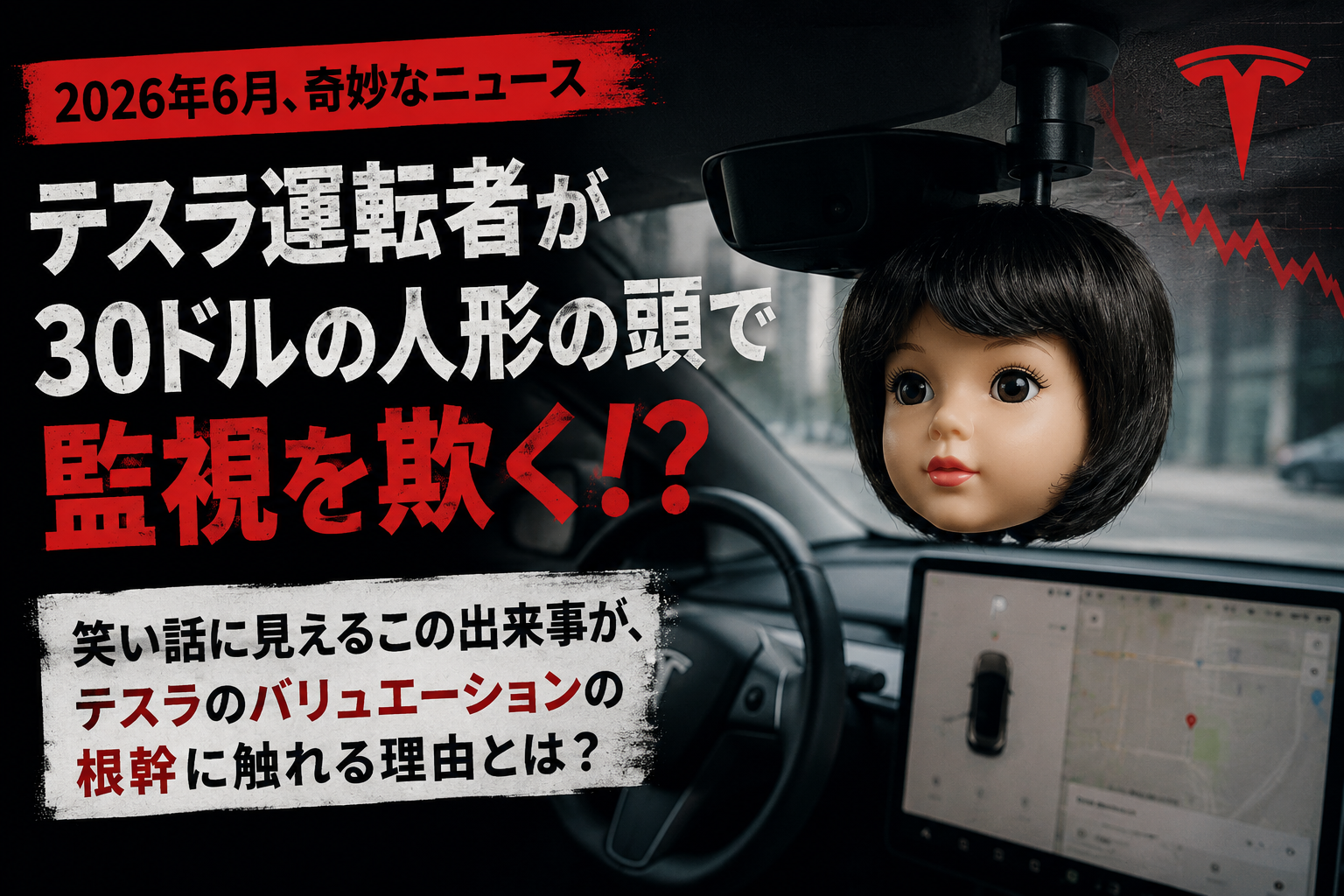
2026年6月、奇妙なニュースが流れました。中国のテスラ運転者が、30ドル程度のプラスチック製の人形の頭をミラー付近に取り付け、車内カメラの監視を欺いている、という報道です。笑い話に見えますが、これは案外テスラのバリュエーションの根幹に触れる話かもしれません。
In June 2026, a strange piece of news made the rounds: drivers in China were reportedly mounting roughly $30 plastic doll heads near the rearview mirror to fool Tesla's cabin camera monitoring. It looks like a joke—but it may quietly touch the very core of Tesla's valuation.
なぜ、こんなことをするのか。背景には、中国特有の事情があります。中国当局は2025年、テスラに対し、運転者の脇見運転をより厳しく監視するソフトウェア更新を事実上求めました。その結果、車内カメラによる監視が一段と厳しくなり、「手放しで走らせたい」と考える一部の所有者がこれに反発。当初はカメラをカバーで塞ぐ手が試みられ、やがて「人が前を見ている」と誤認させる人形の頭へと進化した、という流れです。
Why would anyone do this? The backdrop is specific to China. In 2025, Chinese regulators effectively required Tesla to push a software update that tightened monitoring of distracted driving. Cabin-camera surveillance grew stricter as a result, and some owners who wanted to drive hands-off pushed back. They first tried simply covering the camera, then escalated to doll heads that trick it into thinking "a person is watching the road."
さらにテスラは、この監視前提となるFSD(完全自動運転・監視版)を中国でようやく開始したばかりで、すでに10名の所有者から「完全自動運転」表記をめぐる訴訟も起きています。つまり、厳しい監視義務と「自動で走ってほしい」という所有者の願望の摩擦が、30ドルのオモチャ市場を生んだわけです。
On top of that, Tesla has only just launched FSD (Supervised)—the very feature that assumes this monitoring—in China, and already faces a lawsuit from 10 owners over the "Full Self-Driving" labeling. In short, the friction between a strict monitoring mandate and owners' desire to "let the car drive itself" created a $30 gadget market.
※ FSD(監視版)とは、Full Self-Driving (Supervised) の略で、テスラの先進運転支援機能のこと。名称に「完全自動運転」とあるが、法的にはレベル2の運転支援で、運転者が常に監視し責任を負う。中国では規制対応として2025年に車内カメラ監視が強化され、FSD監視版の本格提供も2026年に始まったばかりで、規制と表記をめぐる係争が続いている。
※ FSD (Supervised) is short for Full Self-Driving (Supervised), Tesla's advanced driver-assistance feature. Despite the "Full Self-Driving" name, it is legally a Level 2 driver-assistance system in which the driver must supervise at all times and bears responsibility. In China, cabin-camera monitoring was strengthened in 2025 for regulatory compliance, the supervised version only began full rollout in 2026, and disputes over regulation and labeling are ongoing.
※ レベル2とは、自動運転の国際基準(SAE)の段階区分の一つで、「部分的な運転支援」を指す。車がハンドル操作と加減速を同時に行えるが、運転の主体はあくまで人間で、常に前方を監視し、いつでも介入できる状態が前提。手放し・脇見は認められない。テスラのFSDも現状はこのレベル2であり、だからこそ車内カメラによる脇見監視が義務になる。人形の頭は、この「人間が監視する」という大前提を欺く行為にあたる。
※ Level 2 is a tier in the international SAE classification of automated driving, meaning "partial driving automation." The car can steer and control acceleration and braking at the same time, but the human remains the driver—required to watch the road at all times and ready to intervene. Hands-off or eyes-off driving is not permitted. Tesla's FSD is currently this Level 2, which is exactly why cabin-camera distraction monitoring is mandatory. The doll head is an act of defeating that core premise that "a human is supervising."
オモチャの話から、規制当局の調査と株価の前提まで、順を追って整理します。
Let's walk it through in order—from the gadget, to the regulators' investigation, to the assumptions baked into the stock price.
事の発端 — 人形の頭
How It Started — The Doll Head
まず、報道されている内容から。とはいえ、これはあくまでネットの報道や所有者の証言ベースの話で、テスラが公式に認めたわけでも、第三者がきちんと裏を取ったわけでもありません。話半分くらいで読んでください。
Start with what's being reported. That said, this rests on internet reports and owner testimony—Tesla hasn't officially confirmed it, and no third party has properly verified it. Read it with a grain of salt.
テスラの新しい車内監視は、運転者の頭の位置と視線をカメラで追います。報道によれば、中国の一部の運転者は、人形やフィギュアの頭部をミラー付近に固定することで、このカメラに「人が前を見ている」と誤認させているとされます。あるモデル3の所有者は、30分間アラートなしで運転できたと主張しています。中国のECサイトで関連商品が売られているとも報じられています。
Tesla's new in-cabin monitoring uses the camera to track the driver's head position and gaze. According to reports, some drivers in China fix a doll or figurine head near the mirror to make the camera misread it as "a person looking forward." One Model 3 owner claimed they could drive for 30 minutes with no alerts. Related products are reportedly being sold on Chinese e-commerce sites.
※ 運転者モニタリング(DMS)とは、ドライバーが運転に集中しているかを車が確認する技術のこと。旧来はハンドルにかかる力(ハンズオン)で判定したが、新しいテスラは車内カメラで頭の向きや視線を追う。人形の頭は、このカメラ式の監視を欺くために使われている。
※ Driver Monitoring System (DMS) is the technology a car uses to confirm the driver is paying attention. Older systems judged by the force on the steering wheel (hands-on); newer Teslas track head direction and gaze with a cabin camera. The doll head is used to deceive this camera-based monitoring.
逸話そのものは小さな話です。問題は、これが「単発の珍事」ではなく、長年繰り返されてきたパターンの最新版だ、という点にあります。
The anecdote itself is small. The point is that it isn't a one-off oddity—it's the latest installment in a pattern that has repeated for years.
なぜ「安全装置を騙す」話が繰り返されるのか
Why the "Fooling the Safety System" Story Keeps Repeating
物理的なオモチャで安全装置を欺く話は、今に始まったことではありません。
Defeating a safety system with a physical gadget is nothing new.
2018年には「Autopilot Buddy」という製品がありました。ハンドルに重りを付けてハンズオンの催促(ナグ)を欺くもので、米運輸当局NHTSAが販売停止命令を出しています。テスラ自身もこの措置を支持しました。その後も、ハンドルに付ける磁気の重りなど、ナグ回避デバイスは売られ続けています。カリフォルニア州は2025年に、こうしたレベル2システムの「無効化装置」の使用を禁止しました。
In 2018 there was a product called "Autopilot Buddy"—a weight clipped to the steering wheel to defeat the hands-on nag. The U.S. transport regulator NHTSA issued a stop-sale order, and Tesla itself backed the move. Even after that, nag-defeating devices such as magnetic steering-wheel weights kept selling. In 2025, California banned the use of such "defeat devices" for Level 2 systems.
皮肉なのは、テスラがハンドルのナグからカメラ監視へ移行したことで、新しい弱点が生まれた点です。ハンドルの重りを潰したら、今度はカメラを人形で潰される。安全装置のいたちごっこが続いている構図です。
The irony is that by moving from the steering-wheel nag to camera monitoring, Tesla created a new weak point. Squash the wheel-weight trick, and the camera gets defeated with a doll instead. It's a cat-and-mouse game with the safety system.
この話を読んでいると、どこぞやの番組で日産GT-Rが新幹線と日本を縦断して競争していた回を思い出します。あの時、ジェレミーは日本のオービスを、ビル・オディの顔を印刷した段ボールのお面で欺きました。カメラに「正しい顔」さえ見せれば監視はすり抜けられる。人は昔から、こうした監視カメラを実に創造的に騙してきた、という話でもあります。
Reading all this, I'm reminded of a certain TV episode where a Nissan GT-R raced a bullet train the length of Japan. Back then, Jeremy fooled Japan's speed cameras with a cardboard mask printed with Bill Oddie's face. Show the camera the "right face" and the monitoring slips right through. Humans, it turns out, have long been wonderfully creative at deceiving these surveillance cameras.

知覚そのものを騙す
Fooling the Perception Itself
監視を欺く話とは別に、もっと根の深い系統があります。AIの「知覚」そのものを物理的に騙す、という話です。
Separate from defeating the driver monitoring, there is a deeper lineage: physically fooling the AI's "perception" itself.
最も有名なのは、2025年3月に公開されたMark Roberの実験です。道路に見えるよう描いた発泡スチロールの壁に対し、ライダー搭載車は停止し、テスラは約40マイル/時で突っ込みました。ただし、この実験は厳しく批判されました。テストされたのは最新のFSDではなくオートパイロットで、ライダー企業Luminarの関与もありました。クリーンな証拠としては扱えない、という注意書きが必要です。
The most famous is Mark Rober's March 2025 experiment. Faced with a foam wall painted to look like the road ahead, a lidar-equipped car stopped while the Tesla plowed through at about 40 mph. That said, the experiment drew heavy criticism: what was tested was Autopilot, not the latest FSD, and lidar firm Luminar was involved. A caveat is in order—it can't be treated as clean evidence.
学術・セキュリティ研究の側にも前例があります。2020年、McAfeeの研究者は速度標識に小さなテープを貼るだけで、カメラが「35」を「85」と誤読し、車が加速することを示しました。2019年には、Tencent Keen Security Labが路面に3枚のステッカーを貼るだけで、オートパイロットを対向車線へ誘導しています。
There are precedents from academic and security research, too. In 2020, McAfee researchers showed that a small strip of tape on a speed-limit sign could make the camera misread "35" as "85" and accelerate the car. In 2019, Tencent's Keen Security Lab steered Autopilot into the oncoming lane with just three stickers on the road surface.
※ 敵対的サンプル(adversarial example)とは、人間には何でもない画像やステッカーが、AIの認識を意図的に誤らせるよう細工された入力のこと。「35」を「85」と読ませる、壁を道路と誤認させる、といった攻撃が該当する。カメラに依存する知覚システムの構造的な弱点。
※ An adversarial example is an input—an image or sticker that looks like nothing to a human—deliberately crafted to make an AI misrecognize it. Making it read "35" as "85," or mistake a wall for the road, are such attacks. It is a structural weakness of perception systems that rely on cameras.
これらは個々には古い事例や留保付きの実験です。一つで「ロボタクシーは危険だ」と断じるのは無理があります。ですが、並べると「カメラのみの知覚は物理的なトリックに弱い」というパターンが浮かびます。
Individually, these are old cases or caveated experiments. No single one proves "robotaxis are dangerous." But lined up together, a pattern emerges: camera-only perception is vulnerable to physical tricks.
カメラのみという思想
The Camera-Only Philosophy
なぜカメラがこれほど狙われるのか。テスラの技術思想そのものに理由があります。
Why is the camera targeted so often? The reason lies in Tesla's engineering philosophy itself.
テスラは2021年からモデル3/Yでレーダーを撤去し、カメラとAIだけの「Tesla Vision」に移行しました。イーロン・マスク氏は2019年に、ライダーを「愚か者の使い」と切り捨てています。8つのカメラだけで世界を認識する、という思想です。
Starting in 2021, Tesla removed radar from the Model 3/Y and moved to "Tesla Vision," using cameras and AI alone. In 2019, Elon Musk dismissed lidar as "a fool's errand." The philosophy is to perceive the world with eight cameras and nothing else.
※ ビジョンオンリーとLiDARの違い。ビジョンオンリーは、カメラとAIだけで周囲を認識するテスラの方式。安価で情報量が豊富だが、2次元の錯覚(描かれた壁、逆光、霧)に弱い。LiDARはレーザーを照射し反射時間で3次元地図を作る方式で、Waymoなどが採用。錯覚には強いが高価。
※ Vision-only vs. LiDAR. Vision-only is Tesla's approach of perceiving surroundings with cameras and AI alone—cheap and information-rich, but weak to two-dimensional illusions (painted walls, backlight, fog). LiDAR fires lasers and builds a 3D map from reflection times, adopted by the likes of Waymo—robust to illusions, but expensive.
そして2025年6月、テスラはオースティンでロボタクシーの運行を開始しました。当初は助手席に安全監視員を乗せた形でしたが、2026年1月には一部で監視員なしの走行も発表されたと報じられています。ビジョンオンリーで無人運転へ、という方向です。
Then in June 2025, Tesla began robotaxi operations in Austin. At first a safety monitor rode in the passenger seat, but by January 2026 some driverless runs without a monitor were reportedly announced. The direction is clear: vision-only, toward unmanned driving.
規制の本丸 — EA26002
The Real Battleground — EA26002
ここまでは前振りです。投資判断として本当に重いのは、規制当局の調査です。
Everything so far has been setup. What truly matters for an investment view is the regulator's investigation.
NHTSAは2024年10月、FSDの「視界」に関する調査を開始しました。逆光、霧、砂塵などの低視界条件でカメラが機能しない問題です。これが2026年3月18日、エンジニアリング分析(EA26002)に格上げされ、対象は320万台超に拡大しました。指摘されているのは、カメラ式システムが一般的な路上条件を検知できず、性能低下を直前まで警告しない点です。9件の事故、1件の死亡が報告されています。
In October 2024, NHTSA opened an investigation into FSD's "visibility"—the problem of cameras failing in low-visibility conditions such as glare, fog, and dust. On March 18, 2026, it was upgraded to an Engineering Analysis (EA26002), expanding the scope to over 3.2 million vehicles. The concern: the camera-based system fails to detect common road conditions and doesn't warn of degraded performance until the last moment. Nine crashes and one death have been reported.
※ Engineering Analysis(EA)とは、NHTSAの調査の第二段階。予備評価(PE)の後に行われる、より深い分析。リコールを命じる前の最後の正式ステップにあたる。EA26002が320万台に拡大したことは、ルーティンの問い合わせよりはるかに重い意味を持つ。
※ An Engineering Analysis (EA) is the second stage of an NHTSA investigation—a deeper analysis following the Preliminary Evaluation (PE). It is the last formal step before ordering a recall. EA26002 expanding to 3.2 million vehicles carries far heavier weight than a routine inquiry.
別系統の調査もあります。2025年10月に開始されたFSDの交通違反調査(PE25012)は、赤信号無視や対向車線進入を対象に、約288万台を調べています。
There is a separate line of investigation as well. The FSD traffic-violation probe (PE25012), opened in October 2025, covers running red lights and entering oncoming lanes, examining roughly 2.88 million vehicles.
EAは通常12〜18ヶ月で結論に至り、リコール命令の直前段階です。人形の頭は、この本丸の弱点を象徴的に示す「見える化」にすぎません。
An EA typically reaches a conclusion in 12 to 18 months and sits one step before a recall order. The doll head is merely a "visualization" that symbolically exposes this core weakness.
バリュエーションの含意
What It Means for the Valuation
では、なぜこれが株の話になるのか。
So why does this become a story about the stock?
テスラの時価総額は2026年6月時点で約1.5兆ドル。問題は、この評価額の相当部分がロボタクシー/FSDの成功を前提にしている点です。バンク・オブ・アメリカは約52%を、ARK(キャシー・ウッド氏)は約90%をロボタクシー由来と見ています。ARKに至っては、ロボタクシーを外すと目標株価が大きく下がる、と明言しています。
Tesla's market cap stood at roughly $1.5 trillion as of June 2026. The issue is that a substantial share of that valuation assumes robotaxi/FSD success. Bank of America attributes about 52%, and ARK (Cathie Wood) about 90%, to robotaxis. ARK has even stated outright that stripping out robotaxis would sharply lower its price target.
※ レベル4とは、自動運転の段階区分でレベル2の二段階上にあたり、限定された地域(運行設計領域)の中であれば、人間の監視なしに車が運転を完結できる完全自動運転を指す。Waymoや、テスラが目指す無人ロボタクシーがこれにあたる。現在のFSDはレベル2(人間が監視)で、バリュエーションの前提は、テスラがこのレベル2から4へ渡り切れるかどうかにかかっている。
※ Level 4 sits two tiers above Level 2 in the automated-driving classification: within a limited area (the operational design domain), the car can complete the driving task without human supervision—full automation. Waymo, and Tesla's intended unmanned robotaxi, fall here. Today's FSD is Level 2 (human supervises), and the valuation premise hinges on whether Tesla can cross all the way from this Level 2 to Level 4.
つまり、半分から9割という評価額の前提が、カメラのみの安全性という一点に乗っています。ステッカー、発泡壁、人形の頭。これらが繰り返し前提を揺らすたび、プレミアムへの疑問符が一つ増える、という構造です。
In other words, the assumption behind anywhere from half to 90% of the valuation rests on a single point: camera-only safety. Stickers, foam walls, doll heads—each time one of these shakes the premise again, another question mark is added to the premium.
日本の個人投資家への含意
What It Means for Japanese Retail Investors
最後に、日本のビジネスパーソンとの接点です。
Finally, the point of contact for Japanese professionals.
テスラは米国S&P500の上位構成銘柄(ウェイトは約2%、上位10位前後)で、NASDAQ100でも上位です。つまり、つみたてNISAでeMAXIS Slim 米国株式(S&P500)やオルカン(全世界株式)を積み立てている人は、このロボタクシーの賭けを自動的に、受動的に保有しています。テスラという銘柄を自分で選んでいなくても、です。
Tesla is a top constituent of the U.S. S&P 500 (a weight of about 2%, around the top 10) and ranks high in the NASDAQ-100, too. So anyone accumulating eMAXIS Slim U.S. Equity (S&P 500) or an all-country fund through Tsumitate NISA holds this robotaxi bet automatically and passively—even if they never picked Tesla themselves.
中国の30ドルのオモチャが、日本のNISA残高につながっている。少し飛躍に聞こえますが、指数を通じた受動的な保有とは、そういう構造です。EA26002の帰結(リコール命令やロボタクシー事故、FSDプレミアムの剥落)は、日本の家計のNISA残高に直接伝わります。
A $30 toy in China is connected to a NISA balance in Japan. It sounds like a leap, but that is exactly what passive holding through an index means. The outcome of EA26002—a recall order, a robotaxi crash, an erosion of the FSD premium—transmits directly to the NISA balances of Japanese households.
逸話に笑う前に、自分が間接的に何を保有しているかを確認しておく。それが、この珍ニュースの本当の読み方です。
Before you laugh at the anecdote, check what you indirectly own. That is the real way to read this curious piece of news.
自動運転の話はどこかSF的で、Omochi編集部としても続きが気になります。数年後ロボタクシーで移動する時代の話を誰かと語る場所探しは、僕らのアプリにお任せください。
Self-driving has a certain sci-fi quality, and we at the Omochi editorial team are curious where it goes next. When you want to find a place to talk through the coming age of robotaxi travel with someone, leave the venue search to our app.