為替介入は近いのか。財務省が動いた日の「前夜」を、全部測ってみました
Is Yen Intervention Near? We Measured the Eve of Every Strike Since 2022
7月22日、円が1ドル=163円台に沈む中で、片山さつき財務相は「必要があればいつでも適切に断固たる対応を取る」と述べました。市場はほぼ無反応でした。SBI FXトレードの上田真理人社長は「同じ内容の繰り返しで市場から無視されている」と評しています。ところが、です。ほぼ同じ言葉が今年4月30日の夕方に発せられた数時間後、政府・日銀は過去最大となる円買い介入※に踏み切りました。同じ言葉が、あるときは無視され、あるときは11兆円の号砲になる。「介入は近いのか」という問いに答えるには、言葉ではなく、介入が実際に行われた日の「前夜」に市場がどんな状態だったかを調べるしかありません。そこで本記事では、2022年以降のすべての円買い介入について、直前の相場水準、当局の発言、そしてボラティリティを実データで測り直しました。よく言われる「相場が静かなうちは介入はない」という通説が、数字の上では既に崩れていることが分かります。
On July 22, with the yen sinking past 163 to the dollar, Finance Minister Satsuki Katayama declared she would "take appropriate and resolute action at any time if necessary." The market barely moved. The president of SBI FX Trade remarked that "the same lines repeated over and over are simply being ignored by the market." And yet. When almost identical words were spoken on the evening of April 30 this year, the government and the Bank of Japan launched the largest yen-buying intervention on record within hours. The same phrase is ignored one day and becomes the starting gun for an 11-trillion-yen strike the next. To answer "is intervention near?", words are useless. The only way is to examine what the market actually looked like on the eve of every day the authorities pulled the trigger. So that is what this article does: for every yen-buying intervention since 2022, we re-measured the price level, the official wording, and the volatility just before the strike, using real data. The popular rule of thumb, "no intervention while the market is calm," turns out to be already dead in the numbers.
※ 為替介入(円買い介入)とは、財務省の指示で日銀が市場でドルを売り円を買い、円安を止めようとする公的操作。日本では財務大臣が権限を持つ。
※ FX intervention (yen-buying intervention) is an official operation in which, on the Finance Ministry's instructions, the Bank of Japan sells dollars and buys yen in the market to arrest yen depreciation. In Japan the legal authority rests with the Finance Minister.
まず、介入の全記録
First, the Complete Intervention Record
2022年以降、政府・日銀が円買い介入を行ったのは、公表ベースで大きく3つの局面です。
Since 2022, on disclosed figures, the government and BOJ have conducted yen-buying interventions in three major waves.
2022年9月と10月。9月22日に145円90銭で24年ぶりの円買い介入(2.8兆円)、10月21日深夜には151円94銭の32年ぶり高値から覆面介入※(5.6兆円)、24日にも追撃(0.7兆円)。合計9.2兆円でした。
September and October 2022. The first yen-buying strike in 24 years came on September 22 at 145.90 (2.8 trillion yen), followed late on October 21 by a stealth strike from the 32-year high of 151.94 (5.6 trillion yen) and a follow-up on the 24th (0.7 trillion yen). Total: 9.2 trillion yen.
2024年4月から7月。4月29日の祝日に160円17銭で5.9兆円、5月2日早朝に3.9兆円、7月11日と12日には米CPI発表の直後に合計5.5兆円。年間合計15.3兆円です。
April to July 2024. 5.9 trillion yen at 160.17 on the April 29 national holiday, 3.9 trillion in the early hours of May 2, and a combined 5.5 trillion on July 11 and 12 right after the US CPI release. The year's total: 15.3 trillion yen.
そして2026年4月から5月。4月30日に160円へ到達した夕方、片山財務相が「いよいよ断固たる措置を取るタイミングが近づいている」と発言し、三村淳財務官※は「非常に投機的な動きが高まっている」「最後の退避勧告」とまで踏み込みました。その直後に介入が始まったとみられ、財務省が5月29日に公表した4月28日から5月27日の介入総額は11兆7,300億円。月次として過去最大です。円は一時155円台まで押し戻されましたが、約7週間で163円まで逆戻りしました。
Then April-May 2026. On the evening of April 30, as the rate touched 160, Finance Minister Katayama said "the time to take resolute measures is finally approaching," and Vice Finance Minister for International Affairs Atsushi Mimura went as far as "highly speculative moves are intensifying" and "this is the final evacuation advisory." Intervention is believed to have begun shortly after. The Ministry of Finance later disclosed a total of 11.73 trillion yen for the April 28 to May 27 window, the largest monthly figure on record. The yen was pushed back to the 155 range, then gave it all back, returning to 163 in about seven weeks.
※ 財務官とは、財務省で国際金融・為替政策を統括する事務方トップ。為替介入の実務上の司令塔で、市場は財務官の一言を最重要シグナルとして扱う。
※ The Vice Minister of Finance for International Affairs (Zaimukan) is the ministry's top career official for international finance and currency policy, the operational commander of FX intervention. Markets treat this official's every word as the single most important signal.
※ 覆面介入(ステルス介入)とは、実施の事実を公表せずに行う介入。月末の財務省公表や翌四半期の日次内訳で事後的に判明する。
※ Stealth intervention is intervention conducted without announcement. It only becomes visible after the fact, in the ministry's month-end totals or the following quarter's daily breakdown.
米ドル円急落、一時155円台に 追加的な為替介入の可能性と介入効果の持続性が焦点(野村證券 NOMURA ウェルスタイル)
円買い為替介入、過去最大の11.7兆円 財務省が4〜5月実績公表(日本経済新聞)
そしてもう一つ、介入の記録には載らない重要な一日があります。今年1月23日、日銀の植田総裁の慎重発言を受けて159円まで円安が進んだ直後、相場は突然反転し、1月27日までに約7円の円高が進みました。市場では「米財務省の指示で米連邦準備制度理事会(FRB)がレートチェック※を実施した」と伝わりました。財務省が後日公表したこの期間の介入額は、ゼロ。つまり1円も使わずに、7円動かした計算になります。
And there is one more day that appears in no intervention record. On January 23 this year, right after cautious remarks from BOJ Governor Ueda pushed the yen down to 159, the market abruptly reversed, and by January 27 the yen had gained roughly 7 yen. Word spread through the market that the US Federal Reserve had conducted a rate check at the direction of the US Treasury. The intervention amount the Japanese ministry later disclosed for that period: zero. In other words, they moved the market 7 yen without spending a single yen.
※ レートチェックとは、中央銀行が銀行に対して「今いくらで取引できるか」と相場水準を照会する行為。介入の直前準備と受け止められるため、それ自体が強烈な警告になる。
※ A rate check is when a central bank calls dealers to ask at what rate it could trade. Because it is read as final preparation for intervention, the inquiry itself acts as a powerful warning shot.
為替介入「なし」、財務省が公表 円急騰はレートチェック要因か(日本経済新聞)
介入前夜に、毎回起きていたこと
What Happened on the Eve of Every Strike
過去の介入日の直前に何があったかを並べると、共通のパターンが見えます。
Line up what happened just before each intervention day and a common pattern emerges.
| 介入日 | 前夜の水準 | 直前のシグナル | きっかけ・時間帯 | 規模 |
|---|---|---|---|---|
| 2022/9/22 | 144円台 | 9/14に日銀がレートチェック、鈴木財務相(当時)「あらゆる手段を排除せず」 | 日銀の緩和維持決定と黒田総裁会見の数時間後、17時ごろ | 2.8兆円 |
| 2022/10/21 | 150円台 | 口先介入の連発、152円目前 | 金曜23時台のNY時間帯。米利上げ減速報道でドルの騰勢が緩んだ直後、週末前 | 5.6兆円 |
| 2024/4/29 | 158円台 | 4/16神田財務官(当時)「変な動きには適切な対応が必要」 | 昭和の日の祝日、東京不在の薄商い | 5.9兆円 |
| 2024/7/11 | 161円台 | 事前警告ほぼなし | 米CPI発表直後21時30分、ドル売りの流れに乗る | 3.2兆円 |
| 2026/4/30 | 160円到達 | 片山財務相「断固たる措置を取るタイミングが近づいている」、三村財務官「最後の退避勧告」 | 発言の数時間後、夕方 | 月間11.7兆円 |
| Strike date | Level on eve | Final signal | Trigger and timing | Size |
|---|---|---|---|---|
| Sep 22, 2022 | mid-144 | BOJ rate check Sep 14; FM Suzuki: "no options off the table" | Around 17:00 JST, hours after BOJ kept easing and Kuroda's presser | JPY2.8T |
| Oct 21, 2022 | mid-150 | Repeated verbal warnings; 152 in sight | Friday around 23:00 JST in NY hours, right after a Fed-slowdown report stalled the dollar, pre-weekend | JPY5.6T |
| Apr 29, 2024 | mid-158 | Kanda (Apr 16): "appropriate action against odd moves" | National holiday, thin Tokyo-absent liquidity | JPY5.9T |
| Jul 11, 2024 | mid-161 | Almost no warning | 21:30 JST right after soft US CPI, riding dollar sell-off | JPY3.2T |
| Apr 30, 2026 | touched 160 | Katayama: "time for resolute steps approaching"; Mimura: "final evacuation advisory" | Hours after the remarks, that evening | JPY11.7T/month |
日銀が「レートチェック」 為替介入の準備か(日本経済新聞)
「変な動きには適切に対応」=神田財務官、円安に介入辞さず(時事通信)
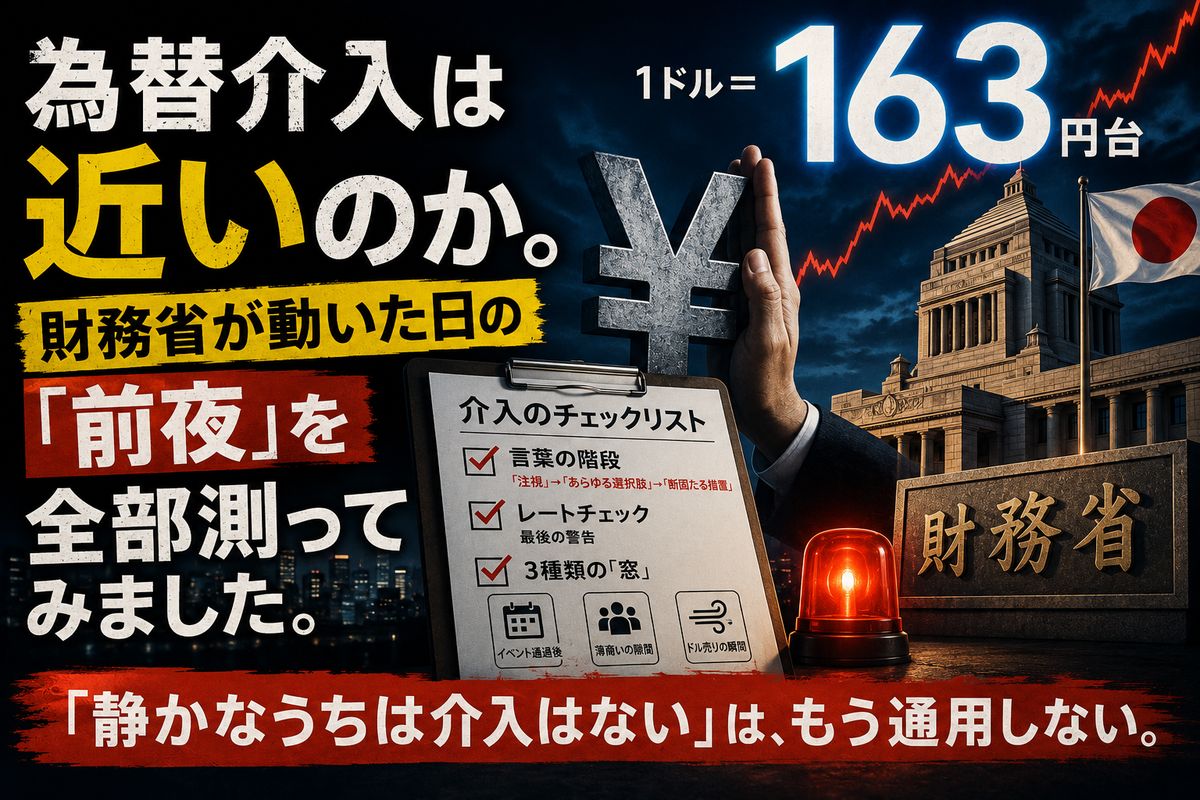
パターンは3段階です。第一に、言葉の階段。「注視」から始まり、「あらゆる選択肢」を経て、「断固たる措置」という最上段の言葉が出る。第二に、最後の警告としてのレートチェック。2022年は実施の8日後に介入が来ました。そして第三に、引き金となる「窓」です。
The pattern has three stages. First, the verbal ladder: it starts at "watching closely," climbs through "all options on the table," and tops out at "resolute measures." Second, the rate check as the final warning; in 2022, intervention came eight days after one. And third, the trigger "window."
この「窓」は、俗に「当局は薄商いを狙う」と一括りにされがちですが、実際の記録を時刻まで追うと、性質の違う3種類に分かれます。
This "window" is usually lumped into a single folk rule, "the authorities aim for thin markets." But trace the record down to the clock time and it splits into three distinct types.
第一の窓は、イベント通過の直後です。2022年9月22日の介入は、日銀が緩和維持を決め、黒田総裁の会見が終わった数時間後の17時ごろに実行されました。2024年5月2日の早朝(公表上は5月1日分)の介入も、米FOMC後のパウエル議長会見が終わった直後、議長の「利上げは考えていない」という発言がドル売り材料になったところに重ねて行われた模様だと分析されています。理屈は明快で、予定されたイベントが終わった直後なら、介入の効果を数時間後の発表が打ち消してしまう事故が起きません。しかも市場はイベント直後にポジションを組み直したばかりで、一番もろい状態にあります。
The first window is the moment right after an event passes. The September 22, 2022 strike came around 17:00 JST, hours after the BOJ decided to keep easing and Governor Kuroda's press conference had ended. The strike in the early hours of May 2, 2024 (booked as May 1) is likewise assessed to have been layered right on top of the end of Chair Powell's post-FOMC press conference, just as his remark that a hike was "not on the table" was already selling the dollar. The logic is clean: strike right after a scheduled event and there is no announcement left to cancel your intervention hours later. Better still, the market has just rebuilt its positions post-event and is at its most fragile.
第二の窓は、流動性の薄い隙間です。2024年4月29日は昭和の日の祝日で、東京の実需勢が不在の朝に160円17銭を付けた後、約5時間で5円押し下げられました。この日の5.9兆円は、1営業日の円買いとしては1991年以降で最大です。参加者が少ない市場では、同じ金額でも値を大きく動かせる。当局が意図的に低流動性のタイミングを選んでいるとみる分析もあります。
The second window is a thin-liquidity gap. April 29, 2024 was the Showa Day holiday; after the rate printed 160.17 in a Tokyo-absent morning, it was driven down 5 yen in roughly five hours. That day's 5.9 trillion yen remains the largest single-day yen purchase since 1991. In a market with few participants, the same money moves the price much further, and some analyses conclude the authorities deliberately select low-liquidity timing.
第三の窓は、ドルの勢いが緩んだ瞬間です。これが最も見落とされています。2022年10月21日の5.6兆円(1日として当時最大)は、「金曜深夜の閑散を狙った」と語られがちですが、日本時間23時台は実際にはニューヨーク市場の午前、つまり世界で最も流動性の厚い時間帯です。この夜に起きていたのは閑散ではなく、22時ごろに米国の利上げ減速観測を伝える報道が流れ、米金利が低下し、ドルの騰勢が一服したことでした。当局はドルが売られ始めたまさにその瞬間に乗り、さらに週末を挟むことで、損失を抱えたドル買い勢が土日を不安の中で越えるよう仕向けています。2024年7月11日の米CPI直後の介入も同じ型で、指標でドルが売られ始めた流れを増幅しました。この型には副産物もあります。指標や報道と同時なら、値動きが介入なのか材料なのか、市場はしばらく判別できません。
The third window is the moment the dollar's momentum stalls, and it is the most overlooked. The 5.6 trillion yen strike of October 21, 2022 (then the largest single day) is usually described as "aimed at the thin Friday midnight," but 23:00 JST is actually mid-morning in New York, the deepest liquidity of the global day. What actually happened that night was not emptiness: around 22:00 JST a report that the Fed would discuss slowing its hikes hit the wires, US yields fell, and the dollar's charge paused. The authorities rode that exact moment when the dollar had started selling off, and by placing the strike before the weekend, they forced wounded dollar-longs to carry their losses and their doubts through Saturday and Sunday. The July 11, 2024 strike minutes after the US CPI followed the same template, amplifying a data-driven dollar sell-off. This type has a bonus feature: struck simultaneously with data or news, the move is indistinguishable from the catalyst itself for quite a while.
つまり「窓」の本質は、時間帯ではなく力学です。イベントリスクが消えた直後か、少ない弾で大きく動かせる隙間か、ドル売りの追い風が吹いた瞬間か。当局は風のない日に力ずくで押すのではなく、押せば倒れる瞬間を待って押しています。
In other words, the essence of the window is not a time of day but a mechanism: the moment after event risk has expired, a gap where little ammunition moves a lot of price, or the instant a dollar-selling tailwind starts to blow. The authorities do not shove against a windless market; they wait for the moment when a push will topple it.
ここで気づくことがあります。今の状況は、言葉の階段は最上段まで登り切り(7月22日の「断固たる対応」)、レートチェックはまだ、という位置です。つまり歴史のパターン上、残っているシグナルは「最後の警告」と、3種類の「窓」のどれかが開く瞬間だけです。
Which leads to a realization about the present. The verbal ladder has been climbed to the top rung (July 22's "resolute action"), and the rate check has not yet appeared. By the historical pattern, the only signals left are the final warning, and the moment one of the three windows opens.
政府が円買いの為替介入を実施:効果は限られ時間稼ぎの政策に(野村総合研究所(木内登英))
円安阻止に寄与した為替介入を振り返る(国際通貨研究所(橋本将司))
再びドル売り・円買い介入か~政府・日銀の意図を探る(三井住友DSアセットマネジメント)
為替介入とは?いつ起きる?日銀・財務省の「発動トリガー」を1.2%の統計学から解明(フジトミ証券)
「相場が静かなうちは介入はない」は本当か。測ってみました
"No Intervention While the Market Is Calm." Is That True? We Measured It
介入を否定する論拠として最もよく聞くのが、「介入の大義は過度な変動への対応。今の円安はじわじわ進む秩序だった動きだから、介入はできない」というものです。日本経済新聞も7月22日、「介入に大義なし」と報じました。この通説を、実データで検証します。
The most common argument against imminent intervention goes like this: the official justification for intervening is countering excessive volatility, and today's yen depreciation is a slow, orderly grind, so the ministry's hands are tied. The Nikkei ran exactly this argument on July 22 under the headline that intervention "lacks a just cause." Let us test this folk rule against actual data.
円相場163円台、見透かされた「通貨安容認」 介入に大義なし(日本経済新聞)
測り方はシンプルです。ドル円の日次終値から、直近3ヶ月(63営業日)の実現ボラティリティ※を年率換算で計算し、過去の各介入の「前夜」にその値がどの水準だったかを調べました。データはMetaTrader 5経由のブローカー配信価格と、FRBが公表する公式レート(FRED: DEXJPUS)の2系統で独立に計算し、結論が一致することを確認しています。
The method is simple. From daily USD/JPY closing prices we computed rolling 3-month (63 trading day) realized volatility, annualized, and checked its level on the eve of each past intervention. We ran the calculation independently on two data feeds, broker prices via MetaTrader 5 and the official rates published by the Federal Reserve (FRED: DEXJPUS), and confirmed that the conclusions agree.
※ 実現ボラティリティとは、実際の値動きの荒さを標準偏差で測った指標。ここでは日次リターンのばらつきを年率換算(%)したもので、数字が大きいほど荒い相場を意味する。
※ Realized volatility measures how rough actual price action has been, as a standard deviation. Here it is the dispersion of daily returns, annualized in percent; the higher the number, the wilder the market.
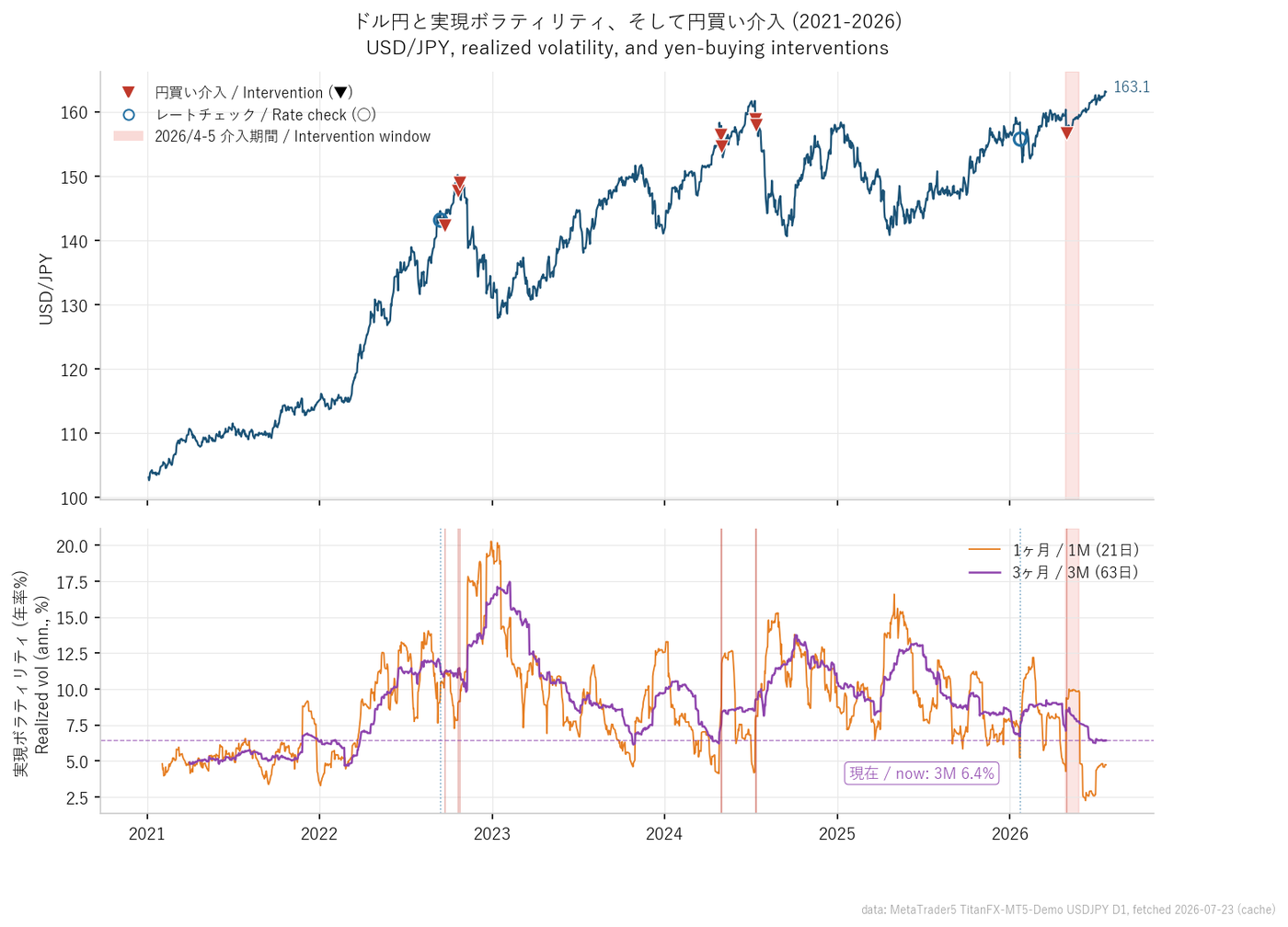
結果がこちらです。
Here are the results.
| 前夜の状態 | 3ヶ月ボラ | ボラの位置(2021年以降) | 直前1ヶ月の値動き |
|---|---|---|---|
| 2022/9/22 介入 | 10.8〜12.5% | 上から2〜3割の高ボラ帯 | +7円 |
| 2022/10/21 介入 | 10.8〜12.5% | 上から2〜3割の高ボラ帯 | +6円 |
| 2024/4/29 介入 | 7.0% | 下から25% | +6〜7円 |
| 2024/7/11 介入 | 8.5% | 下から37〜42% | +5円 |
| 2026/1/23 レートチェック | 6.7〜7.2% | 下から21〜26% | +1円 |
| 2026/4/30 介入(過去最大) | 7.1% | 下から25% | +1〜2円 |
| 現在(2026/7/23) | 6.4〜6.7% | 下から18% | +1円 |
| State on the eve | 3M vol | Vol percentile (since 2021) | Prior-month move |
|---|---|---|---|
| Sep 22, 2022 strike | 10.8-12.5% | Top quarter, high-vol regime | +7 yen |
| Oct 21, 2022 strike | 10.8-12.5% | Top quarter, high-vol regime | +6 yen |
| Apr 29, 2024 strike | 7.0% | 25th percentile from bottom | +6 to 7 yen |
| Jul 11, 2024 strike | 8.5% | 37th-42nd percentile | +5 yen |
| Jan 23, 2026 rate check | 6.7-7.2% | 21st-26th percentile | +1 yen |
| Apr 30, 2026 strike (record) | 7.1% | 25th percentile | +1 to 2 yen |
| Now (Jul 23, 2026) | 6.4-6.7% | 18th percentile | +1 yen |
Japanese Yen to U.S. Dollar Spot Exchange Rate (DEXJPUS)(FRED(米セントルイス連銀))
数字が語ることは明確です。「介入には荒れた相場が必要」だったのは2022年までです。2022年の2回は確かに、ボラが上位2〜3割に入る荒れた相場の中で行われました。しかし2024年4月29日の5.9兆円介入の前夜、3ヶ月ボラは7.0%。2021年以降の分布で下から25%という「静かな側」の相場でした。
What the numbers say is unambiguous. "Intervention requires a wild market" was true only through 2022. The two 2022 strikes did indeed come with volatility in the top quarter of its range. But on the eve of the 5.9-trillion-yen strike of April 29, 2024, 3-month volatility stood at 7.0%, in the bottom 25% of the distribution since 2021, squarely on the calm side of the market.
そして決定的なのが今年です。過去最大の11.7兆円介入(4月30日)の前夜は、3ヶ月ボラ7.1%(下から25%)、直前1ヶ月の値動きはわずか+1〜2円。ゼロ円で7円動かした1月のレートチェックの前夜も、ほぼ同じ静けさでした。そして本日7月23日時点の相場は、3ヶ月ボラ6.4〜6.7%(下から18%)、直前1ヶ月+1円。つまり今の「静かな163円」は、当局が今年すでに2回動いたときの環境と、統計的にほとんど区別がつきません。「静かだから介入はない」という通説は、2026年の当局の行動記録と矛盾しています。ボラティリティは介入を正当化する「言葉」としては使われますが、引き金の「条件」ではなくなっている、というのが実測の答えです。
This year is the decisive evidence. On the eve of the record 11.7-trillion-yen strike (April 30), 3-month volatility was 7.1% (25th percentile) and the prior month's move was a mere 1-2 yen. The eve of January's rate check, the one that moved the market 7 yen at zero cost, was just as quiet. And as of today, July 23, the market sits at 3-month volatility of 6.4-6.7% (18th percentile) with a prior-month move of about 1 yen. Today's "quiet 163" is statistically almost indistinguishable from the conditions under which the authorities have already acted twice this year. The folk rule "calm market, no intervention" contradicts the authorities' own 2026 track record. Volatility survives as the vocabulary used to justify intervention, but the measurements say it is no longer a condition for pulling the trigger.
撃たれた日は、必ず5円動いている
Every Strike Day Has Moved About 5 Yen
もう一つ、実データから見えた規則性があります。主要な介入日4回(2022/9/22、2022/10/21、2024/4/29、2026/4/30)の1日の値幅(高値から安値)は、5.2円、5.6円、5.7円、5.8円。手法も時間帯も規模も違う4回の介入が、いずれも「1日で約5〜6円」の穴を開けています。サンプルは4回に過ぎませんが、介入とは「トレンドを変える」ものではなく「その日、5円の急落を作る」ものだった、というのが記録です。レバレッジをかけてドル円を買っている個人投資家にとって、この5円は多くの場合、強制決済を意味します。介入が相場の方向を変えられなくても短期的に効くのは、この強制決済の連鎖を引き起こすからです。
One more regularity emerged from the data. On the four major strike days (Sep 22, 2022; Oct 21, 2022; Apr 29, 2024; Apr 30, 2026), the full daily range from high to low was 5.2, 5.6, 5.7 and 5.8 yen. Four strikes with different methods, different hours and different sizes each punched a hole of roughly 5 to 6 yen in a single day. The sample is only four, but the record is clear about what intervention actually does: it does not change the trend, it manufactures a 5-yen plunge that day. For a retail investor holding leveraged long dollar-yen positions, 5 yen usually means forced liquidation. That cascade of margin calls is precisely why intervention works in the short run even though it cannot change the direction of the market.
今回が過去と違う点も、正直に
What Is Honestly Different This Time
一方で、「今回は動きにくい」とする材料も無視できません。第一に、口先介入※の効力が尽きています。最上段の言葉が繰り返されて市場に無視される状態は、過去の介入前夜にはなかった現象です。
That said, the case for "harder to move this time" cannot be ignored. First, verbal intervention has run out of power. The top-rung phrase being repeated and shrugged off by the market is something that never happened on the eve of past strikes.
※ 口先介入とは、実際の売買を伴わず、当局者の発言だけで相場をけん制する行為。発言の強さには段階があり、市場は言い回しの変化を介入までの距離として読む。
※ Verbal intervention is jawboning: officials attempting to check the market with words alone, no actual buying or selling. The phrasing escalates in defined steps, and the market reads each change of wording as a measure of the distance to real action.
第二に、効果の耐久性です。過去最大の11.7兆円を使って、買った時間は約7週間でした。この事実は市場も財務省も知っています。第三に、今回の円安はホルムズ海峡発の原油高と米金利という「ファンダメンタルズ」がドルを押し上げている面が強く、投機筋を叩く大義を立てにくい。日経の「大義なし」報道はこの点を突いています。
Second, the durability problem: the record 11.7 trillion yen bought about seven weeks. The market knows this, and so does the ministry. Third, this leg of yen weakness is heavily driven by fundamentals, oil prices out of the Strait of Hormuz crisis and US rates, pushing the dollar up, which makes it hard to frame a strike as punishment of speculators. The Nikkei's "no just cause" piece presses exactly this point.
ただ、この議論には続きがあります。11兆円を使った後、そもそも次を撃つ弾は残っているのか。そして、大義を左右する立場にある米国は、敵なのか味方なのか。ここも数字と記録で確かめておきます。
But the argument does not end there. After spending 11 trillion yen, is there even ammunition left for the next strike? And the United States, the one player whose stance can make or break the "just cause": is it an adversary or an ally here? These, too, can be checked against numbers and records.
弾はあるのか。そして、米国は助けるのか
Is There Ammunition Left? And Will America Help?
まず弾、つまり原資です。ここでよくある誤解を一つ正しておきます。円買い介入の原資は、ニュースでよく見る「外貨準備」そのものではありません。介入は、財務省が所管する外国為替資金特別会計(外為特会)※の外貨資産を取り崩して行われます。日銀は財務大臣の代理人として売買を執行するだけです。「外貨準備」はこの外為特会の資産に日銀自身の外貨資産などを合算した統計であり、財布そのものではなく、財布をのぞき込むための窓です。
First, the ammunition. Let us correct a common misconception up front: the war chest for yen-buying intervention is not the "foreign exchange reserves" you see in the news. Intervention draws down the foreign-currency assets of the Foreign Exchange Fund Special Account (FEFSA), administered by the Ministry of Finance; the BOJ merely executes the trades as the Finance Minister's agent. "Foreign exchange reserves" is a statistic that adds the BOJ's own foreign assets on top of that account. It is not the wallet itself; it is the window through which you can inspect the wallet.
※ 外為特会(外国為替資金特別会計)とは、政府が為替介入のために外貨資産を保有・運用する財務省所管の特別会計。円買い介入の原資はこの会計の外貨資産で、日銀は財務大臣の代理人として売買を執行する。
※ The Foreign Exchange Fund Special Account (FEFSA) is the MOF-administered special account through which the government holds and manages foreign-currency assets for intervention. Yen-buying strikes are funded from this account's assets; the BOJ executes the trades as the Finance Minister's agent.
その窓から中身を見てみます。外貨準備※の総額は6月末時点で1兆2,874億ドル、円換算でおよそ208兆円。ただし全部が弾ではありません。金(1,095億ドル)は実務上、介入の原資として使われません。SDR(604億ドル)はIMF加盟国の政府間でしか使えず、IMFリザーブポジション(113億ドル)も市場で売れる資産ではない。つまり合計約2,000億ドル、全体の15%ほどは、そもそも市場での介入には事実上使えない部分です。市場で使えるのは、米国債を中心とする証券(9,285億ドル)と預金(1,619億ドル)。そして即座に撃てるのは預金の約1,600億ドル(約26兆円)にとどまり、それを超える介入は証券、つまり米国債を売って現金化する必要があります。
Look through that window and here is what you see. Total reserves stood at 1,287.4 billion dollars at the end of June, roughly 208 trillion yen. But not all of it is ammunition. Gold (109.5 billion dollars) is never used to fund FX operations in practice. SDRs (60.4 billion) can only be used between IMF member governments, and the IMF reserve position (11.3 billion) is not a marketable asset either. In total, roughly 200 billion dollars, about 15% of the pile, is effectively unusable for market intervention. What can be used are the securities, mostly US Treasuries (928.5 billion), and deposits (161.9 billion). And what can be fired instantly is only the deposits, about 160 billion dollars or 26 trillion yen; anything beyond that requires selling securities, meaning US Treasuries, to raise cash.
※ 外貨準備とは、外為特会と日銀が保有する対外資産の合計を示す統計。金やSDR(特別引出権)など市場での介入には使えない資産も含むため、その全額が円買いの弾になるわけではない。
※ Foreign exchange reserves are the statistic summing the external assets held by the FEFSA and the BOJ. Because they include assets unusable for market intervention, such as gold and SDRs (Special Drawing Rights), the full amount is never available as yen-buying ammunition.
実際、その「米国債を売る」段階は既に始まっているとみられます。4月から5月の11.7兆円介入の後、5月末の外貨準備は前月比771億ドル減と、比較可能な2000年4月以降で最大の減少率(5.6%)を記録しました。しかも預金はほとんど減らず、証券が756億ドル減っており、介入資金が外債売りで賄われた可能性が指摘されています。日本は、円を買うために米国債を売り始めているのです。
And that Treasury-selling stage appears to have already begun. After the April-May 11.7 trillion yen campaign, end-May reserves fell 77.1 billion dollars from the prior month, a 5.6% decline, the largest since comparable records began in April 2000. Crucially, deposits barely moved while securities fell 75.6 billion dollars, and analysts point out the intervention was likely funded by selling foreign bonds. Japan has started selling US Treasuries in order to buy yen.
それでも、総量としての弾は当面尽きません。ゴールドマン・サックスは5月、「直前の週と同規模の円買い介入をあと30回実施できる」との試算を示しました。本当の制約は在庫ではなく、副作用です。大和総研の分析が指摘するように、大規模介入を繰り返せば、外貨準備の減少自体が市場の注目を集めて介入の信認を削ります。さらに「日本が米国債を売っている」という連想は米長期金利を押し上げ、それ自体がドル高の追い風になるという、自分の介入が自分の敵を強くするループを抱えます。同分析の結論は、持続的な円安是正に必要なのは介入ではなく機動的な利上げだ、というものでした。なお、原資は外貨準備の範囲に縛られてもいません。必要ならIMFや国際決済銀行(BIS)などから外貨を借り入れる拡張手段も、制度上は残されています。まとめると、弾はあります。ただし、撃つたびに高くつく弾です。
Even so, the gross stock of ammunition will not run out any time soon. Goldman Sachs estimated in May that Japan could repeat an intervention of the prior week's scale about 30 more times. The real constraint is not inventory but side effects. As a Daiwa Institute of Research analysis points out, repeated large strikes make the shrinking reserves themselves a market story, eroding the credibility of the whole operation; and the association "Japan is selling Treasuries" pushes US long-term yields higher, which is itself a dollar tailwind, a loop in which each intervention strengthens its own enemy. That analysis concludes that a durable fix requires nimble rate hikes, not intervention. Note also that the war chest is not strictly capped by the reserves: institutionally, Japan retains the option of borrowing foreign currency from the IMF, the BIS and others. In short: the ammunition exists. It just gets more expensive with every shot.
外貨準備等の状況(令和8年6月末現在)(財務省)
為替介入(外国為替市場介入)とは何ですか? 誰が為替介入の実施を決定し、誰が為替介入を行うのですか?(日本銀行)
外為特会の基礎⑥:外貨準備と外為特会の違い(note(服部孝洋・東京大学))
為替介入資金、外債売りで充当の可能性-5月残高が過去最大の減少(Bloomberg)
円買い介入、先週の規模ならあと30回可能-ゴールドマン(Bloomberg)
円買い・ドル売り為替介入の限界(大和総研(中村文香))
次に、米国です。ここに、今回の局面で最も見過ごされている事実があります。日本経済新聞の2月の報道によれば、1月23日のレートチェックは日本側の要請ではなく、ベッセント米財務長官の主導で行われました。2月の衆院選を前にした日本の政治空白の中で、円売りと日本国債売りが連鎖して世界の市場に波及することを米政府当局者が警戒しており、日本が求めれば協調介入※も一時は視野に入っていたといいます。4月には三村財務官が「米国とは協調的にやっている」と明言し、5月にはベッセント長官の来日が介入容認と受け止められて円高が進む場面もありました。米財務省は1月公表の為替報告書で、円安への警戒を一段階引き上げてもいます。2022年に「黙認」だった米国は、2026年には「自ら警告射撃を放つ側」に変わっています。
Now, America. Here lies the most overlooked fact of this entire episode. According to Nikkei reporting in February, the January 23 rate check was not requested by Japan: it was directed by US Treasury Secretary Bessent himself. US officials worried that during Japan's political vacuum ahead of the February Lower House election, a chain reaction of yen selling and JGB selling could spill into global markets, and coordinated intervention was reportedly on the table for a time had Japan asked. In April, Vice Minister Mimura stated plainly that Japan is "working in coordination with the United States"; in May, Secretary Bessent's visit to Japan was read as blessing the intervention and the yen firmed. The US Treasury's January FX report also raised its vigilance over yen weakness by a notch. The America that merely "tolerated" in 2022 has become, in 2026, the side firing its own warning shots.
※ 協調介入とは、複数の国の通貨当局が申し合わせて同時に行う為替介入。単独介入よりはるかに強力とされ、円安局面での抑止力は倍以上になるとの分析もある。
※ Coordinated intervention is intervention conducted simultaneously by multiple countries' currency authorities by agreement. It is considered far more powerful than acting alone; one analysis puts its deterrent power against yen weakness at more than double.
もちろん、米国は公式には「強いドル」の国です。ベッセント長官は6月にも「ドルを強くする措置をわれわれは好む」と述べています。ただ、これは矛盾ではないと考えます。米国の通商上の不満は「ドルが強すぎること」一般ではなく、「円が安すぎること」に向いています。円買い介入は、ドルの信認を傷つけずに円だけを押し上げる、米国にとって都合のよい調整なのです。
Officially, of course, America remains a "strong dollar" country; Secretary Bessent said as recently as June that "we favor measures that strengthen the dollar." We see no contradiction. America's trade grievance is not with a strong dollar in general but with a yen that is too weak in particular. Yen-buying intervention lifts the yen without denting the dollar's standing, which makes it a convenient adjustment from Washington's point of view.
そして、前例が一つだけあります。1998年6月17日、米国が円買いに参加した史上唯一の日米協調円買い介入です。当時もFRBは引き締めスタンスで、米国の参加はサプライズと受け止められました。注目すべきはその後です。円安はその約8週間後の8月11日、147円66銭で天井を打ち、秋には111円台まで一気に巻き戻りました。介入そのものが円安を止めたというより、「米国が動いた」という事実が、円安局面の終盤を告げていたのです。
And there is exactly one precedent. On June 17, 1998, the United States joined a yen-buying strike, the only US-Japan coordinated yen-buying intervention in history. The Fed was in a tightening stance then too, and American participation landed as a genuine surprise. What deserves attention is what followed: the yen-weakness cycle peaked about eight weeks later, on August 11, at 147.66, and by autumn had snapped all the way back to the 111 range. It was less that the intervention itself stopped the yen's slide, and more that the fact of America moving marked the endgame of the entire episode.
1月のレートチェック、米財務長官が主導 協調介入も一時視野(日本経済新聞)
ベッセント米財務長官 ドルを強くする措置をわれわれは好む(みんかぶFX)
【為替】1998年の日米協調介入を振り返る(マネクリ(マネックス証券・吉田恒))
まとめると、こうなります。弾の残量は、当面の制約ではありません。そして米国は、少なくとも1998年以来で最も日本の側に立っています。つまり「撃てるのか」という問いの答えはイエスで、残る問いは「いつ撃てば最も効くか」だけです。これは、介入のタイミングの決定権の一部がワシントンにあるという意味でもあります。
To sum up: the remaining ammunition is not the binding constraint for now, and America stands closer to Japan's side than at any time since at least 1998. The answer to "can they shoot?" is yes; the only question left is "when does a shot count the most?" Which also means part of the timing decision now sits in Washington.
7月末、FOMCと日銀に挟まれた48時間
End of July: 48 Hours Wedged Between the FOMC and the BOJ
では、残っている「窓」はいつか。目の前に、教科書のような日程が並んでいます。7月29日(日本時間30日午前3時)に米FOMC※の結果発表。今回は経済見通しの公表がない回で、注目はウォーシュ議長の会見のトーンに集中します。同じ30日の夜21時30分に米GDP速報とPCE物価。そして31日に日銀の金融政策決定会合。ドルを押し上げ得る米国イベントが、日銀の直前48時間に密集しています。
So when might the remaining windows open? A textbook calendar sits right in front of us. The FOMC announces on July 29 (3:00 a.m. JST on the 30th); this is a meeting without an economic projections release, so all attention lands on the tone of Chair Warsh's press conference. The same night at 21:30 JST come the advance US GDP figures and the PCE price index. Then on the 31st, the Bank of Japan's policy meeting. Every US event capable of pushing the dollar higher is packed into the 48 hours immediately before the BOJ speaks.
※ FOMC(米連邦公開市場委員会)とは、米国の政策金利を決める会合。日本の日銀会合に相当する。
※ The FOMC (Federal Open Market Committee) is the meeting that sets US policy rates, the American counterpart of the BOJ's policy meeting.
この日程は、先ほどの3種類の「窓」がすべて開き得る並びでもあります。FOMC通過後の30日朝と日銀通過後の31日は「イベント直後」の窓。GDPやPCEが弱く出てドルが売られる場面があれば「勢いが緩んだ瞬間」の窓。そして8月に入れば夏休みで市場の参加者が減り、「薄い隙間」の窓が常時開きます。
This calendar is also a lineup in which all three window types can open. The morning of the 30th after the FOMC, and the 31st after the BOJ, are "post-event" windows. Any moment where soft GDP or PCE numbers start selling the dollar is a "momentum stall" window. And once August arrives, summer holidays thin out the market and the "liquidity gap" window stands permanently open.
タカ派的な会見や強い指標で163円が165円へ走れば、「日銀の結果を見るまで財務省は動けないはずだ」という読みで上値を試す動きが出るでしょう。しかしその読みには、有名な反例があります。2022年10月21日の5.6兆円介入は、日銀会合の6日前、FOMCの11日前に実行されました。金曜23時台、流動性の厚いNY市場で、米利上げ減速報道がドルの騰勢を止めた一瞬を突いた、あの介入です。財務省が尊重するのは会議の日程ではなく、ドルの勢いが緩む一瞬です。「日銀前だから安全」は、過去に一度、5.6兆円で否定されています。
If a hawkish press conference or hot data sends 163 running toward 165, expect the market to probe higher on the assumption that "the ministry surely cannot move until it sees the BOJ's decision." That assumption has a famous counterexample. The 5.6-trillion-yen strike of October 21, 2022 was executed six days before a BOJ meeting and eleven days before an FOMC, at around 23:00 JST on a Friday, in the deep liquidity of the New York morning, at the exact instant a Fed-slowdown report stalled the dollar's charge. What the ministry respects is not the meeting calendar; it is the moment the dollar's momentum cracks. "Safe because the BOJ is tomorrow" has already been refuted once, at a cost of 5.6 trillion yen to those who believed it.
編集部の見立て
Our Take
冒頭の問い「介入は近いのか」に、測った数字で答えます。チェックリストの現在地はこうです。言葉の階段は登り切った。水準は163円と、今年2回動いた160円より深い。ボラと値動きの静けさは、過去最大介入の前夜とほぼ同じ。弾は残っており、米国は1月に自ら警告射撃を放つほど近くにいる。残っているのはレートチェックの報道と、引き金の「窓」だけで、その窓は7月29日から31日に密集している。つまり、介入を測る物差しのほとんどが「近い」側に振れており、残る反対材料は「口先が効かなくなった当局が、次も本当に撃つのか」という信頼の問題だけです。
Let us answer the opening question, "is intervention near?", with the numbers we measured. Here is the checklist as of today. The verbal ladder: fully climbed. The level: 163, deeper than the 160 that triggered action twice this year. The calm in volatility and price action: statistically the same as the eve of the largest strike ever. The ammunition: still there. The United States: close enough to have fired its own warning shot in January. What remains is a rate-check headline and the trigger window, and the windows are packed into July 29-31. Nearly every gauge on the intervention dashboard points to "near"; the one remaining counterargument is a question of credibility, whether authorities whose words have stopped working will actually shoot again.
読者への実務的な示唆は3つです。第一に、水準ではなくシグナルを見ること。レートチェックの報道が出たら、過去の記録では行動まで数日でした。第二に、7月29日から31日の48時間は、ドル円のレバレッジ取引にとって今年最も危険な時間帯だとみられること。介入が来ても来なくても、FOMC、米指標、日銀が連続するだけで値が飛びます。第三に、介入が来た場合の想定値幅は「1日5〜6円」という実測値を持っておくこと。介入は方向を変えません。しかし5円の急落は、レバレッジ次第であなたの口座の方向を変えます。
Three practical takeaways. First, watch signals, not levels: once a rate-check headline prints, the historical gap to action has been measured in days. Second, the 48 hours from July 29 to 31 look like the year's most dangerous stretch for leveraged dollar-yen positions; intervention or not, the FOMC, US data and the BOJ in succession are enough to make prices jump. Third, carry the measured number with you: when a strike comes, the day has historically traveled 5 to 6 yen. Intervention does not change the market's direction. But a 5-yen plunge, depending on your leverage, can change the direction of your account.
最後に、もう少し長い目線の話を一つ。1998年の教訓に従えば、もし次の一撃に米国が加わったら、それは単なる急落イベントではありません。史上唯一の日米協調円買いの8週間後に、あの円安局面は天井を打ちました。米国の登場は、円安そのものの終盤を告げるサインとして読むべきかもしれません。
Finally, one longer-horizon thought. By the lesson of 1998, if the next strike comes with American participation, it will be more than a one-day plunge. Eight weeks after the only coordinated US-Japan yen purchase in history, that entire yen-weakness cycle topped out. America stepping in may deserve to be read as the signal that the endgame of yen weakness itself has begun.
ところで、この「介入は近いのか」という話、金融に興味のある同僚との飲み会では鉄板の議題です。「静かだから介入はない」と言う人に、この記事の実測データを見せてあげてください。議論が白熱したところで、次の店の予約はOmochiにお任せください。
By the way, "is intervention near?" is guaranteed dinner-table material with finance-minded colleagues. When someone insists "the market is too calm for intervention," show them the measured data in this article. And once the debate heats up, leave booking the next venue to Omochi.