固定価格の呪い。史上最大の防衛ブームで、Boeingだけが損をする理由
The Fixed-Price Curse: Why Boeing Is the Only Loser in History's Biggest Defense Boom
7月28日のBoeing決算は、3つの見出しが同時に成立する不思議な決算でした。全社の受注残は史上最高の7,150億ドル。フリーキャッシュフローは6.31億ドルの黒字に転換。株価は上昇。そして防衛・宇宙部門は、史上最大の防衛ブームのさなかに営業赤字。しかも赤字の主犯は、大統領専用機です。私たちは前回の記事で、この決算を「影の決算書の最終ページ」と呼び、見るべき4つの行を挙げておきました。答え合わせをした結論から言うと、Boeingの決算はSpaceXの勝利を「半分だけ」証明しました。そしてその半分を理解する鍵は、固定価格契約※という一つの契約条項にあります。
Boeing's July 28 results were a strange print in which three headlines were all true at once. Company-wide backlog: an all-time record $715 billion. Free cash flow: back in the black at $631 million. The stock: up. And the defense and space division: an operating loss, in the middle of the biggest defense boom on record, with the presidential aircraft as the main culprit. In our previous article we called this report "the final page of the shadow earnings report" and listed four lines to watch. Having checked the homework, here is the conclusion: Boeing's results proved SpaceX's victory only halfway. And the key to understanding that half is a single contract clause: the fixed-price contract.
※ 固定価格契約とは、開発の遅延やコスト超過が起きても政府の支払額が変わらず、超過分をすべて受注企業が負担する契約方式のこと。企業がコストを制御できれば利益になり、できなければ青天井の損失になる。
※ A fixed-price contract is a contracting format in which the government's payment does not change even if development slips or costs overrun; every dollar of overrun is absorbed by the contractor. If the company controls its costs it is a source of profit; if it does not, the losses are uncapped.
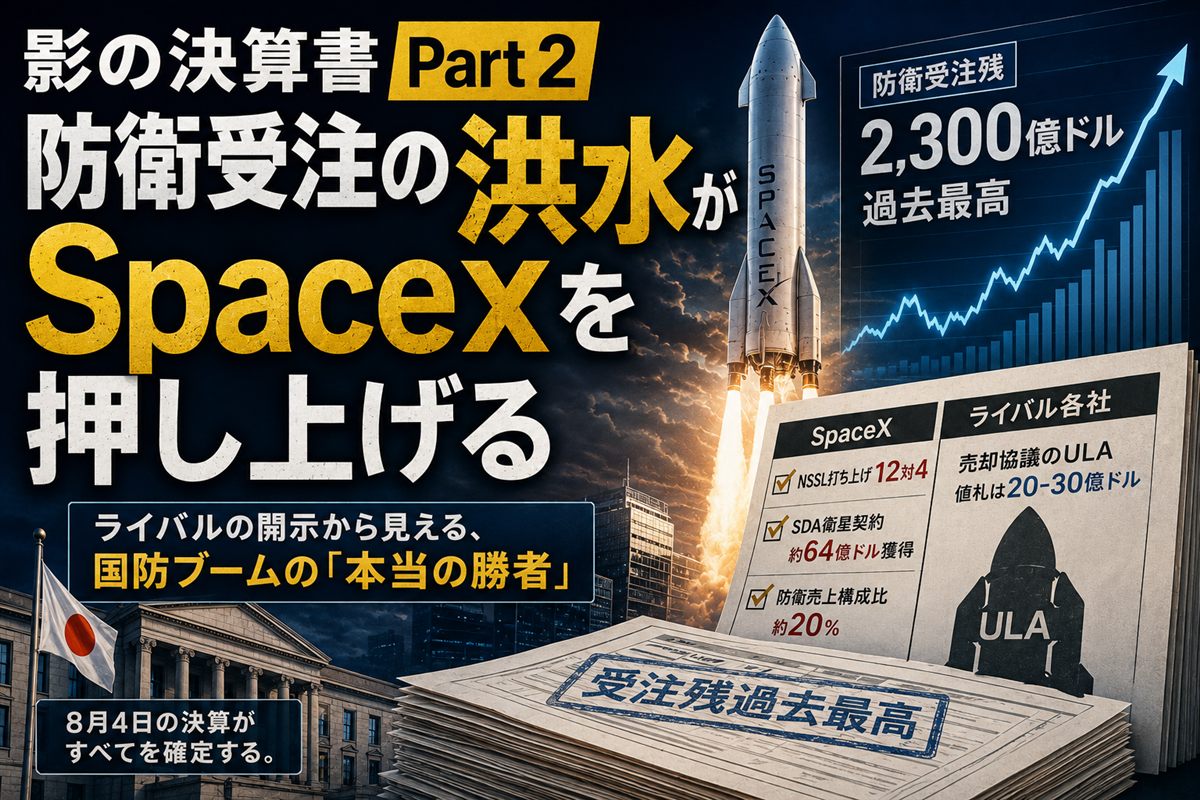
答え合わせ。前回置いた「4つの行」はこうなった
Checking the Homework: How the Four Lines Came In
前回の記事で挙げた4つのチェック項目を、実際の決算に当てはめます。
Let us score the four checklist items from the previous article against the actual results.
第一に、防衛部門の受注残は伸びたか。伸びませんでした。Boeingの防衛・宇宙部門の受注残は、第1四半期末の860億ドルから850億ドルへ、むしろ小幅に減少しています。同じ週にLockheed Martinが四半期だけで650億ドルの新規受注を積み、受注倍率3.2倍を叩き出したことを思い出してください。単純計算で、Boeingの防衛部門の受注倍率は0.9倍前後。潮はすべての船を持ち上げたのに、この船の受注帳だけ水位が変わらなかった。ブームの限界収入がどこか別の場所へ流れていることの、これ以上ない証拠です。
First: did the defense backlog grow? It did not. Boeing's defense and space backlog actually slipped from $86 billion at the end of Q1 to $85 billion. Recall that in the same week, Lockheed Martin booked $65 billion of new orders in a single quarter, a book-to-bill of 3.2. On simple arithmetic, Boeing's defense book-to-bill comes out around 0.9. The tide lifted every boat, and this one order book alone did not rise. There is no clearer evidence that the boom's marginal dollars are flowing somewhere else.
第二に、Starliner※の追加損失はあるか。ありませんでした。ただし、オルトバーグCEOが語ったのは「今後の打ち上げ日程についてNASAとすり合わせを続けている」という一言だけで、成長や増産の話は一切ありません。第三に、SLS※への言及。ゼロでした。予算方針でArtemis III以降の廃止が示されている大型ロケットについて、経営陣は何も語りませんでした。第四に、ULA(BoeingとLockheed Martinが50%ずつ出資する打ち上げ合弁会社)の持分法評価。こちらも言及ゼロで、詳細は後日の四半期報告書(10-Q)まで見えません。
Second: a new Starliner charge? There was none. But all CEO Ortberg offered was a single line about "continuing to work with NASA to align the schedule for future launches"; not a word about growth or ramping production. Third: any mention of SLS? Zero. On the heavy rocket that budget plans have marked for retirement after Artemis III, management said nothing. Fourth: the equity-method valuation of ULA (the launch joint venture owned 50/50 by Boeing and Lockheed Martin). Also unmentioned; the detail stays invisible until the 10-Q filing.
※ Starliner(スターライナー)とは、BoeingがNASAの委託で開発した有人宇宙船のこと。国際宇宙ステーションへの飛行士輸送をSpaceXと分担するはずだったが、開発遅延と不具合が続き、2024年の有人試験飛行では乗せていった飛行士を軌道上に残して無人で帰還した。
※ Starliner is the crewed spacecraft Boeing developed under NASA contract. It was meant to share astronaut transport to the International Space Station with SpaceX, but delays and malfunctions piled up, and on its 2024 crewed test flight the capsule returned empty, leaving its astronauts in orbit.
※ SLS(スペース・ローンチ・システム)とは、NASAの月探査計画Artemisのために開発された使い捨ての超大型ロケットのこと。Boeingが中核機体を製造するが、打ち上げコストの高さが問題視され、米政府の予算方針ではArtemis III以降の廃止が示されている。
※ SLS (Space Launch System) is the expendable super-heavy rocket developed for NASA's Artemis Moon program. Boeing builds its core stage, but its launch costs have drawn criticism, and US budget plans call for its retirement after Artemis III.
Boeing Reports Second Quarter Results(Boeing)
正直に整理します。この決算がSpaceXについて証明したのは、①ブームの中でBoeingの防衛受注帳だけが停滞していること、②宇宙事業(Starliner、SLS、ULA)がもはや成長の物語として語られていない、つまり事実上の撤退管理に入っていること、の2点です。一方、証明していないこともあります。営業赤字の主犯である大統領専用機の損失は、SpaceXとは何の関係もない自傷です。そしてBoeingの防衛受注残850億ドルの中身は戦闘機や兵器システムが中心で、SpaceXと直接競合しない領域が大半です。SpaceXの勝ちの「大きさ」を測るなら、前回書いたとおり政府の発注配分表を見るしかありません。Boeingの決算が教えてくれるのは、勝ちの「構造」の方です。その構造の名前が、固定価格です。
Let us be honest about the scorecard. What this report proved about SpaceX is two things: first, that Boeing's defense order book alone stagnated in the middle of the boom; second, that the space businesses (Starliner, SLS, ULA) are no longer narrated as growth stories, meaning they are effectively in wind-down management. What it did not prove also matters. The loss that caused the operating deficit, the presidential aircraft, is a self-inflicted wound with no connection to SpaceX. And most of the $85 billion defense backlog is fighter jets and weapons systems, areas where SpaceX does not compete. To measure the size of SpaceX's win, you still have to read the government's award allocation tables, as we wrote last time. What Boeing's results teach is the structure of the win. The name of that structure is fixed price.
大統領専用機が2.4倍になった話
The Presidential Plane That Cost 2.4 Times Itself
赤字の中身を見ます。防衛・宇宙部門は売上74.8億ドルと前年比13%増えたのに、営業損益はマイナス0.2%。原因は、次期大統領専用機VC-25B(エアフォースワン)で計上した2.8億ドルの追加損失です。この計画は2018年に総額39億ドルの固定価格で契約されたもので、遅延と設計変更のたびに超過コストをBoeingが自腹で負担してきました。累計損失は約24億ドル。契約額39億ドルの仕事で、24億ドルの持ち出しです。カルフーン前CEO自身が後に、この価格で引き受けるべきではなかったと認めています。
Inside the loss: the defense and space division grew revenue 13% to $7.48 billion, yet posted a negative 0.2% operating margin. The cause was a fresh $280 million charge on the VC-25B, the next Air Force One. The program was signed in 2018 as a $3.9 billion fixed-price deal, and every delay and design change since has come out of Boeing's own pocket. Cumulative losses now stand at roughly $2.4 billion. On a $3.9 billion contract, Boeing has eaten $2.4 billion. Former CEO Dave Calhoun himself later admitted the company should never have accepted that price.
Boeing's Air Force One programme incurs fresh $280 million loss(Aerospace Global News)
そして、これは一機種の話ではありません。系譜があります。
And this is not the story of one aircraft. There is a lineage.
呪いの系譜。5つの固定価格プログラム
The Curse's Lineage: Five Fixed-Price Programs
Boeingは2010年代、シェア防衛のために主要な開発案件を相次いで固定価格で受注しました。空中給油機KC-46は、欧州Airbusに給油機の牙城を奪われないための戦略的な安値入札だったとされます。その後の実績は以下のとおりです。
Through the 2010s, Boeing took one major development program after another at fixed prices to defend market share. The KC-46 tanker is widely described as a strategic lowball bid to keep the tanker franchise out of Airbus's hands. The record since:
| プログラム | 内容 | 累計損失 |
|---|---|---|
| KC-46(空中給油機) | 2011年受注、Airbus対抗の戦略入札 | 約80億ドル |
| Starliner(有人宇宙船) | 2014年受注、SpaceXとの同時契約 | 20億ドル超 |
| VC-25B(大統領専用機) | 2018年受注、契約額39億ドル | 約24億ドル |
| T-7A(練習機) | 2018年受注 | 数十億ドル規模 |
| MQ-25(艦載給油ドローン) | 2018年受注 | 数億ドル規模 |
| Program | Background | Cumulative losses |
|---|---|---|
| KC-46 (aerial tanker) | Won 2011, strategic bid against Airbus | ~$8 billion |
| Starliner (crewed spacecraft) | Won 2014, twin award with SpaceX | Over $2 billion |
| VC-25B (Air Force One) | Won 2018, $3.9B contract | ~$2.4 billion |
| T-7A (trainer jet) | Won 2018 | Billions |
| MQ-25 (carrier refueling drone) | Won 2018 | Hundreds of millions |
2024年だけで、この5計画の損失は合計50.1億ドルに達しました(KC-46が20.0億、T-7Aが17.7億、Starlinerが5.2億、VC-25Bが3.8億、MQ-25が3.4億)。1年で5,000億円規模を、契約条項ゆえに顧客に請求できず自社で飲み込んだ計算です。
In 2024 alone, losses across these five programs totaled $5.01 billion (KC-46: $2.00 billion, T-7A: $1.77 billion, Starliner: $523 million, VC-25B: $379 million, MQ-25: $339 million). Roughly 500 billion yen in a single year that, because of a contract clause, could not be billed to the customer and had to be swallowed whole.
Boeing's defense unit to eat $1.7 billion in fourth quarter(Defense One)
Boeing reports $565M loss on KC-46 as firm looks forward to repricing(Defense News)
Boeing's Starliner losses top $2 billion after spacecraft program reports worst year yet(CNBC)
経営陣の総括は明快です。カルフーン前CEOは2023年、投資家会議でこう言い切りました。「固定価格開発の世界は終わらせなければならない。まったく機能していない。我々にとっても、顧客にとっても機能していない」。同年にはCFOも、固定価格の開発契約は今後一切結ばない方針を明言。2024年には、無人僚機プログラムへの入札でも固定価格なら参加しないと表明しています。現在のオルトバーグCEOも今回の決算説明で、KC-46を「今後はリスクの低い事業になる」と位置づけました。要するにBoeingは、固定価格という契約方式そのものを、二度と触れない毒物として扱っています。
Management's own verdict is unambiguous. At an investor conference in 2023, then-CEO Calhoun put it flatly: "That fixed-price development world has to stop. It just doesn't work. It doesn't work for us, and it doesn't work for our customers." The same year, the CFO stated the company had signed no further fixed-price development contracts and did not intend to. In 2024, Boeing said it would not even bid on the drone-wingman program if the terms were fixed-price. And in this week's earnings remarks, current CEO Ortberg positioned the KC-46 as "a lower-risk program going forward." In short, Boeing now treats the fixed-price format itself as a poison it will never touch again.
'It just doesn't work': Boeing CEO takes aim at fixed-price contracting(Missouri Business Alert)
Boeing says it will shun fixed-price contracts for drone wingmen(Defense News)
ところが、同じ毒で栄えている会社がある
And Yet, One Company Thrives on the Same Poison
ここで、めったにない「対照実験」を紹介します。2014年、NASAは有人宇宙船の開発を2社に同時発注しました。契約方式はどちらも固定価格。Boeingに42億ドル、SpaceXに26億ドルです。同じ発注者、同じミッション、同じ契約条項。違うのは受注した会社だけです。
Here is a controlled experiment of a kind markets rarely get. In 2014, NASA awarded crewed-spacecraft development to two companies simultaneously, both on fixed-price terms: $4.2 billion to Boeing, $2.6 billion to SpaceX. Same customer, same mission, same contract clause. The only variable was the company.
NASA Chooses American Companies to Transport U.S. Astronauts to International Space Station(NASA)
12年後の結果です。低い方の価格で受注したSpaceXは、2020年から現在まで有人飛行を安定して続け、この契約を利益の出る定期便事業に変えました。高い方の価格で受注したBoeingは、20億ドル超の損失を計上し、有人飛行は2024年の試験飛行1回。しかもその飛行では不具合により、乗せていった宇宙飛行士を軌道上に残して機体だけが帰還しています。
Twelve years later, the results are in. SpaceX, which took the lower price, has flown crews reliably since 2020 and turned the contract into a profitable scheduled service. Boeing, which took the higher price, has booked over $2 billion in losses and completed exactly one crewed flight, the 2024 test, on which malfunctions forced the capsule to come home empty while its astronauts stayed in orbit.
つまり、固定価格は「呪い」そのものではありません。固定価格は選別装置です。コスト構造を自分で所有している会社には利益の源泉になり、外部のサプライチェーンと過去の見積もり慣行にコストを預けている会社には、青天井の罰金になる。SpaceXがロケットのエンジンから発射台まで垂直統合※で内製し、コストを1ドル単位で自分の手の中に置いているのに対し、伝統的な大手はコストプラス契約※の時代に最適化された体質のまま、固定価格の世界に足を踏み入れました。結果が、片や累計損失の系譜、片や政府売上が全体の5分の1を占める第2の本業です。
Which means fixed price is not itself the curse. Fixed price is a sorting mechanism. For a company that owns its cost structure, it is a source of profit; for a company that has outsourced its costs to external supply chains and legacy estimating habits, it is an uncapped fine. SpaceX builds everything from rocket engines to launch pads in-house through vertical integration, keeping every dollar of cost in its own hands; the traditional primes walked into the fixed-price world with corporate metabolisms optimized for the cost-plus era. The results: on one side, a lineage of cumulative losses; on the other, a second core business in which government work makes up a fifth of revenue.
※ 垂直統合とは、部品の製造から組み立て、運用までを外注せず自社内で一貫して行う事業構造のこと。外部業者のマージンと納期に左右されないため、コストと開発速度を自社で制御できる。
※ Vertical integration is a business structure in which parts manufacturing, assembly and operations are all done in-house rather than outsourced. Free from external suppliers' margins and lead times, the company controls its own costs and development speed.
※ コストプラス契約とは、開発にかかった実費に一定の利益を上乗せして政府が支払う伝統的な防衛契約方式のこと。コスト超過のリスクを政府が負うため、受注企業は損をしにくい一方、コスト削減の動機も働きにくい。
※ A cost-plus contract is the traditional defense contracting format in which the government pays actual development costs plus a set profit margin. Because the government bears the overrun risk, contractors rarely lose money, but they also have little incentive to cut costs.
そして、ここが今回の答え合わせの核心ですが、米国防総省の発注は、SDA※の量産衛星もゴールデンドームも、この固定価格型・商用型の方式へ着実に寄っています。発注のルールそのものが、コストを所有する会社を選ぶように書き換えられている。前回の記事で見た配分表(打ち上げ12対4、衛星でSpaceX単独64.5億ドル)は、この構造が生む必然的な出力です。Boeingの決算がSpaceXの勝利を「半分」証明したと書いたのは、この意味です。四半期の損益はSpaceXの勝ちの大きさを測れませんが、ゲームのルールが誰に有利に書かれているかは、これ以上なく雄弁に語っています。
And here is the core of this homework check: Pentagon procurement, from the SDA's mass-produced satellites to Golden Dome, is steadily shifting toward exactly this fixed-price, commercial-style format. The rules of the ordering system themselves are being rewritten to select companies that own their costs. The allocation tables from our previous article (12 to 4 in launch, $6.45 billion single-handedly in satellites) are the inevitable output of that structure. This is what we meant by "half proven": a quarterly P&L cannot measure the size of SpaceX's win, but it speaks with total clarity about whose favor the rules of the game are written in.
※ SDA(宇宙開発局)とは、低軌道に多数の小型衛星を配備してミサイル追跡や通信網を構築する、米宇宙軍傘下の調達機関のこと。従来の大型・高額な軍事衛星と異なり、数百機規模の「量産衛星コンステレーション」を固定価格型で発注する。
※ The SDA (Space Development Agency) is a procurement agency under the US Space Force that builds missile-tracking and communications networks out of large numbers of small satellites in low Earth orbit. Unlike the traditional model of a few large, expensive military satellites, it orders mass-produced constellations by the hundreds, on fixed-price terms.
受注残の「質」という問題
The Question of Backlog Quality
最後に、投資家として見るべき数字の話をします。受注残※の大きさと、その受注残が生む利益は、別物です。
Finally, the number that matters to investors. The size of a backlog and the profit that backlog produces are two different things.
※ 受注残(バックログ)とは、契約済みでまだ売上に計上されていない仕事の残高のこと。防衛産業では将来数年分の売上の予約表にあたるが、契約条件次第では「損失の予約表」にもなり得る。
※ Backlog is the value of contracted work not yet recognized as revenue. In the defense industry it serves as a multi-year reservation book for future sales, but depending on contract terms it can just as easily be a reservation book for future losses.
Boeingの防衛受注残850億ドルは、立派な数字です。しかしその一部は、消化するほど損失が積み上がる固定価格開発案件で構成されてきました。同じ「受注残」という言葉でも、Lockheed Martinの2,300億ドルとBoeingの850億ドルでは、1ドルあたりの意味が違います。史上最大の防衛ブームの果実は、受注残の量ではなく、コストを制御できる者のところにだけ落ちる。今回の決算週で、それが一番よく見えた瞬間が、Boeingの営業損益マイナス0.2%という一行でした。
Boeing's $85 billion defense backlog is a respectable number. But part of it has consisted of fixed-price development programs that generate more losses the more they are executed. The word "backlog" is the same, yet a dollar of Lockheed Martin's $230 billion and a dollar of Boeing's $85 billion do not mean the same thing. The fruits of history's biggest defense boom fall not to whoever holds the most backlog, but only to those who control their costs. The single line where that was most visible this earnings week was Boeing's negative 0.2% defense operating margin.
Lockheed Martin (NYSE: LMT), RTX (NYSE: RTX), And Northrop Grumman (NYSE: NOC) Post Record Backlogs, Raise Guidance After Q2 Results(Foreign Policy Journal)
編集部の見立て。8月4日に見えるのは、同じコインの表側
Our Take: What August 4 Will Show Is the Other Face of the Same Coin
ここから先は、Omochi編集部の見立てです。
What follows is the Omochi editorial desk's own read.
第一に、Boeingの決算は「SpaceXの勝利宣言」ではなく「レジームの確認」として読むべきだと考えます。需要の潮位は本物で、Boeingですら防衛売上は13%伸びました。ただし利益はゼロ近辺で、受注帳は停滞。ブームの限界収入と利益は、コスト構造の優劣に沿って配分されている。この配分ルールが変わらない限り、配分表の偏り(前回の12対4)は続くとみるのが自然です。
First, Boeing's results should be read not as a declaration of SpaceX's victory but as confirmation of the regime. The demand tide is real; even Boeing grew defense revenue 13%. But profit sits near zero and the order book has stalled. The boom's marginal revenue and profit are being distributed along the gradient of cost-structure quality. As long as that distribution rule holds, it is natural to expect the skew in the allocation tables (last article's 12 to 4) to continue.
第二に、8月4日のSpaceX初決算は、この記事の裏面になります。防衛売上が政府発注の5分の1を占める会社が、固定価格の世界でどれだけの利益率を出しているのか。Boeingの防衛マージンがマイナス0.2%である以上、SpaceXの数字がプラス圏にあるだけで、選別装置の存在は誰の目にも見える形になります。もっとも、前回と同じ注意も繰り返します。その2営業日後にはIPOより大きいロックアップ※解禁が控えており、業績の答えがどれほど良くても、需給の答えは別の帳簿で付けられます。
Second, SpaceX's first earnings on August 4 will be the reverse face of this article. A company that draws a fifth of its revenue from government work: what margin does it earn in the fixed-price world? With Boeing's defense margin at negative 0.2%, SpaceX merely printing a positive number would make the sorting mechanism visible to everyone. That said, we repeat the same warning as last time. Two trading days later comes a lockup expiry larger than the IPO itself, and however good the earnings answer is, the supply-demand answer is scored in a separate ledger.
※ ロックアップとは、上場前からの株主に課される上場後一定期間の売却禁止約束のこと。SpaceXでは8月4日の初決算の2営業日後に、最大9億1,150万株が解禁される見込み。
※ A lockup is a post-IPO selling restriction imposed on pre-IPO shareholders. In SpaceX's case, up to 911.5 million shares are expected to become sellable two full trading days after the August 4 debut earnings report.
第三に、この「契約方式で勝敗が決まる」という視点は、防衛の外でも使えます。AIのインフラ投資でも、クラウドの長期契約でも、コスト構造を自分で所有している側とそうでない側の差は、ブームが大きいほど拡大します。受注の見出しではなく、契約の条項と原価の所在を見る。地味ですが、需給の時間割と並んで、今回の連載から持ち帰る価値のある道具だと思います。
Third, this lens, that contract format decides winners, works outside defense too. In AI infrastructure investment and long-term cloud contracts alike, the gap between those who own their cost structure and those who do not widens as the boom gets bigger. Read the contract clauses and the location of the costs, not the order-win headlines. Unglamorous, but alongside the supply-demand timetable, it is one of the tools worth taking home from this series.
答え合わせの日程です。本日米国時間7月29日のGeneral Dynamics、8月4日のSpaceX初決算、そして8月6日ごろの解禁初動。数字は嘘をつきませんが、順番は入れ替わりません。
The answer-checking calendar: General Dynamics today, July 29 US time; SpaceX's first earnings on August 4; and the first unlock flows around August 6. The numbers do not lie, and the order does not change.
こうした決算の読み方を、うまい食事を挟んでじっくり語り合う場所探しは、Omochiにお任せください。
And when you want a place to talk through readings like these over a good meal, leave the venue-hunting to Omochi.
免責事項: 本記事は情報提供を目的としたものであり、特定の金融商品の売買を推奨するものではありません。投資に関する最終的な決定は、ご自身の判断と責任で行ってください。記載の情報は執筆時点のものであり、その正確性・完全性を保証するものではありません。
Disclaimer: This article is for informational purposes only and does not constitute a recommendation to buy or sell any financial instrument. Investment decisions are your own responsibility. Information is current as of the time of writing and its accuracy and completeness are not guaranteed.