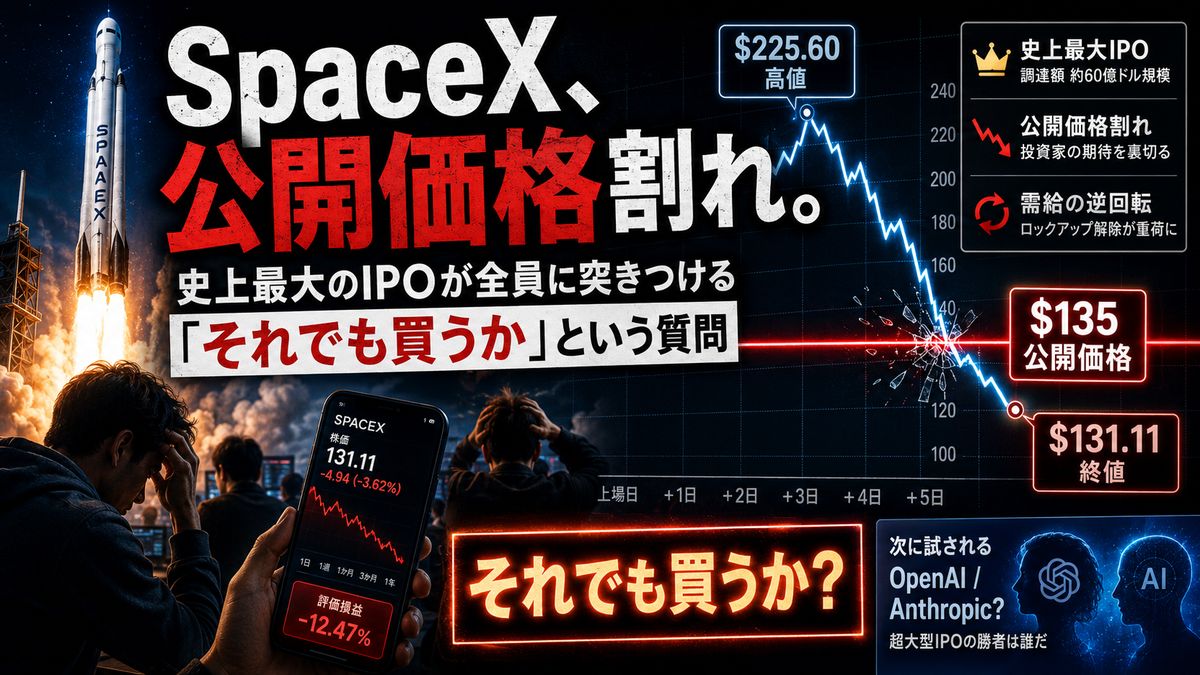
2026年7月16日、SpaceXの株価は$131.11で取引を終えました。6月11日に$135で値決めされ、史上最大の調達額約750億ドル、想定時価総額1.77兆ドルで上場した銘柄が、わずか1ヶ月あまりで公開価格を下回ったのです。上場直後には$225.60の高値を付けていました。そこからの下落率は約4割になります。
On July 16, 2026, SpaceX closed at $131.11. A stock that priced at $135 on June 11 and listed as history's largest IPO, raising roughly $75 billion at an implied valuation of $1.77 trillion, slipped below its offer price just over a month later. Shortly after listing it had touched a high of $225.60. From that peak, the decline is roughly 40%.
※ 公開価格(IPO価格)とは、新規上場する企業が上場前の需要調査を経て決める、最初の売出価格のこと。上場後の株価がこれを下回ることは「公募組が全員含み損」を意味するため、市場では心理的な節目として強く意識される。
※ The IPO price is the initial offering price a company sets after pre-listing demand surveys. When the stock trades below it, everyone who bought in the offering is underwater, which is why the level is watched as a strong psychological line.
SpaceX stock closes below its IPO price for the first time since it went public(NBC News)
このIPOには特徴がありました。通常なら1桁台の比率しか回ってこない個人投資家への配分が、約3割あったのです。「開かれたIPO」と呼ばれた売出しに参加した個人の多くが、いま含み損を抱えています。SNSには悲鳴と嘲笑が同時に流れています。
This IPO had one unusual feature. Retail investors, who normally receive a single-digit share of an offering, were allocated about 30%. Many of the individuals who joined what was billed as an open IPO are now sitting on losses, and social media is carrying screams and schadenfreude in equal measure.
イーロン・マスクの宇宙事業は失敗したのでしょうか。それとも、これは何か別の現象なのでしょうか。
Did Elon Musk's space business just fail? Or is this something else entirely?
Omochi編集部の結論を先に言うと、この公開価格割れは、ロケットへの判決ではありません。需給の時間割どおりに進んでいる、機械の逆回転です。そして本当に面白い話は、SpaceXの株価そのものではなく、この値動きを固唾を飲んで見ている2つの未上場企業、OpenAIとAnthropicの側にあります。
Omochi's editors will state our conclusion up front: this break below the IPO price is not a verdict on rockets. It is a machine running in reverse, right on the supply-and-demand timetable. And the truly interesting story is not SpaceX's share price itself, but the two private companies watching it with held breath, OpenAI and Anthropic.
答え合わせ。私たちは6月に「機械的な暴騰」を書いた
Grading Our Own Homework: In June We Wrote About a Mechanical Melt-Up
この上場の前、私たちは3兆ドルが米株へ流入? 暴騰リスクの可能性についてという記事を書きました。要旨はこうです。米国の主要インデックスがIPO銘柄の組み入れルールを一斉に緩和しようとしている。パッシブファンドは指数に入った銘柄を機械的に買うしかない。フロートが薄いメガIPOにその買いが集中すれば、機械的なメルトアップが起きる、と。
Before this listing, we published an article on the $3 trillion flowing into US equities and the melt-up risk. The gist: the major US indices were loosening their IPO inclusion rules in unison; passive funds have no choice but to buy whatever enters an index; and if that buying concentrates on mega IPOs with thin floats, a mechanical melt-up follows.
※ パッシブファンドとは、S&P 500やNasdaq-100といった株価指数の構成銘柄を、そのまま機械的に保有するファンドのこと。指数に銘柄が追加されれば判断を挟まず買い、除外されれば売る。米国ETF市場だけで約13兆ドルという巨大な規模を持つ。
※ A passive fund mechanically holds the constituents of an index such as the S&P 500 or Nasdaq-100. When a stock is added it buys without judgment; when one is removed it sells. The US ETF market alone is roughly $13 trillion in size.
※ フロート(浮動株)とは、発行済株式のうち、創業者や経営陣、ロックアップ中の初期投資家の保有分を除いた、市場で実際に売買できる株式のこと。フロートが薄い銘柄ほど、少ない資金で価格が大きく動く。
※ Float refers to the shares actually available for trading, after excluding holdings of founders, management, and early investors still under lockup. The thinner the float, the more the price moves on less money.
前半は、当たりました。SpaceXは初日から買いが殺到し、翌営業日には20%上昇。時価総額は一時2兆ドルを超え、米国上場企業の第6位に躍り出ました。高値$225.60は公開価格の1.67倍です。
The first half of that call landed. SpaceX drew a rush of buying from day one and rose 20% the next full session. Its market cap briefly topped $2 trillion, making it the sixth most valuable US-listed company. The $225.60 high was 1.67 times the offer price.
SpaceX stock jumps 20% in first full day of trading after record debut(CNBC)
では、後半に何が起きたのか。あの記事で書いた「機械」が、逆向きに回り始めたのです。
So what happened in the second half? The machine we described in that article started turning the other way.
第一に、最大の買い手が来ないことが確定しました。S&P Dow Jonesは6月4日、メガキャップIPO向けにシーズニング期間の短縮とGAAP黒字要件の免除を検討していた市場協議の結果、ルールを一切変更しないと発表しました。つまりSpaceXがS&P 500に入れるのは、最短でも上場から12ヶ月後の2027年半ば。しかも直近4四半期のGAAP黒字が条件です。SpaceXの2025年は、売上約187億ドルに対して約49億ドルの純損失でした。テスラのときに510億ドルの強制買いを生んだあの巨大な蛇口は、当面開きません。
First, it became official that the biggest buyer is not coming. On June 4, S&P Dow Jones concluded its market consultation on shortening the seasoning period and waiving the GAAP profitability test for megacap IPOs by announcing that it would change nothing at all. That means the earliest SpaceX can enter the S&P 500 is mid-2027, twelve months after listing, and only with four consecutive quarters of GAAP profit. In 2025, SpaceX posted a net loss of roughly $4.9 billion on revenue of about $18.7 billion. The giant faucet that generated $51 billion of forced buying in Tesla's case stays closed for now.
※ GAAPとは、米国で公式に採用されている会計基準(米国会計原則)のこと。S&P 500への組み入れには、この基準で計算した利益が直近4四半期の合計と直近1四半期の両方で黒字であることが求められる。調整後利益ではなく、会計基準どおりの黒字である点が重要。
※ GAAP stands for the officially adopted US accounting standards. S&P 500 inclusion requires profitability under these standards both for the most recent quarter and for the sum of the most recent four quarters. The key point is that this means accounting-standard profit, not adjusted profit.
SpaceX, Mega IPOs Denied Fast S&P 500 Index Entry(Bloomberg)
第二に、売り手の到着時刻が決まっています。8月上旬、最初のロックアップ解除で約9.1億株、時価にして約1,230億ドル分の株式が売却可能になります。解除は段階的に続くため、この供給圧力は今後1年近く断続的に続く見込みです。市場は「8月に大量の売り物が出る」と知っているので、その前に降りようとする。だから解除日の前から株価は下がる。教科書どおりの前倒しです。
Second, the sellers have a scheduled arrival time. In early August, the first lockup expiration will make roughly 910 million shares, about $123 billion at market value, eligible for sale. Because the lockups expire in stages, this supply pressure is expected to recur for close to a year. The market knows a wall of stock arrives in August, so it tries to get out beforehand, which is why the price falls ahead of the date. Textbook front-running of a known event.
※ ロックアップとは、上場前からの株主(従業員、初期投資家、経営陣など)に課される、上場後一定期間の売却禁止約束のこと。解除日を過ぎると保有株を市場で売れるようになるため、解除日前後は需給の悪化が強く意識される。
※ A lockup is a commitment imposed on pre-IPO shareholders such as employees, early investors, and management not to sell for a set period after listing. Once it expires they can sell in the open market, so supply-demand deterioration is heavily anticipated around expiry dates.
SpaceX IPO lockup expiry: $123B in shares set to unlock in early August 2026(Investing.com)
第三に、会社側も燃料を投下しました。750億ドルを調達した直後に250億ドルの追加社債を発行。さらに7月半ばには主力ロケットStarshipの打ち上げ延期が重なり、時間外取引で株価は一時$124まで売られました。
Third, the company added fuel of its own. Days after raising $75 billion, it issued another $25 billion in debt. Then in mid-July a delay to the flagship Starship launch landed on top, and the stock was sold down to $124 at one point in after-hours trading.

整理すると、こうなります。買う理由(インデックスの強制買い)は2027年に持ち越され、売る理由(ロックアップ解除)は8月に迫っている。フロートが薄い銘柄は、上げるときも下げるときも値幅が出る。6月の急騰と7月の急落は、同じ一つの構造の表と裏です。業績が1ヶ月で4割悪化したわけではありません。
Put it all together and the picture is simple. The reason to buy, forced index buying, has been postponed to 2027. The reason to sell, the lockup expiration, arrives in August. A thin-float stock swings hard in both directions. The June surge and the July plunge are two faces of the same single structure. The business did not get 40% worse in a month.
| 日付 | 出来事 | 需給への意味 |
|---|---|---|
| 6月4日 | S&P Dow Jonesがルール変更を拒否 | S&P 500の強制買いは最短2027年半ばへ |
| 6月11-12日 | $135で値決め、Nasdaq上場 | 史上最大の約750億ドルを調達 |
| 6月中旬 | 高値$225.60 | 組み入れ期待と熱狂、フロートの薄さが増幅 |
| 7月15-16日 | 公開価格割れ、終値$131.11 | Starship延期も重なり時間外$124 |
| 8月上旬 | ロックアップ第1弾解除 | 約1,230億ドル分が売却可能に |
| 2027年半ば | S&P 500組み入れの最短時期 | 条件は直近4四半期のGAAP黒字 |
| Date | Event | What it means for flows |
|---|---|---|
| Jun 4 | S&P Dow Jones rejects rule changes | Forced S&P 500 buying pushed to mid-2027 at the earliest |
| Jun 11-12 | Priced at $135, lists on Nasdaq | History's largest raise at roughly $75B |
| Mid-June | High of $225.60 | Inclusion hopes and euphoria, amplified by the thin float |
| Jul 15-16 | Breaks the IPO price, closes $131.11 | Starship delay adds $124 in after-hours |
| Early Aug | First lockup expiration | About $123B of stock becomes sellable |
| Mid-2027 | Earliest S&P 500 entry | Requires four straight quarters of GAAP profit |
この光景には前例があります。2012年5月、当時史上最大のテックIPOだったFacebookは、公開価格$38に対して初日からつまずき、9月には$17.55まで半値以下に沈みました。メディアは「IPOの失敗」と書き立てました。その後の10年で何が起きたかは、いまMeta株を見れば分かります。公開価格割れは、企業の死亡診断書だったことも、絶好の買い場だったこともある。線を割ったという事実そのものには、どちらの情報も含まれていません。
There is precedent for this scene. In May 2012, Facebook, then the largest tech IPO in history, stumbled from day one against its $38 offer price and sank below half that to $17.55 by September. The media wrote it up as a failed IPO. What the following decade delivered is visible in Meta's stock today. A broken IPO price has been both a corporate death certificate and the buying opportunity of a decade. The fact of crossing the line, by itself, contains neither piece of information.
Facebook Plunges Below IPO Price in Frenetic Trading(Forbes)
株の中身。xAIという赤字の同居人
Inside the Stock: xAI, the Loss-Making Housemate
とはいえ、「全部需給のせい」で済ませるのは不誠実です。売られる側にも事情はあります。そしてSpaceXの場合、その事情には名前が付いています。xAIです。
That said, blaming everything on supply and demand would be dishonest. The side being sold has its own issues, and in SpaceX's case the issue has a name: xAI.
2025年にSpaceXへ統合されたマスクのAI事業は、上場に伴う開示で初めて家計簿を公開しました。数字は強烈です。2025年は売上32億ドルに対して63.6億ドルの損失。2026年第1四半期だけで、売上8.18億ドルに対して24.7億ドルの営業損失。設備投資は2025年に127億ドルと、SpaceX本体がStarlinkとロケット事業に投じた合計80億ドルを上回りました。米メディアはこの開示を「無謀に見える財務」と評しています。ChatGPTやGeminiと戦うAIレースにおいて、Grokが劣勢であることを隠す数字ではありません。
Musk's AI business, folded into SpaceX in 2025, opened its household accounts for the first time in the listing disclosures, and the numbers are stark. In 2025 it lost $6.36 billion on $3.2 billion of revenue. In the first quarter of 2026 alone, it ran a $2.47 billion operating loss on $818 million of revenue. Its 2025 capital spending of $12.7 billion exceeded the $8 billion SpaceX itself put into Starlink and the rocket business combined. US media described the disclosure as financials that look reckless. Nothing in these figures hides the fact that Grok is losing the AI race against ChatGPT and Gemini.
'Financials Look Reckless': Lifting xAI's Hood in the SpaceX IPO(Morningstar)
ただし、この話には皮肉な脚注が付きます。xAIがメンフィスに建てた巨大データセンターColossus 1は、稼働率約11%で遊んでいました。それを丸ごと借り上げたのが、よりによって競合のAnthropicです。月額12.5億ドル、2029年5月までの契約で、総額は400億ドルを超える可能性があると報じられています。
This story, however, carries an ironic footnote. Colossus 1, the giant data center xAI built in Memphis, was sitting at roughly 11% utilization. The company that leased the whole thing was, of all parties, rival Anthropic: $1.25 billion a month under a contract through May 2029, reportedly worth more than $40 billion in total.
Anthropic will pay xAI $1.25B per month for compute(TechCrunch)
つまりマスクは、AIモデルの競争では負けつつ、AIインフラの大家としては勝ち始めている。ロケットと衛星通信で圧倒的な本業を持ち、失敗しかけたAI投資すら不動産収入に変えてしまう。「xAIで失敗し、SpaceXで成功している」という同居の構図こそが、この銘柄の評価を難しくしている正体です。投資家はロケット会社を買ったつもりで、AIスタートアップの燃焼率も一緒に抱えることになりました。
In other words, Musk is losing the AI model race while starting to win as an AI infrastructure landlord. He commands an overwhelming core business in rockets and satellite communications, and even a faltering AI bet gets converted into rental income. This cohabitation, failing at xAI while succeeding at SpaceX, is exactly what makes the stock so hard to value. Investors thought they were buying a rocket company and found an AI startup's burn rate living in the same house.
本当の観客席にいるのは、OpenAIとAnthropic
The Real Audience: OpenAI and Anthropic
ここまでが表のストーリーです。では、この公開価格割れを世界で最も真剣に見ているのは誰でしょうか。SpaceXの株主ではないと思います。これから上場する側です。
That is the surface story. So who is watching this broken IPO price more intently than anyone else on earth? Probably not SpaceX's shareholders. The companies about to go public are.
SpaceXは、1兆ドル級の未上場企業が公開市場に着水するとどうなるかを試した、最初の実験でした。そしてその実験は「初月に67%上がり、翌月に公開価格を割る」という結果を出した。この答案用紙を、OpenAIとAnthropicの経営陣とバンカーたちが精読していないはずがありません。
SpaceX was the first experiment in what happens when a trillion-dollar private company splashes down in the public market. The experiment returned its result: up 67% in the first month, below the offer price in the second. There is no chance the executives and bankers at OpenAI and Anthropic are not studying that answer sheet line by line.
実際、2社の動きは対照的です。Anthropicは6月1日に機密でS-1を提出し、10月にもNasdaqへ上場する計画と報じられています。一方のOpenAIは6月8日にS-1を提出しながら、市場のボラティリティなどを理由に上場を2027年へ先送りする方向だと、Bloombergが報じました。「市場のボラティリティ」が何を指すかは、SPCXのチャートを見れば一目瞭然です。
And the two are moving in opposite directions. Anthropic filed a confidential S-1 on June 1 and is reported to be planning a Nasdaq listing as soon as October. OpenAI filed its own S-1 on June 8, yet Bloomberg reports it is leaning toward pushing its listing to 2027, citing market volatility among other reasons. One glance at the SPCX chart shows exactly what "market volatility" refers to.
※ S-1とは、米国で株式を公開する企業がSEC(米証券取引委員会)に提出する上場登録届出書のこと。財務諸表、リスク要因、資金使途などが記載される。機密提出(confidential filing)の場合、内容は一定期間公開されないため、市場は「提出した」という事実だけを知ることになる。
※ An S-1 is the registration statement a company files with the SEC to go public in the US, covering financial statements, risk factors, and use of proceeds. With a confidential filing, the contents stay private for a period, so the market learns only the fact that a filing was made.
OpenAI Considers 2027 IPO After Anthropic’s Expected Public Debut(Bloomberg)
同じ答案を読んで、1社は「ロックアップの売り圧力が本格化する前の窓で先に上場する」ことを選び、もう1社は「実験台の結果が出揃うまで待つ」ことを選んだように見えます。どちらが正解かはまだ分かりません。確かなのは、AIバブルかどうかという論争の主戦場が、モデルの性能比較から、上場のタイミングという極めて古典的な資本市場の駆け引きへ移ったことです。
Reading the same answer sheet, one company appears to have chosen to list first, inside the window before lockup selling pressure peaks, while the other chose to wait until the test subject's full results are in. Which is right, nobody knows yet. What is certain is that the main battlefield of the AI bubble debate has shifted from model benchmarks to listing timing, one of the oldest games in capital markets.
編集部の見立て。公開価格割れとは「質問が本物になった価格」
Our Take: The Broken IPO Price Is Where the Question Became Real
ここから先は、Omochi編集部の見立てです。
What follows is the view of Omochi's editorial team.
SNSの論調は分かりやすく二分されています。「だから言っただろう、バブルだ」と「絶好の買い場だ」。私たちはどちらの断言にも与しません。その代わり、一つの質問を置きたいと思います。
Social media has split into two easy camps: "told you it was a bubble" and "buying opportunity of the year." We side with neither declaration. Instead, we want to leave one question on the table.
もしあなたが、$131でSpaceXの株を、あるいは上場前のOpenAIやAnthropicの株を買える立場だったら、本当に見送りますか。
If you were in a position to buy SpaceX at $131, or pre-IPO shares of OpenAI or Anthropic, would you honestly pass?
未上場の間、この質問は答えなくていい質問でした。評価額は資金調達のたびに関係者が決め、外野は「高すぎる」と言うだけで済んだ。公開市場は違います。毎朝9時30分、世界中の全員に同じ質問を突きつけ、答えを価格として記録する装置です。買わないという判断も、売るという判断も、全部値段になって残る。
While these companies stayed private, this was a question nobody had to answer. Valuations were set by insiders at each funding round, and outsiders could simply say "too expensive" and move on. The public market is different. Every morning at 9:30, it puts the same question to everyone on earth and records the answers as a price. The decision not to buy, and the decision to sell, all of it becomes a number that stays.
だから、公開価格割れという出来事の本質は「SpaceXが失敗した」ことではないと考えています。1.77兆ドルという評価額に対して、初めて全員参加の答え合わせが始まった、ということです。6月の$225は熱狂の答えで、7月の$131は恐怖と需給の答えでした。おそらくどちらも正解ではありません。本当の答えは、8月からのロックアップ解除が消化され、2027年にS&P 500の蛇口が開くかどうかが見え、xAIの赤字が縮むか膨らむかが分かる過程で、ゆっくり出てきます。
That is why we think the essence of this event is not that SpaceX failed. For the first time, the grading of a $1.77 trillion valuation has begun with everyone participating. June's $225 was the answer of euphoria; July's $131 is the answer of fear and flow mechanics. Most likely, neither is correct. The real answer will emerge slowly, as the lockup supply gets absorbed from August, as it becomes clear whether the S&P 500 faucet opens in 2027, and as xAI's losses either shrink or swell.
そしてその頃には、AnthropicとOpenAIの株価も、同じ黒板に並んでいるはずです。史上最大のIPOの公開価格割れは、終わりの合図ではなく、AI時代の企業価値を全員で値付けし直す長い作業の、最初の消しゴムの跡なのだと思います。
And by then, Anthropic's and OpenAI's share prices should be up on the same blackboard. The broken price of history's largest IPO is not a closing bell. It is the first eraser mark in the long, collective work of repricing what companies are worth in the AI era.
答え合わせの続きは、2027年に。
The next round of grading comes in 2027.
こうした相場の話を、数字を肴にじっくり語り合う場所探しは、Omochiにお任せください。
And when you need a place to talk markets over the numbers, slowly and properly, leave the venue-hunting to Omochi.