最初の30分は嘘をつく。雇用統計の初期反応と、引けまでに残ったもの
The First Thirty Minutes Lie. What the Jobs Report Did, and What Survived to the Close
8月7日の夜、日本時間の21時30分。米労働省が7月の雇用統計を発表した瞬間から15分間で、ドル円は1円62銭下げ、米2年債利回りは9ベーシスポイント低下しました。数字は誰が見ても弱く、市場の反応は誰が見ても素直でした。「これで9月の利上げはなくなった」という反応です。
9:30pm Japan time on August 7. In the fifteen minutes from the moment the US Labor Department released the July employment report, USD/JPY fell 1.62 yen and the 2-year Treasury yield dropped 9 basis points. The numbers were weak by anyone's reading, and the market's reaction was equally straightforward: the September rate hike is off the table.
ところが、その日の引けまで残ったものを数えると、話が変わります。ドル円は下げ幅の68.5%を戻し、2年債利回りの低下も9ベーシスポイントから5ベーシスポイントへと縮みました。一方で米国株は初期の上昇を一度も手放さず、S&P500は最高値で引けています。
Count what was still there at the close, though, and the story changes. USD/JPY had retraced 68.5% of its drop, and the 2-year's decline had narrowed from 9 basis points to 5. US equities, meanwhile, never surrendered any of their initial gain, and the S&P 500 closed at a record high.
大事なのは、この差が何を意味するかです。為替と金利は「利上げは本当になくなったのか」という問いをその日のうちに考え直し、答えを「まだ分からない」に修正しました。株はその問い直しをしなかった。同じニュースを、片方は真剣に値付けし直し、片方は気にしなかったということです。この記事は、その差分を実測して整理します。
What matters is what that gap means. FX and rates spent the day reconsidering the question "is the hike really off?" and revised their answer to "not yet clear." Equities never reconsidered at all. One side re-priced the same news seriously; the other side did not care. This article measures that difference.
まず、何が発表されたのか
First, What Was Actually Released
7月の非農業部門雇用者数※は前月比2万3000人の減少でした。市場予想は8万人前後の増加(集計機関により8万〜8万3000人)でしたから、方向が逆です。しかも事前予想のなかで最も弱い見通しすら下回りました。
July nonfarm payrolls※ fell by 23,000 from the prior month. The consensus called for a gain of roughly 80,000 (80,000 to 83,000 depending on the compiler), so the sign itself was wrong. The print also came in below even the weakest individual forecast.
※ 非農業部門雇用者数(NFP)とは、米国の農業を除く事業所の就業者数の前月比増減のことです。毎月第1金曜に発表され、米国の景気と金融政策を占う最重要指標とされています。
※ Nonfarm payrolls (NFP) is the month-over-month change in the number of workers at US establishments excluding agriculture. Released on the first Friday of each month, it is regarded as the single most important indicator for reading the US economy and monetary policy.
しかし本当に効いたのは、見出しの数字ではなく過去の修正でした。5月分が12万9000人から6万3000人へ、6月分が5万7000人から2万人へ。2カ月合計で10万3000人が消えています。予想との乖離が約10万人ですから、両方を足すと、市場はこの朝、それまで前提にしていた雇用の勢いを20万人分ほど失った計算になります。ロイターによれば、この修正幅は前任のBLS長官が解任される引き金となった2025年7月分以来の大きさです。
But what really landed was not the headline number; it was the revisions to the past. May was cut from 129,000 to 63,000, and June from 57,000 to 20,000. Across the two months, 103,000 jobs vanished. Add the roughly 100,000 shortfall against consensus and the market lost something like 200,000 jobs' worth of assumed momentum in a single morning. According to Reuters, these are the largest revisions since the July 2025 report that triggered the dismissal of the previous BLS commissioner.
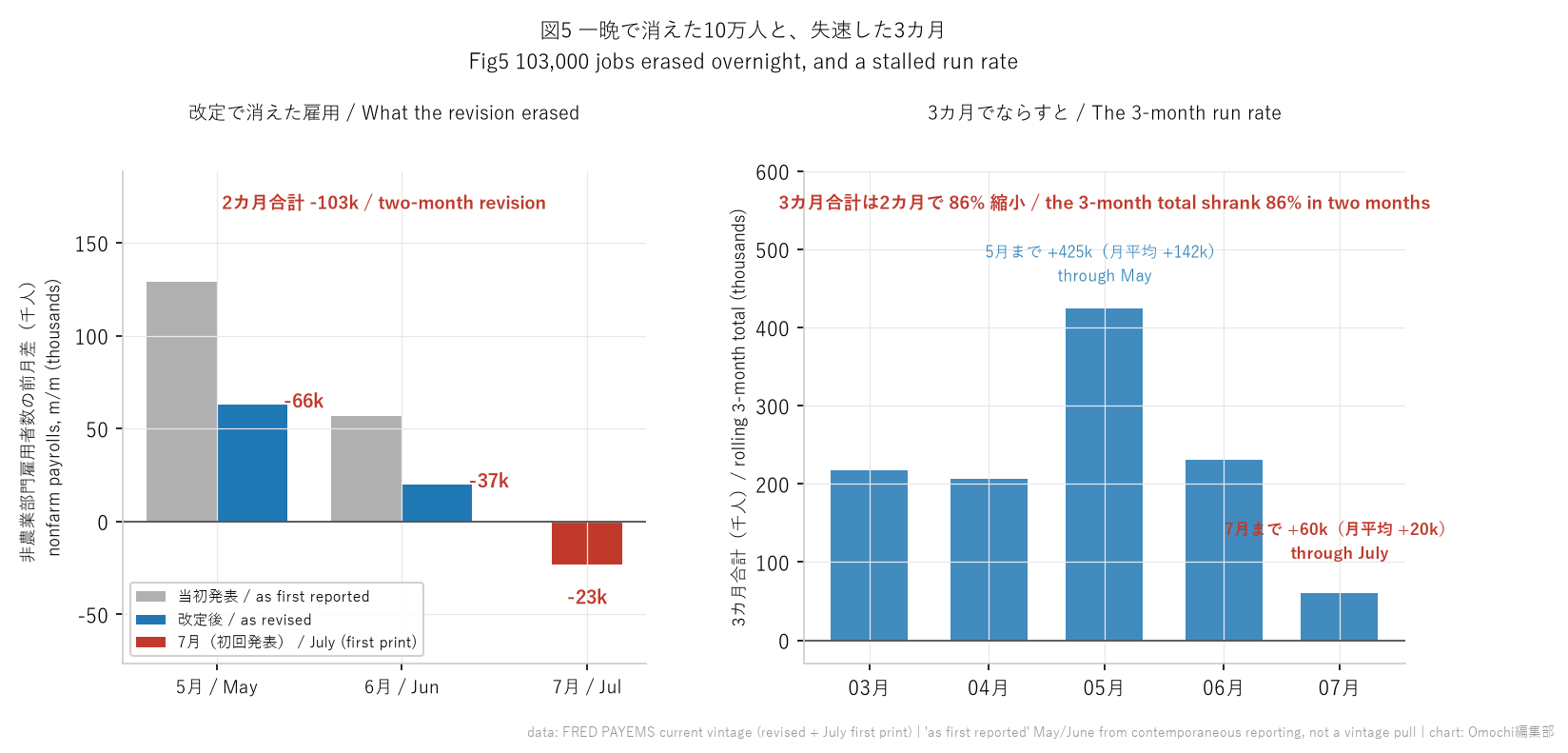
数字を3カ月でならすと、この報告書の重さがもう少しはっきりします。3カ月合計の雇用増加数は、5月までの42万5000人(月平均14万2000人)から、7月までは6万人(月平均2万人)へ。わずか2カ月で86%縮んだ計算です。1カ月の数字は振れますが、四半期分をまとめても月平均2万人しか増えていないとなると、これは「たまたま弱い月があった」では説明がつきません。
Smooth the numbers over three months and the weight of this report becomes clearer. The three-month total of job gains fell from 425,000 through May (an average of 142,000 a month) to 60,000 through July (an average of 20,000). That is an 86% contraction in just two months. Single months are noisy, but when a full quarter's worth of data averages only 20,000 jobs a month, "one weak month happened to land" no longer explains it.
奇妙なのは失業率です。雇用者数が減ったのに、失業率は4.2%から4.1%へ低下しました。理由は分解すると分かります。家計調査の就業者数は8万7000人減った一方で、労働力人口は26万4000人減っている。失業者としてカウントされる人が17万8000人減った計算です。つまり職を失った人以上に「探すのをやめた人」がいたため、統計上の失業者が減ったわけです。失業率は「働きたいのに職がない人」の割合ですから、職探しそのものをやめれば分母からも分子からも消えて、数字はかえって改善します。ネイビー・フェデラル・クレジット・ユニオンのチーフエコノミスト、ヘザー・ロング氏の言葉が的確でした。
The odd part is the unemployment rate. Employment fell, yet the rate declined from 4.2% to 4.1%. Break it down and the reason appears. Household survey employment dropped 87,000, while the labor force shrank by 264,000, meaning the number of people counted as unemployed fell by 178,000. More people stopped looking than lost work, so the statistical count of the unemployed went down. The unemployment rate measures those who want work but have none, so if you abandon the job search entirely you disappear from both the numerator and the denominator, and the figure improves. Heather Long, chief economist at Navy Federal Credit Union, put it precisely.
「失業率4.1%。これは間違った理由で下がりました。26万人以上が労働力から抜けたのです」
"Unemployment rate: 4.1%. This went down for the WRONG reasons. Over 260,000 left the labor force."
労働参加率※は61.4%と5年ぶりの低さで、1月からの7カ月で約0.7ポイント下がっています。就業者が減ったというより、労働市場から人が抜けていく過程が続いている、と読むべき数字です。
The participation rate※ stands at 61.4%, its lowest in five years, down about 0.7 points over the seven months since January. This is better read as an ongoing exit of people from the labor market than as a simple decline in employment.
※ 労働参加率とは、生産年齢人口のうち働いているか職を探している人の割合のことです。職探しをやめた人が増えると、失業率が下がっても労働参加率は低下します。
※ The labor force participation rate is the share of the working-age population that is either employed or looking for work. When more people give up searching, the participation rate falls even as the unemployment rate declines.
内訳には2026年固有の事情もあります。減少幅が最も大きかったのは地方政府の教育部門で5万人減。次いでレジャー・接客業が4万人減ですが、これは複数の米メディアがワールドカップの開催終了に伴う一時雇用の剥落として説明しています。すべてが弱かったわけではなく、建設は2万2000人増、製造業も5000人増でした。ただし一過性の要因を差し引いても、医療分野の増加が2万2000人と過去12カ月平均の3万6000人を大きく下回っており、これまで雇用を支えてきた柱が細っていることは確かです。
The composition also carries circumstances specific to 2026. The largest decline was local government education, down 50,000. Next came leisure and hospitality at 40,000, which several US outlets attribute to temporary jobs rolling off after the World Cup ended. Not everything was weak: construction added 22,000 and manufacturing 5,000. Even setting the one-off factors aside, however, health care added only 22,000 against a twelve-month average of 36,000, so the pillar that has been holding up employment is visibly thinning.
なお統計そのものの信頼性についても、この日は象徴的な出来事がありました。この報告書が出た数時間後、上院はブレット・マツモト氏を51対47でBLS長官に承認しています。2025年8月に前任者が解任されて以来空席だったポストが、その解任理由と同種の大幅修正が出た当日に埋まったことになります。ロイターはデータ操作の証拠はないと明記していますが、BLSは幹部ポストの3分の1以上が空席で、事業所調査の初回回答率が従来の約70%から約60%へ低下しており、43日間の政府閉鎖で10月分の収集ができなかったことも記録されています。数字の質そのものが論点になりつつある、という背景は押さえておく価値があります。
There was also a symbolic development that day regarding the reliability of the statistics themselves. Hours after the report was published, the Senate confirmed Brett Matsumoto as BLS Commissioner by 51 to 47. A post that had sat vacant since his predecessor was dismissed in August 2025 was filled on the very day that revisions of the same kind that caused that dismissal were released. Reuters states explicitly that there is no evidence of data manipulation, but more than a third of senior BLS positions are vacant, the establishment survey's first-close response rate has fallen from roughly 70% to about 60%, and a 43-day government shutdown made October collection impossible. The quality of the numbers themselves is becoming a live question, and that background is worth holding onto.
初期反応と、引けに残ったもの
The Knee-Jerk, and What Was Left at the Close
ここからは私たちが実測した部分です。ブローカー配信の15分足を使い、発表時刻(米東部時間8時30分)の直前の終値を基準に、その後の値動きを測りました。発表の瞬間を挟む15分足がその日で最も値幅の大きい足になることを確認して、時刻のずれがないことを検証しています。なお為替・株価指数・原油は私たちの実測値、米国債の利回りは報道および公表統計からの引用です(利用しているブローカー配信に債券商品がないため、日中の利回り推移だけは自前で測れていません)。この2つは区別して書きます。
From here on, these are our own measurements. Using 15-minute bars from a broker feed, we measured price action against the last close before the release time (8:30am US Eastern). We verified that the 15-minute bar containing the release moment is the widest-range bar of the day, which confirms there is no timestamp misalignment. Note that the FX, equity index and crude figures are our measurements, while the Treasury yields are cited from reporting and published statistics: our broker feed carries no bond instruments, so the intraday yield path alone is not something we can measure ourselves. We keep the two clearly separated.
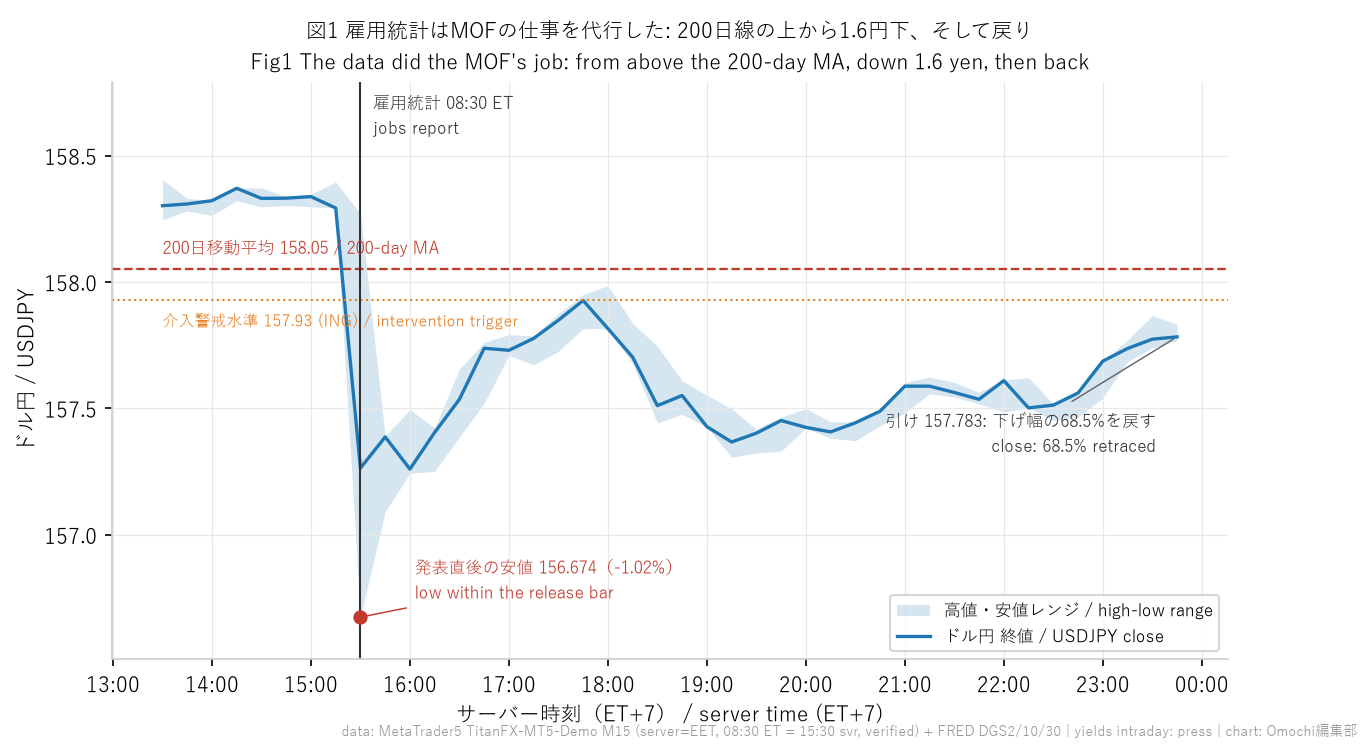
ドル円は発表直前に158.293円でした。ここが重要な点です。私たちが8月6日に公開した記事で、200日移動平均の158.05円を上に抜けたら財務省の介入が現実味を帯びる、と書いたその水準を、既に上抜けていたのです。INGが介入警戒ラインとして挙げていた157.93円も超えていました。
USD/JPY stood at 158.293 immediately before the release. This is the important part. In an article we published on August 6, we wrote that a break above the 200-day moving average at 158.05 would make Ministry of Finance intervention a live prospect. The pair had already broken above it. It was also through the 157.93 level ING had flagged as its intervention-alert line.
そこに雇用統計が来ました。発表直後の15分足は高値158.271円から安値156.674円まで、実に1円60銭の値幅で振れています。前日比マイナス1.02%。介入を待つまでもなく、統計そのものが円を買い戻したことになります。ロイターも慎重に書いていました。
Then the jobs report arrived. The 15-minute bar covering the release swung from a high of 158.271 to a low of 156.674, a range of 1.60 yen, or minus 1.02%. Without waiting for any intervention, the statistics themselves bought the yen back. Reuters was careful in its wording.
「日本の当局が関与したかどうかは直ちには明らかでないが、アナリストらは雇用統計の弱さだけでもドルを売る理由として十分だと指摘した」
"It was not immediately clear whether Japanese authorities were involved, although analysts said the weakness in the jobs data could be reason enough to sell the dollar."
ところが、そこからが本題です。引け(サーバー時刻23時45分)のドル円は157.783円。安値からの戻りは下げ幅の68.5%に達しました。1円62銭下げて、1円11銭戻したことになります。
But here is the real point. At the close (23:45 server time), USD/JPY was at 157.783. The recovery from the low amounted to 68.5% of the drop. It fell 1.62 yen and climbed back 1.11 of them.
米2年債利回りも同じ形でした。報道ベースで4.22%から一時4.15%まで9ベーシスポイント低下した後、引けは4.19%近辺と、低下幅の4割強を戻しています。2年債は「これから2年間の政策金利の平均」を映す年限ですから、ここが戻ったということは、市場が「利上げ停止」の織り込みを部分的に取り消したことを意味します。
The 2-year Treasury yield traced the same shape. On reported figures it fell 9 basis points from 4.22% to a low of 4.15%, then closed near 4.19%, giving back a little over 40% of the decline. The 2-year reflects the average expected policy rate over the coming two years, so a retracement there means the market partially cancelled its pricing of a halt to rate hikes.
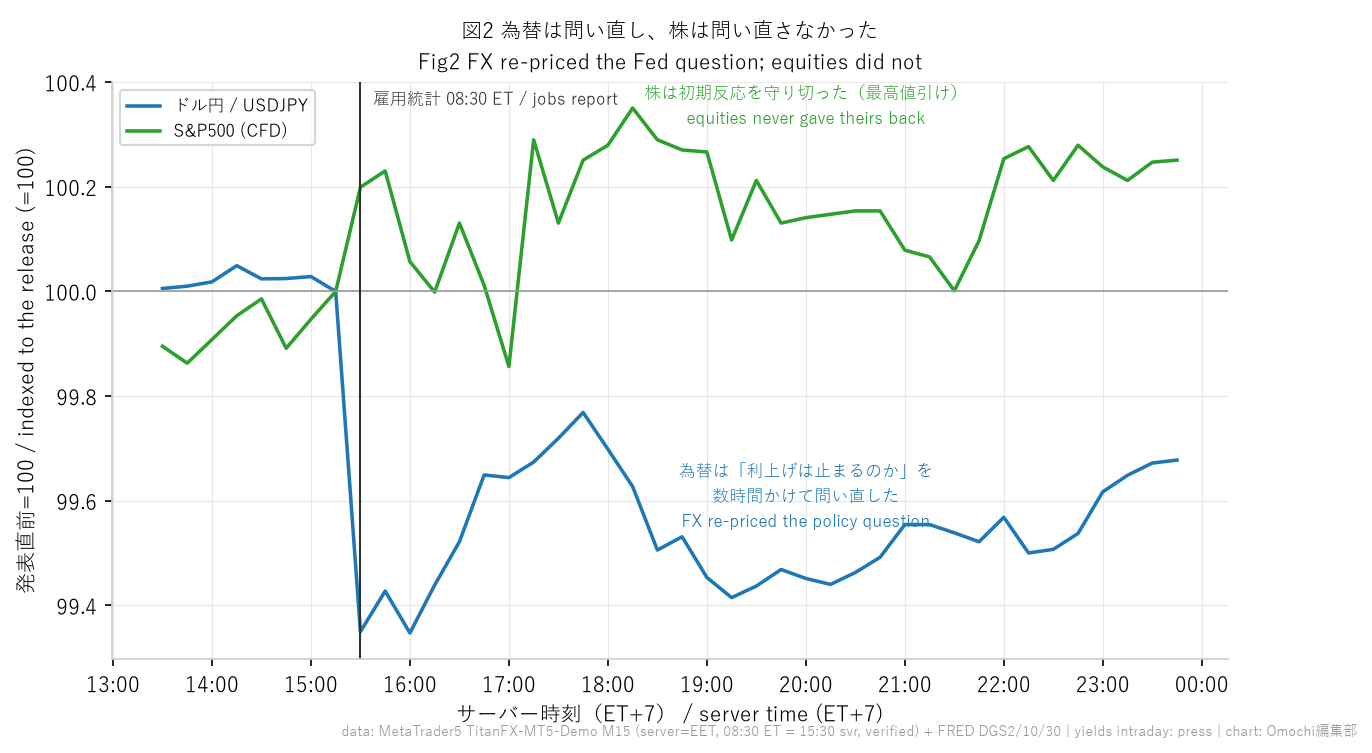
例外は株でした。S&P500(CFD)は発表後に上昇して、その後も一度も発表前の水準を割り込まないまま引けています。現物のS&P500は7757.64、前日比プラス0.62%で史上最高値引け。ナスダック総合はプラス1.30%の26690.62、ダウはプラス0.28%でした。
Equities were the exception. The S&P 500 (CFD) rose after the release and never once traded back below its pre-release level before the close. The cash S&P 500 finished at 7,757.64, up 0.62%, an all-time closing high. The Nasdaq Composite gained 1.30% to 26,690.62, and the Dow added 0.28%.
ここが、この日の相場のいちばん正直な要約です。為替と金利という、金融政策そのものを値段にしている市場は、「利上げはなくなったのか」という問いに対して初期反応で一度は「なくなった」と答え、数時間かけて「まだ分からない」へ戻しました。理屈のうえでは、これが正しい振る舞いです。雇用が弱いことと、利上げが止まることは、同じではないからです。一方で株式市場は、初期反応の「利上げが遠のいた」という解釈だけを持ち帰り、最高値で引けました。同じ材料に対して、片方は考え直し、片方は考え直さなかった。
This is the most honest summary of the day. FX and rates, the markets that put a price on monetary policy itself, answered "yes, it's off" in the knee-jerk and then spent several hours walking back to "not yet clear." Logically, that is the correct behaviour, because weak employment and a halt to rate hikes are not the same thing. The equity market, by contrast, took home only the initial reading that hikes had receded, and closed at a record. Facing identical information, one side reconsidered and the other did not.
戻した理由を、時計で確かめる
Checking the Reason for the Retracement Against the Clock
なぜ初期反応は消えたのか。ブルームバーグは午後に原油が上昇したことを理由に挙げています。イラン議会の委員会がホルムズ海峡での米・イスラエル船籍の通航禁止を審議しているとの報道で、WTI原油は一時1.46%高。原油高はインフレ懸念に直結しますから、いったん引っ込んだ利上げ観測が戻る、という筋書きです。
Why did the initial reaction fade? Bloomberg points to crude oil rising in the afternoon. On reports that an Iranian parliamentary committee was reviewing a ban on US and Israeli vessels transiting the Strait of Hormuz, WTI rose as much as 1.46%. Higher oil feeds directly into inflation concerns, so the story goes that rate-hike expectations, having briefly retreated, came back.
筋は通っています。ただ、私たちが測れた範囲では、時計の順番が少し合いません。
The logic is sound. But within the range of what we could measure, the order of the clock does not quite line up.
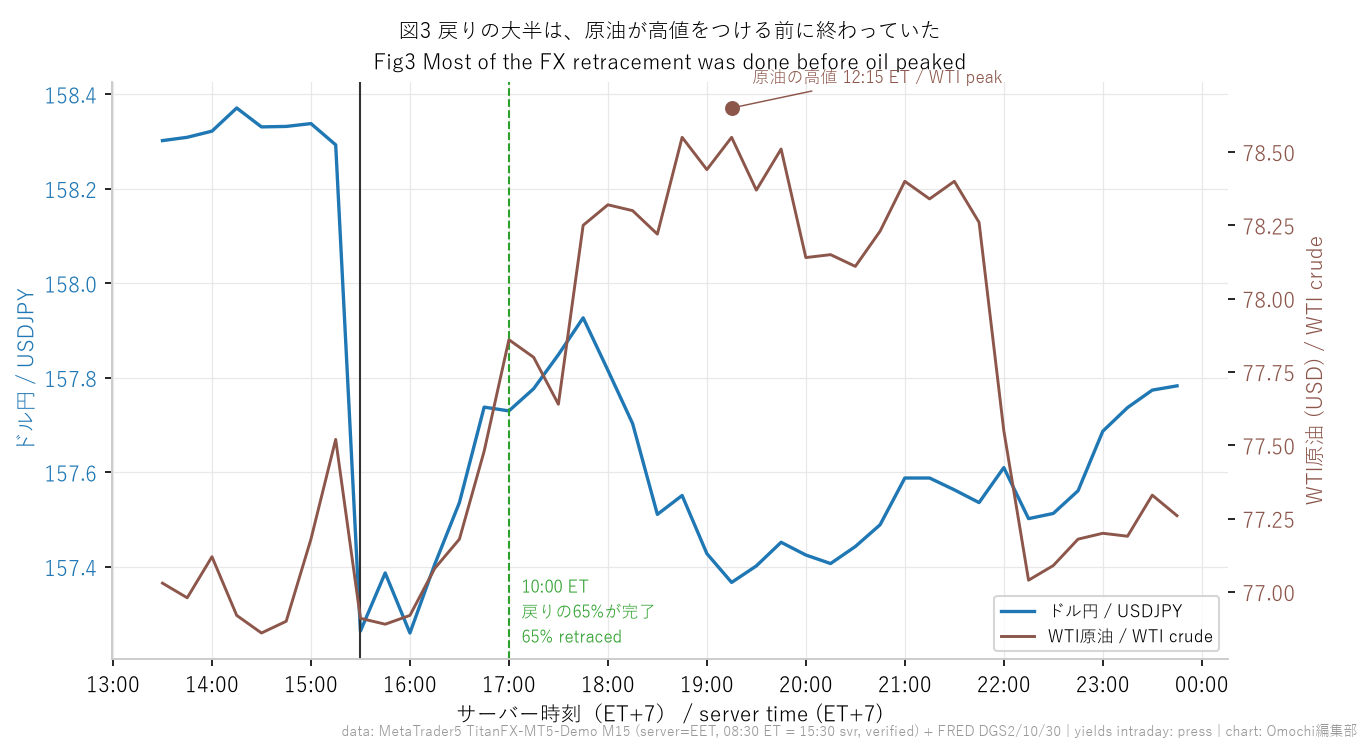
ドル円の戻りは、米東部時間9時の時点で下げ幅の36.2%、10時の時点で65.2%まで進んでいました。その10時のWTIは77.86ドル。この日の高値78.65ドルをつけたのは12時15分で、戻りの3分の2が終わってから2時間以上あとのことです。しかも原油が高値をつけたその瞬間のドル円は157.367円で、10時の157.730円より低い水準にありました。
USD/JPY's recovery had reached 36.2% of the drop by 9:00am Eastern and 65.2% by 10:00. WTI stood at $77.86 at that 10:00 mark. It did not reach the day's high of $78.65 until 12:15pm, more than two hours after two-thirds of the retracement was already done. Moreover, at the exact moment crude peaked, USD/JPY was at 157.367, below the 157.730 it had reached at 10:00.
つまり為替に関しては、原油が動く前に戻りの大半が終わっていた。原油の上昇は時間帯として重なってはいますが、ドル円の戻りを説明する唯一の要因とは言いにくい、というのが実測から言えることです。
In other words, as far as FX is concerned, most of the recovery was over before crude moved. The rally in oil overlaps in time, but it is hard to call it the sole explanation for USD/JPY's retracement. That is what the measurements support.
ここで正直に線を引いておきます。私たちが15分足で測れたのは為替・株・原油であって、米国債の日中の値動きは測れていません(利用しているブローカー配信に債券商品がないためです)。ブルームバーグが原油を理由に挙げたのは債券についての説明ですから、債券に関しては原油が効いた可能性が十分にあります。ここで言えるのは、ドル円の戻りについては時系列が原油だけでは説明しきれない、という限定的な話です。読者ご自身が図3の時計を見て判断できるよう、両方を同じ時間軸に並べました。
Let us draw an honest line here. What we could measure on 15-minute bars is FX, equities and crude; we did not measure the intraday path of Treasuries, because our broker feed carries no bond instruments. Bloomberg raised oil as an explanation for the bond market specifically, so it is entirely possible oil did drive that leg. What we can say is narrower: for USD/JPY's retracement, the sequence is not fully explained by oil alone. We have placed both on the same time axis in Figure 3 so readers can judge the clock themselves.
では為替は何を見ていたのか。最も説明力があるのは、市場が「弱い雇用は利上げを止めるか」という問いに対して、その日のうちに「まだ分からない」と答え直したという読み方です。モルガン・スタンレー・ウェルス・マネジメントのエレン・ゼントナー氏が発表当日に述べています。
So what was FX watching? The reading with the most explanatory power is that the market, asked whether weak employment stops the hiking cycle, revised its answer to "not yet clear" within the same session. Ellen Zentner of Morgan Stanley Wealth Management said as much on the day of the release.
「今日の弱い雇用統計は9月会合での利上げ圧力を和らげるかもしれませんが、来週のインフレ指標が依然として決定的な要因になるでしょう」
"Today's weak payrolls print may ease the pressure on the Fed to raise rates at its September meeting, but next week's inflation data will still likely be the deciding factor."
雇用は弱かった。しかし利上げを決めるのは雇用だけではない。この当たり前の再確認が、初期反応を削っていったと考えるほうが、時計とは整合します。
Employment was weak. But employment alone does not decide rate hikes. Treating that obvious re-realization as what eroded the initial reaction fits the clock better.
利上げは消えたのか、先送りされたのか
Did the Hike Disappear, or Just Get Postponed?
雇用統計を受けて、9月利上げの織り込みは大きく下がりました。CME FedWatch※をもとにしたフォーブスの集計では、前日8月6日時点の55.0%から、発表当日には43.9%へ。据え置きの確率が45.0%から56.1%へと逆転しています。1日で11ポイントの低下です。
Following the jobs report, pricing for a September hike fell sharply. Per Forbes' tally based on CME FedWatch※, the probability went from 55.0% on August 6 to 43.9% on the day of the release, while the odds of a hold flipped from 45.0% to 56.1%. That is an 11-point drop in a single day.
※ CME・FedWatchとは、フェデラルファンド金利先物の価格から、FOMCで政策金利がどう動くかの市場織り込み確率を逆算して公表しているツールのことです。刻々と更新されるため、同じ日でも報道各社が引用する時刻によって数字は多少前後します。
※ CME FedWatch is a tool that publishes market-implied probabilities for FOMC policy moves, derived from fed funds futures prices. It updates continuously, so figures quoted by different outlets on the same day vary somewhat depending on the time of the snapshot.
ただし「利上げが消えた」と読むのは早計です。CNBCによれば、10月会合までに利上げが行われる累積確率は雇用統計の後もなお55%程度、12月までなら約75%が織り込まれたままです。9月に限れば半分を割りましたが、年内のどこかで1回という見方はむしろ多数派として残っている。市場が変えたのは利上げの有無ではなく、その時期です。
It would be premature, though, to read this as "the hike is gone." According to CNBC, the cumulative probability of a hike by the October meeting remained around 55% even after the jobs report, and by December roughly 75% is still priced in. For September specifically the odds fell below half, but the view that there will be one hike somewhere before year-end remains the majority position. What the market changed was not whether a hike happens, but when.
そして、7月会合で利上げを主張して反対票を投じた3人は、意見を変えていません。クリーブランド連銀のハマック総裁は「今こそFOMCが行動すべき時だ。高インフレが長引くほど、それを引き下げる作業は困難で高くつく」と述べ、ダラス連銀のローガン総裁は「労働、消費、金融市場の状況は、金融政策が経済を抑制していないことを示している」と明言しています。ミネアポリス連銀のカシュカリ総裁に至っては、雇用統計の2日前にあたる8月5日のCNBCで「今の金融政策が特に引き締め的だという証拠が、私にはどこにあるのか」と語り、9月の利上げ開始に言及していました。
And the three officials who dissented in favour of a hike at the July meeting have not changed their minds. Cleveland Fed President Hammack said "now is the time for the FOMC to act... The longer that high inflation persists, the more challenging and costly it can be to bring it back down," while Dallas Fed President Logan stated plainly that "labor, consumption and financial market conditions indicate that monetary policy is not restraining the economy." Minneapolis Fed President Kashkari went further still, asking on CNBC on August 5, two days before the jobs report, "what evidence do I have that monetary policy is particularly restrictive right now?" and referring explicitly to beginning hikes in September.
彼らの主張の芯は「インフレが加速しているから」ではありません。むしろ直近の数字は減速しています。6月のCPIは前年比3.5%で前月比マイナス0.4%と2020年4月以来の大きな下落、コアPCEも3.3%へ低下しました。それでも利上げを主張する理由は3つあります。第一に、水準です。コアPCEの3.3%は目標の2%を1.3ポイント上回ったままです。第二に、改善の中身です。6月の低下はイランを巡る一時的な停戦でガソリンが9.2%下がったことによるもので、ホルムズ海峡が再び緊迫すれば巻き戻ります。8月7日の午後に原油が動いたこと自体が、その脆さの実演でした。第三に、これが最も算術的です。政策金利3.50〜3.75%からコアPCE3.3%を引くと、実質政策金利はおおむね0.2〜0.45%。ほぼゼロです。「金融政策は引き締め的ではない」というローガン総裁の指摘は、この計算のことを言っています。
The core of their argument is not that inflation is accelerating. If anything, the latest numbers are decelerating: June CPI was 3.5% year over year and minus 0.4% month over month, the largest monthly decline since April 2020, and core PCE eased to 3.3%. There are three reasons they still argue for hikes. First, the level: core PCE at 3.3% remains 1.3 points above the 2% target. Second, the composition of the improvement: June's decline came from gasoline falling 9.2% on a temporary truce around Iran, which unwinds if the Strait of Hormuz tightens again. Crude's move on the afternoon of August 7 was itself a demonstration of that fragility. Third, and most arithmetic of all: subtract core PCE of 3.3% from a policy rate of 3.50-3.75% and the real policy rate is roughly 0.2 to 0.45%, essentially zero. Logan's remark that policy is not restraining the economy is a statement about this calculation.
市場参加者の見方も、これほど割れている局面は珍しい。バンク・オブ・アメリカは2026年に0.75%の利上げ(9月・10月・12月)を見込む一方、ゴールドマン・サックスは2026年を通じた据え置きを見ており、シティグループは2027年1月までに3回の利下げを予想しています。同じデータを見て、片や3回の利上げ、片や3回の利下げです。
It is also rare for market participants to be this divided. Bank of America expects 75 basis points of hikes in 2026 across September, October and December; Goldman Sachs sees a hold all the way through 2026; and Citigroup forecasts three cuts by January 2027. Looking at the same data, one house sees three hikes and another sees three cuts.
構造的な事情も押さえておく価値があります。ウォーシュ議長はフォワードガイダンス※を廃止しており、しかも8月にFOMCは開かれません。つまり9月15日から16日の会合までに市場が手にする手がかりは、指標そのものだけです。8月12日のCPI、8月26日のPCE、9月4日の雇用統計、9月11日のCPI。この4つで決まります。8月分のPCEは9月30日公表で、会合には間に合いません。
The structural situation is worth noting too. Chair Warsh has abolished forward guidance※, and there is no FOMC meeting in August. That means the only clues the market gets before the September 15-16 meeting are the data releases themselves: CPI on August 12, PCE on August 26, the jobs report on September 4, and CPI on September 11. Those four decide it. August PCE is published on September 30, too late for the meeting.
※ フォワードガイダンスとは、中央銀行が将来の政策方針をあらかじめ言葉で示す手法のことです。これを廃止すると、市場は公表された経済指標から政策を推測するしかなくなります。
※ Forward guidance is the practice of a central bank signalling its future policy stance in words ahead of time. Abolish it, and the market has no choice but to infer policy from published economic data.
なかでも8月12日のCPIが最大の分岐点です。ゼントナー氏が発表当日に「来週のインフレ指標が決定的」と述べたのは、この構造を指しています。
Of those, the August 12 CPI is the biggest fork in the road. When Zentner said on the day of the release that next week's inflation data would be decisive, this is the structure she was pointing at.
いま、市場と当局は何を考えているのか
What the Market and the Authorities Are Thinking Now
ここまでは1日の値動きの話でした。しかし為替については、この雇用統計を「介入をめぐる駆け引きの途中に落ちてきた出来事」として見ると、もう一段面白い読み方ができます。
Up to this point we have discussed a single day's price action. For FX, though, there is a more interesting reading available if you treat this jobs report as an event that landed in the middle of an ongoing standoff over intervention.
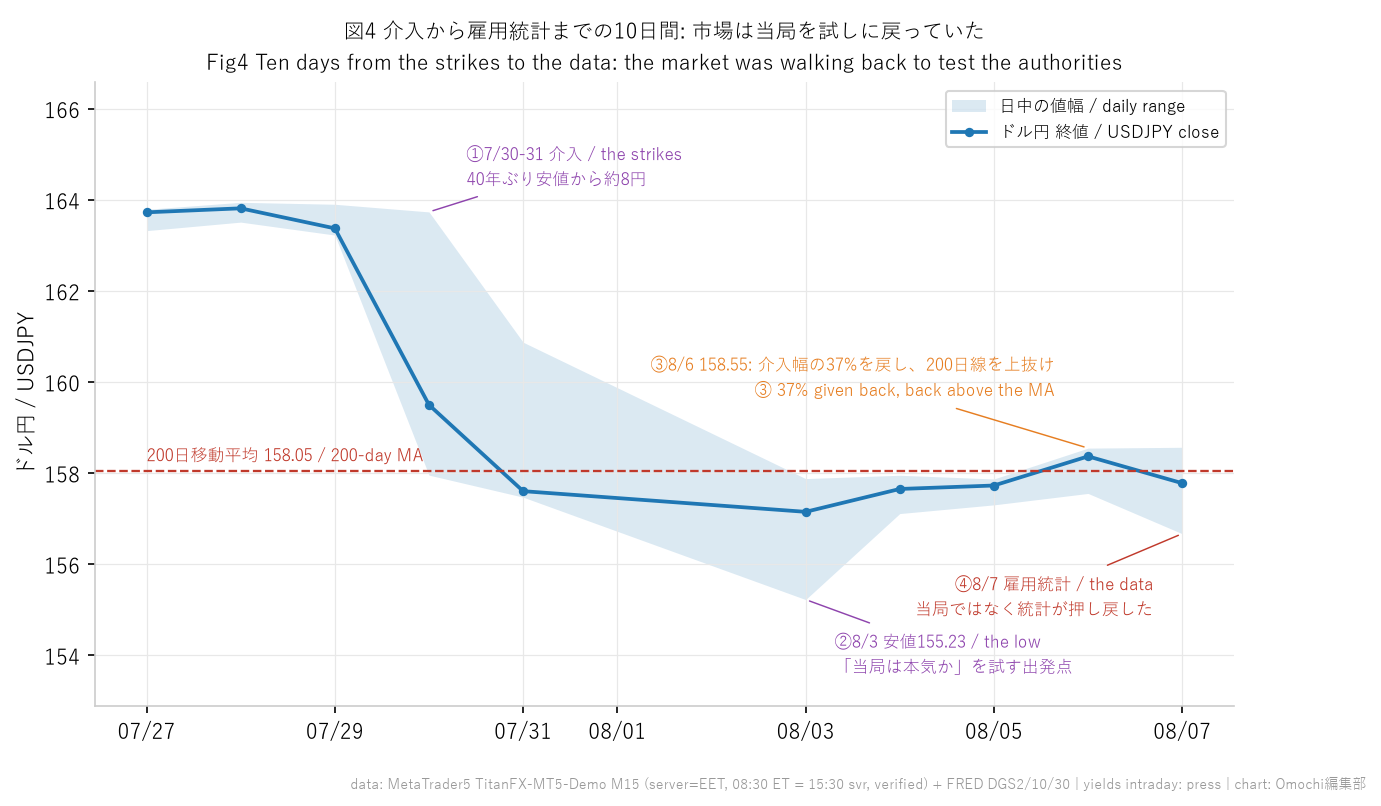
時系列を追い直します。7月30日と31日、財務省は40年ぶり安値の163円台から約8円の円買い介入を実施し、8月3日にはドル円が155.23円まで下げました。ここまでは当局の勝ちです。
Let us retrace the sequence. On July 30 and 31, the Ministry of Finance conducted yen-buying intervention of roughly 8 yen from a 40-year low in the 163 handle, and by August 3 USD/JPY had fallen to 155.23. To that point, the authorities had won.
問題はそのあとでした。市場は3営業日かけて158.55円まで押し戻しています。介入で動かした値幅の37%を取り返し、200日移動平均の158.05円を上抜けた水準です。これは単なる値動きではなく、市場から当局へのメッセージだと読むべきものです。「本当に次も撃つのか」を試しに行った、ということです。
The problem came afterward. Over three business days the market pushed back to 158.55, recovering 37% of the range the intervention had moved and clearing the 200-day moving average at 158.05. This should be read not as mere price action but as a message from the market to the authorities: a test of whether they would really fire again.
そこには理由もありました。介入後の当局の発言は「緊密に連絡を取り合っている」「ためらわない」といった、これまで何度も聞いた定型文の範囲にとどまり、新しい踏み込みがありませんでした。加えて、お盆で東京勢が薄くなる週が目前でした。薄商いは当局にとって好都合な条件ですが、同時に「そこで来なければ当分来ない」という賭けの材料にもなります。市場は後者に傾いていた、というのがこの3日間の値動きの意味です。
There were reasons for it. Official comments after the intervention stayed within the familiar boilerplate of "in close communication" and "will not hesitate," with no new commitment. On top of that, the Obon week that thins out Tokyo participants was imminent. Thin markets are favourable conditions for the authorities, but they equally provide material for a bet that if nothing comes then, nothing is coming for a while. The price action of those three days means the market was leaning toward the latter.
そこに雇用統計が落ちてきました。当局が一発も撃たないまま、統計が1円60銭の円高を作ってしまったわけです。
And then the jobs report landed. Without the authorities firing a single shot, the statistics produced 1.60 yen of yen strength on their own.
ここから先は、双方の立場を想像する話になります。まず市場参加者の側。試しに行った矢先に、当局ではなく統計に叩かれた。ポジションとしては痛手ですが、「当局は結局撃たなかった」という事実も同時に残りました。しかも引けまでに3分の2を取り返している。強気にも弱気にもなり切れない、中途半端な状態のはずです。
From here we are imagining both sides' positions. First, market participants. Just as they went out to test, they were hit by the data rather than by the authorities. That hurts positions, but the fact that the authorities ultimately did not fire also remains. And two-thirds of the move was clawed back by the close. They should be in an in-between state, unable to commit to either bullishness or bearishness.
そして当局の側。過去の介入を振り返ると、当局が最も効率よく撃てるのは、市場が「もう来ない」と高をくくって円売りを積み上げた瞬間です。裏を返せば、今の市場のように「試したら統計に殴られて、少し慎重になっている」状態は、当局にとって最良のタイミングではありません。仕掛けるうまみが薄いのです。
Then the authorities. Looking back at past interventions, the moment they can strike most efficiently is when the market has grown complacent, assuming nothing is coming, and has piled up short-yen positions. Conversely, a market like the current one, which went out to test, got hit by the data and has turned somewhat cautious, is not the best timing for them. There is less to be gained from pulling the trigger.
つまり両者とも、決め手を欠いたまま次の材料を待つ形になりました。その次の材料が、8月12日のCPIです。数字が強ければドル円は再び158円台を試し、市場の慢心が育ち、当局の出番が近づく。弱ければ雇用統計の延長線で円高が進み、当局は何もせずに済む。どちらに転んでも、この1週間の駆け引きの続きはCPIが決めます。
So both sides now wait for the next catalyst without a decisive hand. That catalyst is the August 12 CPI. If the number is strong, USD/JPY tests the 158 handle again, complacency rebuilds, and the authorities' moment draws nearer. If it is weak, yen strength continues as an extension of the jobs report and the authorities never have to act. Either way, CPI decides the next chapter of this week's standoff.
編集部の見立て
Our Editorial Read
この日の相場から実務的に持ち帰れることは、2つあります。
There are two practical takeaways from this day's market.
1つは、初期反応の大きさと持続性は別物だという単純な事実です。8時30分から15分間の値動きは、その指標が予想からどれだけ離れたかをほぼ機械的に映します。しかし引けまでの数時間で市場が測り直すのは「それで政策が変わるのか」という別の問いです。指標発表の瞬間に飛びついた判断が、数時間後には根拠を失っていた、ということです。
The first is the simple fact that the size of an initial reaction and its durability are different things. The fifteen minutes from 8:30 mechanically reflect how far the indicator landed from expectations. What the market re-measures over the following hours, however, is a different question: does this actually change policy? A judgment made in the instant of the release had lost its basis a few hours later.
もう1つが、この記事の本題です。為替と金利は問い直し、株は問い直さなかった。金融政策そのものを値段にしている市場は、弱い雇用と利上げ停止が同じではないことを数時間かけて思い出しました。株式市場は「利上げが遠のいた」という初期解釈のまま最高値で引けています。どちらが正しかったかは、8月12日のCPIが判定します。もしCPIが強ければ、問い直した側が正しかったことになります。
The second is this article's central point. FX and rates reconsidered; equities did not. The markets that price monetary policy itself spent several hours remembering that weak employment and an end to rate hikes are not the same thing. The equity market closed at a record still holding its initial interpretation that hikes had receded. Which side was right will be settled by the August 12 CPI. If CPI comes in strong, the side that reconsidered will have been correct.
答え合わせの日付を置いておきます。
Here are the dates for checking the answer.
| 日付 | 出るもの | 見るポイント |
|---|---|---|
| 8月12日 | 7月CPI | 9月会合の最大の分岐点。ゼントナー氏の言う「決定的な要因」 |
| 8月26日 | 7月PCE | Fedが目標に使う指標。コア3.3%が下がるか |
| 9月4日 | 8月雇用統計 | 3カ月平均2万人という失速が本物か、ワールドカップ要因の一過性か |
| 9月11日 | 8月CPI | 会合直前の最後の材料 |
| 9月15〜16日 | FOMC | 利上げか据え置きか。ドットチャート(経済見通し)も公表 |
| Date | Release | What to watch |
|---|---|---|
| Aug 12 | July CPI | The biggest fork for the September meeting; Zentner's "deciding factor" |
| Aug 26 | July PCE | The gauge the Fed targets. Does core fall from 3.3%? |
| Sep 4 | August jobs report | Is the +20k three-month average real, or a passing World Cup effect? |
| Sep 11 | August CPI | The last input before the meeting |
| Sep 15-16 | FOMC | Hike or hold, with the dot plot of economic projections |
為替で見ておく水準は変わりません。ドル円の200日移動平均、158.05円です。雇用統計はこの線の上から相場を叩き落としましたが、引けは157.78円と、線のすぐ下に貼り付いた状態のままです。財務省の片山大臣は8月7日、日米が「緊密に連絡を取り合っている」とし、必要なら「介入をためらわない」と改めて述べています。統計が一度は当局の仕事を代行しましたが、構図そのものは動いていません。
The level to watch in FX has not changed: USD/JPY's 200-day moving average at 158.05. The jobs report knocked the market down from above that line, but the close at 157.78 leaves it pinned just beneath it. On August 7, Finance Minister Katayama said again that Japan and the US are "in close communication" and would "not hesitate to intervene" if necessary. The statistics did the authorities' job for them once, but the underlying setup has not moved.
そして、こういう夜更かしの翌日こそ、同僚と一杯やりながら「あの数字どう見た?」と話したくなるものです。相場の初期反応は読めなくても、集まる店選びは外したくない。店探しと予約は、Omochiにお任せください。
And the day after a late night like this is exactly when you want to sit down with colleagues over a drink and ask, "so how did you read that number?" You may not be able to predict the market's first reaction, but you can get the choice of venue right. Leave the restaurant search and the booking to Omochi.