「お盆の窓」 介入の可能性と備え方について
The Obon Window. Why Japan May Strike Its Thinnest Week, and How to Position for It
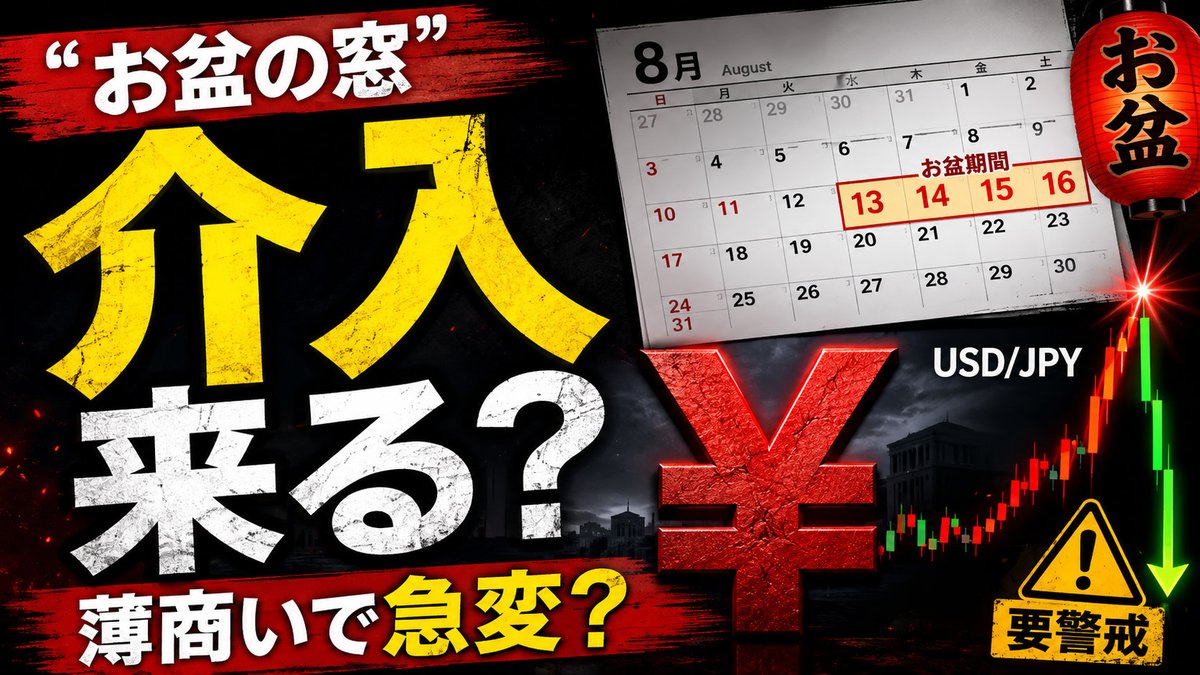
今年のお盆は、カレンダーの並びが特別です。8月11日の山の日が火曜日に当たるため、月曜と水曜に有給を2日入れるだけで、8月8日の土曜から16日の日曜まで9連休がつながります。「最大9連休」という見出しを、多くの人が旅行の計画表として読んでいます。
This year's Obon calendar is special. Mountain Day falls on Tuesday, August 11, so just two days of paid leave, Monday and Wednesday, bridge a nine-day break from Saturday the 8th through Sunday the 16th. Most people are reading the "up to 9 consecutive days off" headlines as a travel planner.
私たちは同じカレンダーを、別の読み方で眺めています。為替相場の視点で見ると、これは「東京の注文板が夏場で最も薄くなる週」の予定表です。しかも8月11日の火曜は、東京市場が祝日で完全に閉まる一方、シンガポールもロンドンもニューヨークも通常営業です。円は世界中で取引されているのに、円の地元だけが不在になる。この非対称な1日を含む8月10日から14日の週が、目前に迫っています。
We read the same calendar differently. From the FX market's point of view, this is the schedule for the week when Tokyo's order books get thinner than at any other point of the summer. And on Tuesday, August 11, the Tokyo market is fully closed for the holiday while Singapore, London and New York all trade as usual. The yen trades around the world, but the yen's home team is absent. The week of August 10 to 14, containing that asymmetric day, is right in front of us.
薄商い※の市場では、同じ金額でも値段が大きく動きます。そして日本の通貨当局には、まさにこの性質を利用してきた前歴があります。今年7月19日、海外の市場情報サイトはこう書いていました。「Yen on intervention watch as Tokyo holiday thins liquidity, a recipe the Ministry of Finance likes!(東京の祝日で流動性が薄くなるなか、円は介入警戒。財務省の好むレシピだ)」。5月にはBloombergも「休日の薄い流動性のなかの介入リスク」を記事にしています。祝日の薄商いを狙った実績も、推測ではありません。2024年4月29日、昭和の日。東京が休みの薄い市場で、財務省は1日で5.92兆円の円買い介入を実行しました。介入の歴史のなかでも屈指の規模です。
In a thin market※, the same amount of money moves prices much further. And Japan's currency authorities have a track record of exploiting exactly this property. On July 19 this year, an overseas market-news site wrote: "Yen on intervention watch as Tokyo holiday thins liquidity, a recipe the Ministry of Finance likes!" In May, Bloomberg also ran a piece on intervention risk amid holiday-thinned liquidity. Nor is the holiday-strike precedent speculation. April 29, 2024, Showa Day: in a thin market with Tokyo closed, the MOF executed 5.92 trillion yen of yen-buying intervention in a single day, one of the largest strikes in the history of intervention.
※ 薄商い(うすあきない)とは、市場参加者が少なく取引量が細った状態のことです。同じ売買金額でも相場が大きく動きやすくなります。
※ A thin market (usuakinai) is a state in which few participants are active and trading volume dries up, so the same order size moves prices much more than usual.
ところが、不思議なことがあります。私たちが確認した範囲で、直近の主要な為替見通し(大手FX会社の週報、月報、直近のデイリーレポート数本)には、「お盆」と「介入」を結びつけた記述が一つもありませんでした。休暇の記事は9連休を語り、為替の記事は介入を語り、この2つがまだ紙面の上で出会っていないのです。この記事は、その2つを重ねてみる試みです。そして最後に、この状況に賭ける方法として、ほとんど誰も名指ししていない通貨ペアの話をします。
And yet something odd is going on. As far as we could check, none of the major current FX outlooks (a leading broker's weekly and monthly reports, plus several recent dailies) contains a single line connecting Obon to intervention risk. The holiday articles talk about the nine-day break; the FX articles talk about intervention; the two have not yet met on the page. This article is an attempt to lay one on top of the other. And at the end, we discuss a currency pair almost nobody names as the way to position for it.
介入の効果は、もう3割戻された
A Third of the Intervention Has Already Been Given Back
まず現在地を測ります。7月30日、財務省は推定で単日最大規模の円買い介入を実行し(推定6兆〜8.45兆円。正確な金額は8月28日の月次公表待ちです)、翌31日には米財務省との協調介入に踏み切りました。円買いでの日米協調は1998年以来です(2011年の協調介入は震災後の円「売り」でした)。ドル円は163.99円の高値から一気に155.20円まで、約9円押し下げられました。
First, the current position. On July 30 the MOF executed what is estimated to be the largest single-day yen-buying intervention ever (estimates run 6 to 8.45 trillion yen; the exact figure waits for the monthly disclosure on August 28), and on the 31st it escalated to joint intervention with the US Treasury, the first joint yen-BUYING operation since 1998 (the 2011 joint action was yen-selling, after the earthquake). USD/JPY was driven from a 163.99 high down to 155.20, roughly nine yen.
それから4営業日。ドル円は157円台後半まで戻っています。押し下げた9円のうち、およそ3割がすでに返上された計算です。国内の為替レポートは今週、介入の影響を「一巡」と表現し始めました。現在の水準は200日移動平均線※の158.05円のすぐ下です。ここを上に抜ければ、市場の視線は再び160円、つまり国内レポートが「絶対防衛ライン」と呼ぶ水準に向かいます。
Four sessions later, USD/JPY is back in the upper 157s. Of the nine yen the strikes bought, roughly 30% has already been handed back. Domestic FX commentary began describing the intervention's effect as "having run its course" this week. The pair now sits just under the 200-day moving average※ at 158.05. A break above it points the market's eyes back at 160, the level domestic reports call the "absolute defense line."
※ 200日移動平均線とは、過去200営業日の終値の平均を結んだ線のことです。長期トレンドの分かれ目として機関投資家に広く参照されます。
※ The 200-day moving average is the line connecting the average of the last 200 daily closes. Institutional investors widely reference it as the divide between long-term uptrends and downtrends.
一方、次に日銀が動ける定例の機会は9月17日と18日の金融政策決定会合で、6週間も先です。9月利上げの織り込みは6割を超えたと報じられていますが(野村證券のように「9月は1割、本命は10月」と読む声もあります)、いずれにせよそれまでの間、円を支える公式の手段を持っているのは財務省だけです。今年これまでの例では、当局による円の押し上げ効果は1.5カ月から2カ月で剥落したと観察されています(1月の急落局面、4月から5月の大規模介入とも)。7月末の介入の「賞味期限」を同じ物差しで測ると、切れるのはちょうど9月の日銀会合のあたりです。
Meanwhile, the next scheduled chance for the BOJ to act is the September 17-18 policy meeting, six weeks away. Market pricing of a September hike is reported above 60% (though Nomura, for one, reads it as 10% for September with October the main scenario). Either way, until then the only institution holding an official tool to support the yen is the MOF. In this year's episodes so far, official yen-boosting effects have decayed within roughly 1.5 to 2 months (both the January plunge episode and the April-May campaign). Apply the same yardstick to the late-July strikes and their expiry lands almost exactly on the September BOJ meeting.
つまりこういう時間割です。効果は減衰し始めている。次の援軍は6週間先。そして目の前に、夏で最も薄い週が来る。
So the timetable reads: the effect is already fading; the next reinforcement is six weeks out; and the thinnest week of the summer is arriving now.
「奇襲」はもう使った。だからこそ窓が要る
The Ambush Has Been Spent. That Is Exactly Why the Window Matters
今年7月1日、Reutersは通貨当局の戦術転換を報じました。見出しは「Japan shifts to ambush intervention tactics against yen short sellers(日本、円売り筋への「待ち伏せ」介入戦術に転換)」。記事中の関係者の言葉は直接的です。「狙いは投機筋に痛打を与えることだ」「水準の問題ではない」。事前の口先介入で警告を重ねる従来型をやめ、沈黙そのものを武器にして、円売りポジションを一掃しにいく。そういう教義です。
On July 1, Reuters reported a tactical shift by Japan's currency authorities under the headline "Japan shifts to ambush intervention tactics against yen short sellers." The sourced quotes are blunt: "The purpose would be to hit speculators hard." "It's not about yen levels." Drop the old pattern of stacked verbal warnings, weaponize silence itself, and go wipe out the short-yen positioning. That is the doctrine.
7月30日の一撃は、この教義の実践でした。CFTC建玉報告※によれば、介入直前の7月28日時点で投機筋の円ショートは16.3万枚。過去最大だった2024年7月の18.4万枚に迫る水準で、円に換算するとおよそ2兆円分の売り持ちです。ヘッジファンドの円弱気は「2007年以来の極端さに近い」という集計もあります。燃料は満タンで、そこに史上最大級の一撃が入った。だからこそ9円動いたわけです。
The July 30 strike was that doctrine in practice. Per the CFTC's Commitments of Traders report※, speculators held 163,000 contracts of net yen shorts as of July 28, two days before the strike, approaching the all-time record of 184,000 from July 2024, roughly 2 trillion yen of short exposure. One tally puts hedge funds' yen bearishness "close to its most extreme since 2007." The tank was full, and into it went one of the largest strikes ever. That is why the pair moved nine yen.
※ CFTC建玉(たてぎょく)報告とは、米商品先物取引委員会が毎週金曜に公表する、投機筋などの先物ポジション統計のことです。火曜時点の建玉が金曜に公表されます。
※ The CFTC Commitments of Traders report is the weekly futures-positioning statistics published every Friday by the US Commodity Futures Trading Commission, showing positions as of the preceding Tuesday.
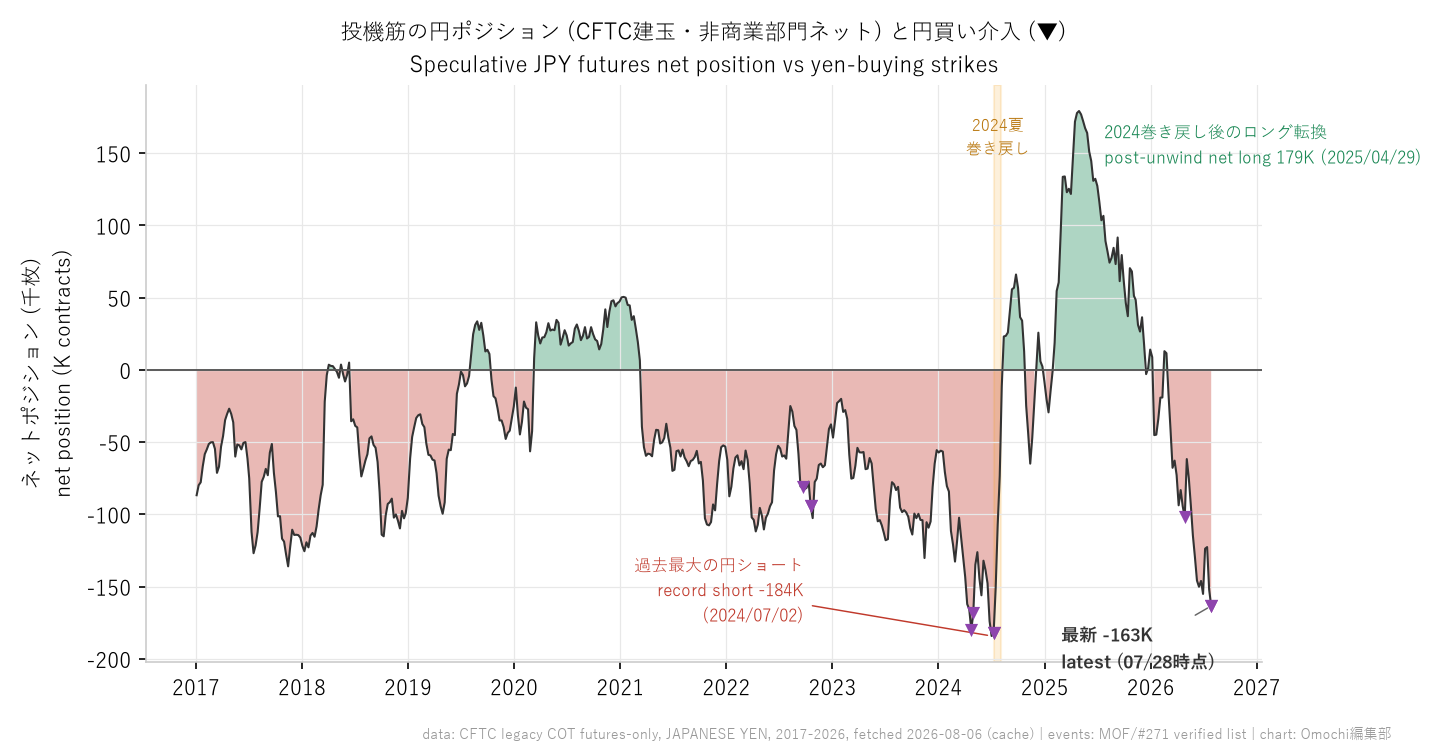
このチャートに介入マーカー(▼)を重ねると、もう一つのことが見えてきます。2024年4月末の介入はショート18.0万枚、同年7月の介入は18.2万枚、そして今回は16.3万枚。財務省は毎回、ポジションの傾きが極端になった局面を選んで撃っています。「投機筋に痛打を与える」という教義を、データの側から眺めた姿です。
Overlay the intervention markers on this chart and a second pattern appears. The late-April 2024 strike came with shorts at 180,000 contracts; the July 2024 strike at 182,000; this one at 163,000. Every time, the MOF picks the moment when positioning is at its most lopsided. It is the "hit speculators hard" doctrine, seen from the data's side.
ただし、奇襲は一度使うと奇襲ではなくなります。市場は次を警戒し、同じ規模でも効きは落ちる。それを補える数少ない増幅装置が、流動性の薄さです。板が薄ければ、同じ1兆円でも動く値幅は大きくなり、ストップロス※を巻き込んだ連鎖も起きやすくなります。現在の市場では、ストップの集中は155円近辺と165円近辺に観察されています。155.20円は今回の介入局面でつけた安値(8月3日)。ここを薄い市場で再び割れば、損切りの円買いが円買いを呼ぶ構図です。
But an ambush, once used, is no longer an ambush. The market braces for the next one and the same size buys less movement. One of the few amplifiers that can compensate is thin liquidity. In a thin book, the same trillion yen moves the price further, and cascades through stop-loss orders※ become easier to trigger. Stops are currently observed clustering near 155 and near 165. 155.20 is the low of this intervention episode (August 3). Break it again in a thin market and stop-loss yen buying begets more yen buying.
※ ストップロスとは、損失の拡大を防ぐためにあらかじめ設定される逆指値注文のことです。特定の水準に集中していると、そこを抜けた瞬間に注文が連鎖して値が飛ぶことがあります。
※ A stop-loss is a resting order placed in advance to cap losses. When stops cluster at a specific level, breaking that level can chain the orders together and gap the price.
もう一つ、当局には「先に動く理由」があります。2024年8月5日の記憶です。あの日、日銀の利上げをきっかけに積み上がった円キャリートレード※が一斉に巻き戻り、日経平均は1日で12.4%下落、過去最大の下げ幅を記録しました。ドル円は7月の高値からひと月足らずで約12%円高に振れています。混雑した円ショートは、いずれ必ず壊れます。問題は「誰が、いつ、どう壊すか」です。9月の日銀会合まで放置して、利上げを引き金に無秩序に壊れるのを待つのか。それとも財務省が薄い夏の市場で、自分のタイミングで秩序立てて壊すのか。2024年の教訓を最も痛切に覚えているのは、ほかならぬ当局のはずです。
The authorities also have a reason to move first: the memory of August 5, 2024. That day, the yen carry trade※ that had piled up unwound all at once on the back of a BOJ hike, and the Nikkei fell 12.4% in a single session, its largest points drop ever. USD/JPY swung about 12% toward yen strength from its July high in under a month. A crowded yen short always breaks eventually; the question is who breaks it, when, and how. Leave it until the September BOJ meeting and let a rate hike break it chaotically? Or have the MOF break it on its own schedule, in an orderly way, in the thin summer market? Nobody remembers the lesson of 2024 more painfully than the authorities themselves.
※ キャリートレードとは、低金利の通貨を借りて高金利の通貨で運用し、金利差を収益にする取引のことです。金利の低かった円は長年、世界の代表的な調達通貨でした。
※ A carry trade is a position that borrows a low-interest-rate currency and invests in a higher-yielding one, earning the rate differential. The near-zero-rate yen was for years the world's flagship funding currency.
財務官の三村淳氏は8月3日、「さらなる協調介入に躊躇しない」と明言しました。米側の支援を「単なる精神的支援を超える」とも表現しています。カレンダーと教義と動機と公式発言。役者は揃っています。あとは窓が開くだけです。
On August 3, Vice Finance Minister for International Affairs Atsushi Mimura stated plainly that Japan "will not hesitate to conduct further coordinated intervention," and described US support as going "beyond mere moral support." The calendar, the doctrine, the motive and the official statements: the cast is assembled. All that remains is for the window to open.
弾は切れない。FIMAレポの「答え合わせ」と本当のコスト
The Ammo Does Not Run Out. A FIMA Repo Answer-Check and the Real Cost
「でも介入の弾には限りがあるのでは」という定番の疑問には、前回の記事で書いたFIMAレポ※の続報で答えます。まず訂正から。7月末の介入がFIMAレポで調達されたという観測が一部で流れましたが、データはそれを支持していません。FRBが毎週公表するバランスシート統計(H.4.1)の「海外公的機関向けレポ」の残高は、7月29日時点でゼロでした。片山財務大臣の8月3日の公式声明も、FIMAレポを「今後活用する予定」と、はっきり未来形で書いています。つまりパイプは開通したが、まだ一滴も流れていない。7月末の介入は、外為特会※の手元資金という従来の財布で賄われたと見られます。
The standard objection, "but intervention ammo is finite," we answer with a follow-up to the FIMA repo※ story from our previous article. First, a correction. Reports circulated that the late-July intervention was funded through FIMA repo. The data does not support that. The "repurchase agreements, foreign official" line of the Fed's weekly balance-sheet release (H.4.1) stood at zero as of July 29. And Finance Minister Katayama's official August 3 statement says Japan plans to utilize the FIMA Repo Facility "in the future," in the explicit future tense. The pipe has been connected, but not a drop has flowed through it. The late-July strikes appear to have been paid for out of the FX special account's※ cash on hand, the traditional wallet.
※ FIMAレポとは、海外の中央銀行や政府が保有する米国債を担保に、FRBからドルを翌日物で借りられる常設制度のことです。米国債を売却せずにドルを調達できます。
※ The FIMA Repo Facility is a standing Fed facility that lets foreign central banks and governments borrow dollars overnight against their US Treasury holdings, raising dollars without selling the Treasuries.
※ 外国為替資金特別会計(外為特会)とは、為替介入の資金を管理する日本政府の特別会計のことです。過去の円売り介入で取得した外貨資産、約210兆円規模を保有しています。
※ The Foreign Exchange Fund Special Account (Gaitame Tokkai) is the Japanese government's special account that manages intervention funds. It holds roughly 210 trillion yen of foreign assets acquired through past yen-selling interventions.
では、いざ使うとしたら何が起きるか。コストを単純計算してみます。FIMAレポの翌日物金利は現在3.75%。上限の600億ドル(約9.5兆円)をまるごと借りると、利息は1日あたり625万ドル(約10億円)、1カ月で約1.9億ドル(約300億円)です。大きく聞こえますが、ここには反対側があります。担保に差し入れた米国債の利子は、借り手である日本が受け取り続けます。外為特会の決算から逆算すると、保有外貨資産の利回りはおおむね3.5%から3.9%。つまり「3.75%を払い、約3.7%を受け取る」構図で、差し引きの持ち出しはほぼゼロです。年間5兆円規模の運用益を上げる会計にとって、誤差の範囲と言っていい。
So what happens if they actually use it? Simple arithmetic. The FIMA repo overnight rate is currently 3.75%. Borrow the full 60 billion dollar cap (about 9.5 trillion yen) and the interest is 6.25 million dollars a day (about 1 billion yen), roughly 190 million dollars a month (about 30 billion yen). Sounds large, until you look at the other side of the ledger: the coupons on the pledged Treasuries keep flowing to Japan, the borrower. Working backward from the FX special account's results, the portfolio yields roughly 3.5 to 3.9%. So the structure is "pay 3.75%, receive about 3.7%," and the net outlay is approximately zero. For an account that earns some 5 trillion yen a year, it is a rounding error.
さらに言えば、介入でドルを「売る」場合、それは損失どころか利益確定です。外為特会のドルは、大部分が2000年代の円売り介入、つまり1ドル100円台から120円の時代に仕込まれたものです。それを157円から164円で売るのだから、売った分だけ含み益(推定約50兆円)が実現益に変わります。ここに一つ、面白いねじれがあります。FIMAレポは「借入」であって「売却」ではないので、使えば使うほど利益確定を先送りする装置になる。売れば利食い、借りれば温存。どちらを選んでも財務的に痛くない。「弾切れで介入は続かない」という古い定説は、この夏、静かに退場しました。
Better still: when intervention SELLS dollars, that is not a loss but profit-taking. Most of the account's dollars were acquired through the yen-selling interventions of the 2000s, when a dollar cost somewhere between the low 100s and 120 yen. Selling them at 157 to 164 converts unrealized gains (estimated around 50 trillion yen) into realized ones, dollar by dollar. And here sits an interesting twist: FIMA repo is a borrowing, not a sale, so using it is a device for postponing that profit-taking. Sell and you take profit; borrow and you preserve it. Neither choice hurts financially. The old axiom that intervention must stop when the ammo runs out quietly left the stage this summer.
検証可能な次の答え合わせも書いておきます。日本時間8月7日早朝に公表されるH.4.1(8月5日時点)で、「海外公的機関向けレポ」の行が動いたかどうか。動けばFIMA初稼働の証拠、ゼロのままなら従来型の資金繰りが続いている証拠です(ただしこの統計は水曜時点の残高スナップショットなので、水曜をまたがない短期の借入は写りません)。
The next verifiable answer-check: the H.4.1 released early on August 7 Japan time (balances as of August 5). If the foreign-official repo line has moved, that is evidence of FIMA's first activation; if it is still zero, the traditional funding continues. (Caveat: the statistic is a Wednesday snapshot of an overnight facility, so a short borrowing that does not span a Wednesday never appears in it.)
介入で勝っても、円は「調達通貨の座」を追われている
Winning the Battle, Losing the Funding-Currency Franchise
ここまでが表の戦況です。裏側では、もっと静かな構造変化が進んでいます。円キャリートレードの「調達通貨」の交代です。
That is the visible battlefield. Behind it, a much quieter structural change is under way: the changing of the guard in the carry trade's funding currency.
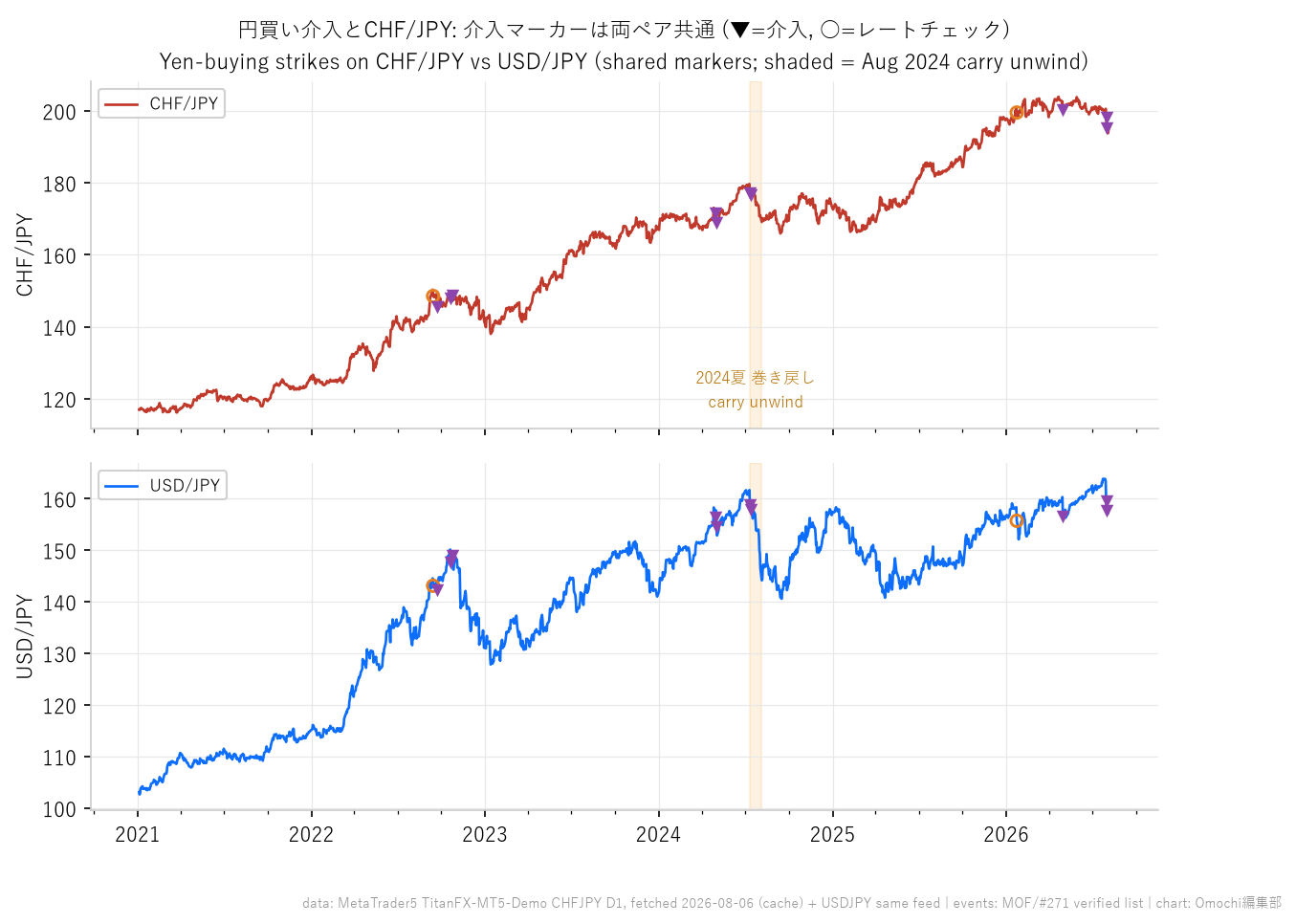
7月28日、つまり介入の2営業日前に、オランダの大手金融機関INGはこう書いていました。キャリートレード投資家は今後「円ではなくスイスフランで調達する」ようになる。フラン調達のほうが金利が安く、しかも「日銀(日本当局)による700億ドル規模の介入リスクを避けられる」からだ、と。国内でも同じ観察が出ています。マネックス証券のコラムの見出しは「キャリー通貨が『円』から『スイスフラン』に?」。理由は単純で、日本の短期金利(政策金利1.00%)がスイス(同0.00%)を上回ってしまったからです。円を借りるより、フランを借りるほうが安い。この逆転は、かつての「金利ゼロの円」の世界では考えられなかったことです。
On July 28, two business days before the strikes, the Dutch bank ING wrote that carry-trade investors will increasingly "fund out of Swiss francs rather than the yen," because franc funding is cheaper and it "avoids the risk of the Bank of Japan intervening to the tune of $70bn." The same observation is appearing domestically: a Monex Securities column ran under the headline "Is the carry currency switching from the yen to the Swiss franc?" The reason is simple. Japan's short-term rate (policy rate 1.00%) has climbed above Switzerland's (0.00%). Borrowing francs is now cheaper than borrowing yen, an inversion that was unthinkable in the old world of the zero-rate yen.
過去のパターンでは、介入で潰された円ショートは数週間で再建されてきました。実際、2024年8月の巻き戻し後に一度は17.9万枚の円「ロング」(2025年4月)まで振れたポジションは、そこから1年あまりで16.3万枚のショートへ、振り子のように戻っています。しかし次に再建されるショートの調達通貨は、もう円だけではありません。介入は目の前のドル円という戦闘には勝てても、「世界の調達通貨」という円の座は、金利の逆転とともに静かにフランへ移りつつある。この構造変化が、最後の話につながります。
The historical pattern is that yen shorts crushed by intervention rebuild within weeks. Indeed, after the August 2024 unwind swung positioning all the way to 179,000 contracts net LONG (April 2025), the pendulum came back to 163,000 short in little more than a year. But the funding currency of the next rebuild will no longer be only the yen. Intervention can win the battle for USD/JPY in front of it, while the yen's seat as the world's funding currency quietly migrates to the franc along with the rate inversion. And that structural change leads to our final point.
円高に賭けて、金利を「もらう」。誰も名指ししないペアの話
Getting Paid to Bet on the Yen. The Pair Nobody Names
ここからは私たち編集部の見立てです。先に断っておくと、調べた範囲で、これから述べる通貨ペアを名指しで推奨するセルサイドレポートは見つかりませんでした。誰も気づいていないのか、プロが避ける理由があるのか。両方の可能性を残したまま、材料を並べます。
From here on, this is our editorial read. A disclosure first: in our research we found no sell-side report that names the pair we are about to discuss as a recommendation. Either nobody has noticed, or professionals have a reason to avoid it. We lay out the evidence with both possibilities left open.
介入の継続に賭ける、つまり円高に賭ける最も素直な方法はドル円のショートです。ただしこれには値札が付いています。金利差です。米国の2年金利は4.26%(FRB統計)、日本は1.57%(財務省公表の国債金利、8月5日時点)。差し引きおよそ270ベーシスポイント※を、円高を待つ間ずっと払い続けることになります。介入が来るまで3週間待てば、その分だけ確実に懐が痛む。「正しい方向に賭けて、待ち賃で負ける」のがこの取引の古典的な失敗パターンです。
The most straightforward way to bet on the intervention cycle continuing, i.e. on yen strength, is a USD/JPY short. But it carries a price tag: the rate differential. The US 2-year yield is 4.26% (Fed statistics); Japan's is 1.57% (MOF-published JGB yields, as of August 5). The difference, roughly 270 basis points※, is what you pay continuously while waiting for the yen to strengthen. Wait three weeks for the strike and you bleed for three weeks, guaranteed. Being right on direction and losing on the waiting fee is this trade's classic failure mode.
※ ベーシスポイント(bp)とは、金利の単位で、100分の1パーセントのことです。270ベーシスポイントは年率2.70%に相当します。
※ A basis point (bp) is a unit of interest rates equal to one hundredth of a percent. 270 basis points corresponds to 2.70% per year.
ところが、円高への賭けを「スイスフラン売り・円買い」、つまりCHF/JPYのショートで組むと、この値札の符号が反転します。日本の2年金利1.57%に対し、スイスは0.07%。政策金利でも1.00%対0.00%。円のほうが高金利なので、フランを売って円を買うポジションは、理屈の上で金利差を受け取る側に回ります。主要な通貨ペアのなかで、「円高に賭けながら、待ち時間に金利を払うのではなくもらえる」組み合わせは、現在ここだけです。
Construct the same yen-strength bet as "sell Swiss franc, buy yen," a CHF/JPY short, and the sign on the price tag flips. Japan's 2-year yield is 1.57% against Switzerland's 0.07%; policy rates are 1.00% versus 0.00%. The yen is now the HIGHER-yielding currency, so a position that sells francs to buy yen sits, in principle, on the receiving side of the rate differential. Among the major pairs, this is currently the only combination where betting on yen strength pays you interest during the wait instead of charging you.
方向の賭けとして機能するのか、というのが当然の疑問です。私たちは過去の円買い介入の全打撃日について、CHF/JPYの当日変化率を測りました。結果、2022年以降の介入実行日10日のうち9日で、CHF/JPYはドル円と同様に下落していました。しかも直近では逆転が起きています。日米協調介入のあった7月31日、ドル円の下落が1.19%だったのに対し、CHF/JPYは1.44%下落。さらに初撃の翌日以降の続落局面(7月30日の終値から8月3日の終値まで)でも、ドル円の下落1.47%に対してCHF/JPYは2.16%と、クロスのほうが大きく下げています。円買い介入は円側のイベントなので、ドルを介さないクロスにも素直に波及する、というのが測ってみて分かることです。
The obvious question is whether it works as a directional bet. We measured CHF/JPY's same-day change on every yen-buying strike day. The result: on 9 of the 10 intervention days since 2022, CHF/JPY fell alongside USD/JPY. And recently the ranking has flipped. On July 31, the day of the joint US-Japan intervention, USD/JPY fell 1.19% while CHF/JPY fell 1.44%. In the follow-through after the first strike (July 30 close to August 3 close), USD/JPY fell another 1.47% while CHF/JPY fell 2.16%, the cross moving more than the dollar pair. Yen-buying intervention is a yen-side event, so it propagates cleanly into crosses that do not involve the dollar. That is what the measurement shows.
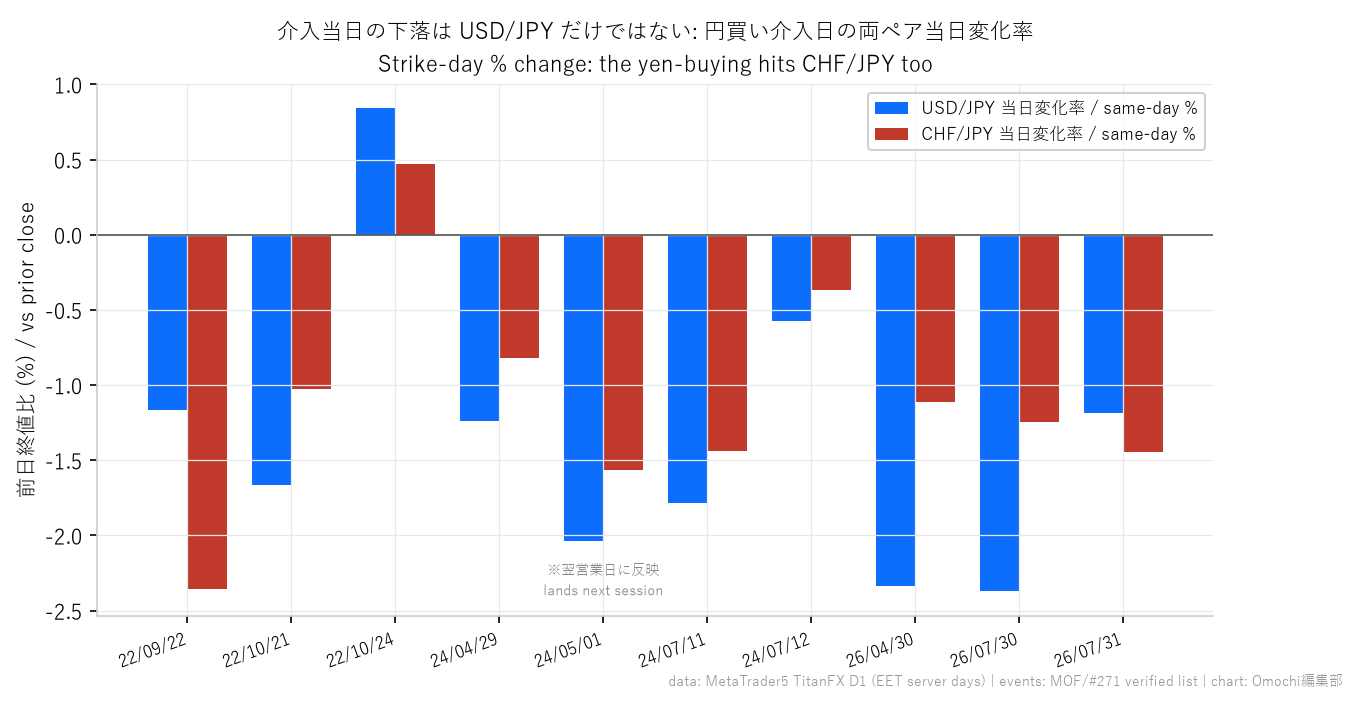
逆に、今年1月に米側のレートチェック※をきっかけにドル円が高値から7円あまり急落した局面(1月23日から27日)では、ドル円が終値ベースで3.9%下げる間、CHF/JPYの下落はわずか0.4%でした。つまりこのクロスは、ドル側の事情で動く相場には反応が鈍く、円側の事情、すなわち介入やキャリー巻き戻しの局面でこそ動く。「介入サイクルの継続」という特定のシナリオに賭ける道具として、性質が合っています。2024年8月の巻き戻し局面でも、ドル円の10.8%下落に対してCHF/JPYは5.9%の下落。クラッシュの場面ですら、円はフランより強く買われました。
Conversely, in January this year, when a US-side rate check※ sent USD/JPY tumbling more than seven yen from its high (January 23-27), USD/JPY fell 3.9% on a closing basis while CHF/JPY slipped just 0.4%. The cross barely reacts to dollar-driven moves; it moves on yen-side events, which is to say interventions and carry unwinds. As an instrument for the specific scenario of "the intervention cycle continues," its character fits. Even in the August 2024 unwind, USD/JPY's 10.8% fall came with a 5.9% fall in CHF/JPY. Even in a crash, the yen was bought harder than the franc.
※ レートチェックとは、当局が銀行に為替レートの水準を問い合わせる行為のことです。実際の介入の前段階として市場が警戒します。
※ A rate check is when authorities call banks to ask for exchange-rate quotes. Markets treat it as the stage before actual intervention.
そして、このポジションの一番の特異点は「公的な追い風が両側から吹く」ことです。買っている円の側には、「さらなる協調介入に躊躇しない」と公言し、米国の祝福まで得た財務省がいます。売っているフランの側には、自国通貨が強すぎて困っており、フラン安ならむしろ歓迎するスイス国立銀行がいます。しかもスイスは米財務省の為替監視リストに載っているため、大規模なフラン売り介入という手段を事実上封じられており、フラン高への対抗手段として利下げ(マイナス金利復帰の可能性さえ「排除しない」としています)に傾きやすい。日本の当局は円高を望み、スイスの当局はフラン安を望む。2つの願いが同時に叶う場所が、CHF/JPYの下落です。
And the position's greatest peculiarity: official tailwinds blow from BOTH sides. On the yen you are buying stands the MOF, on record that it "will not hesitate" to intervene again, with America's blessing secured. On the franc you are selling stands the Swiss National Bank, troubled by its own currency's strength and quite happy to see it weaken. Moreover, because Switzerland sits on the US Treasury's currency-manipulation monitoring list, large-scale franc-selling intervention is effectively sealed off, tilting the SNB toward rate cuts as its anti-strength tool (it has said even a return to negative rates "cannot be ruled out"). Japan's authorities want a stronger yen; Switzerland's want a weaker franc. The place where both wishes come true at once is a falling CHF/JPY.
公平のために、反対材料も同じ精度で書きます。第一に、CHF/JPYは今年4月に203.93円という史上最高値をつけたばかりで、現在もそこから4%程度しか離れていません。5年間で7割上昇した強いトレンドを逆張りする形になります(もっともその上昇の主エンジンは「金利ゼロの円で調達するキャリー」であり、そのエンジンは金利逆転ですでに逆回転を始めています)。第二に、フランと円はどちらも「安全通貨」です。地政学ショックの局面では両方が同時に買われ、クロスがどちらに動くかは読みにくくなります。第三に、受け取れる金利差は年1.5%程度と、このペアの1日の変動幅より小さい。つまりこれはあくまで方向の賭けであり、金利は追い風にすぎません。そして第四に、実際のFX取引で受け払いされるスワップポイント※は業者の設定次第で、理論値の金利差と一致するとは限りません。ここは必ずご自身の取引環境で確認してください。
In fairness, the case against, at the same precision. First, CHF/JPY set its all-time high of 203.93 just this April and sits only about 4% below it; the position is a counter-trend short against a 70% five-year climb (though the engine of that climb was carry funded by a zero-rate yen, and that engine has already shifted into reverse with the rate inversion). Second, the franc and the yen are both safe-haven currencies: in a geopolitical shock both get bought at once and the cross becomes hard to read. Third, the receivable differential, about 1.5% a year, is smaller than this pair's typical DAILY range; this is a directional bet, and the carry is merely a tailwind. Fourth, the swap points※ actually paid and received in retail FX depend on each broker's terms and do not necessarily match the theoretical differential. Check your own trading environment on this point, always.
※ スワップポイントとは、FX取引で通貨ペアの金利差に応じて日々受け払いされる金額のことです。同じペアでも取引業者によって水準が異なります。
※ Swap points are the amounts paid or received daily in FX trading according to a pair's rate differential. Levels differ by broker even for the same pair.
編集部の見立て
Our Editorial Read
まとめます。介入効果の減衰、6週間の政策空白、夏で最も薄い週の到来、待ち伏せ教義、ほぼゼロコストの資金調達、そして当局者の「躊躇しない」。これだけの材料が同じ週に重なるのは偶然ではありません。私たちの見立ては、「お盆の窓は、少なくとも当局のカレンダーには載っている」です。介入が実際に来るかどうかは分かりません。しかし来るとすれば、追加の一撃に最も効率が良いのはこの窓であり、逆にこの窓を素通りして158円台を上抜けさせるようなら、9月の日銀会合まで円安圧力を受け止め続ける覚悟だ、ということになります。窓が開いても閉じても、当局の本気度が読める1週間です。
To sum up: a fading intervention effect, a six-week policy vacuum, the thinnest week of the summer arriving, an ambush doctrine, near-zero-cost funding, and officials on record saying they will not hesitate. This much material stacking onto the same week is not a coincidence. Our read: the Obon window is on the authorities' calendar, at the very least. Whether intervention actually comes, nobody knows. But if it comes, this window is where an additional strike buys the most; and if the authorities let the window pass and allow a break above the 158s, that itself tells you they are prepared to absorb yen weakness until the September BOJ meeting. Open or shut, it is a week that reveals how serious they are.
検証のための日付も置いておきます。この記事の答え合わせは、すべて公開情報でできます。
Here are the dates for verification. Every claim in this article can be answer-checked with public information.
| 日付 | 出るもの | 見るポイント |
|---|---|---|
| 8月7日(金)早朝 | FRB H.4.1(8/5時点) | 「海外公的機関向けレポ」がゼロから動けばFIMA初稼働 |
| 8月8日(土)早朝 | CFTC建玉報告(8/4時点) | 介入後初の投機筋ポジション。16.3万枚の円ショートがどれだけ減ったか |
| 8月10日〜14日 | お盆の窓 | 8/11(火)は東京完全休場。薄い市場での急変動と、155.20円の攻防 |
| 8月28日(金)19時 | 財務省の月次介入実績 | 7/30〜8/26の介入総額。7/30単日「推定6兆〜8.45兆円」の答え合わせ |
| 9月17日〜18日 | 日銀金融政策決定会合 | 利上げの有無。介入効果の「賞味期限」との交差点 |
| Date | Release | What to watch |
|---|---|---|
| Aug 7 (Fri) early JST | Fed H.4.1 (as of Aug 5) | If the foreign-official repo line moves off zero, FIMA is live |
| Aug 8 (Sat) early JST | CFTC COT (as of Aug 4) | First post-strike positioning: how much of the 163K short survived |
| Aug 10-14 | The Obon window | Tokyo fully closed Aug 11 (Tue); thin-market volatility and the fight over 155.20 |
| Aug 28 (Fri) 19:00 JST | MOF monthly intervention total | Jul 30-Aug 26 total; the answer to the "6-8.45 trillion yen" single-day estimate |
| Sep 17-18 | BOJ policy meeting | Hike or not; where the intervention's shelf life expires |
つみたてNISAや米国株の投資信託だけを持っている方にも、この話は無関係ではありません。円建ての基準価額は為替で動きます。お盆の週に基準価額が急に跳ねたり沈んだりしても、それは市場が薄いなかで為替が大きく動いただけで、保有資産の中身が変わったわけではない。休暇中にスマホで残高を見て慌てて売る、というのが薄商いの週の個人投資家の典型的な失敗です。仕組みを知っていれば、静かに見送れます。
Even if all you hold is a tsumitate-NISA or a US equity fund, this story is not irrelevant to you. Yen-denominated fund prices move with the exchange rate. If your fund's NAV jumps or sinks during Obon week, that is the currency moving hard in a thin market, not the contents of your holdings changing. Checking a phone balance on vacation and panic-selling is the classic retail mistake of a thin-market week. Know the mechanism, and you can let it pass quietly.
最後に。お盆は市場だけでなく、人も動く季節です。帰省先での家族の食事会、久しぶりに集まる旧友との一席、夏休み明けの職場の飲み会。為替の急変動は読めなくても、集まりの店選びは外したくないものです。店探しと予約は、Omochiにお任せください。
One last thing. Obon moves people, not just markets. The family dinner back home, the reunion with old friends, the office gathering after the summer break. You cannot predict a currency spike, but you can get the venue right. Leave the restaurant search and the booking to Omochi.